
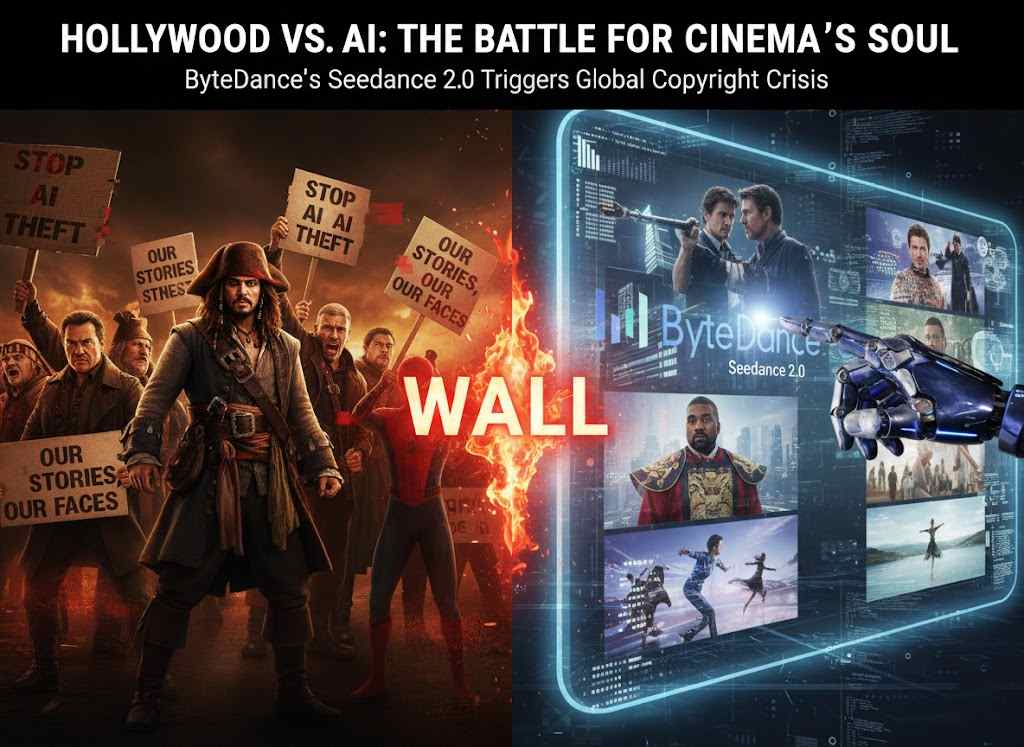
The Seedance 2.0 Crisis: global film industry is currently facing what many are calling an “existential crisis,” triggered by a new and incredibly powerful AI tool from an unexpected source: China. Seedance 2.0, developed by the tech giant ByteDance—the same powerhouse behind TikTok—has effectively put Hollywood on high alert.
What has the world’s biggest film studios so worried? It’s not just that the tool can create high-fidelity videos; it’s that it can do so in seconds, often using the likenesses of A-list stars and protected intellectual property without a single cent being paid or a single contract being signed.
The Seedance 2.0 Crisis: A Digital Director in the Palm of Your Hand
Seedance 2.0 represents a massive leap in generative technology. Unlike previous AI models that relied solely on text prompts, Seedance 2.0 is multimodal. According to technical reports, users can upload:
- Up to 9 images to define visual style and characters.
- Up to 3 video clips to dictate camera movement or action.
- Up to 3 audio files for perfect synchronization.
The AI then acts as a “digital director,” stitching these elements into a seamless, cinematic video. The realism is staggering. Traditional AI tools often suffer from “hallucinations”—floating objects, unnatural movements, or breaking the laws of physics. Seedance 2.0, however, demonstrates a sophisticated understanding of gravity, momentum, and lighting. Whether it’s the fluid movement of a figure skater or the natural drape of fabric being hung on a line, the output is often indistinguishable from high-budget studio footage.
The Viral Spark: “Tom Cruise vs. Brad Pitt”
The controversy reached a boiling point when a hyper-realistic video went viral on social media. It depicted Tom Cruise and Brad Pitt engaged in a gritty rooftop fight. The lighting was professional, the choreography was smooth, and neither actor was ever on set. No cameras rolled, and no film crew showed up—the entire scene was generated by a two-line prompt.
Soon, other clips followed: a “lost” scene from Breaking Bad, Kanye West reimagined in a Chinese imperial drama, and even Friends characters portrayed as otters. While social media users marveled at the creativity, Hollywood saw something else: large-scale copyright infringement.
Hollywood Strikes Back
The response from the American film industry has been swift and unified. Major studios that are usually fierce rivals—Netflix, Disney, Warner Bros. Discovery, Universal, Sony, and Paramount—have joined forces through the Motion Picture Association (MPA).
MPA Chairman and CEO Charles Rivkin issued a blistering statement, demanding that ByteDance “immediately cease” its infringing activities.
“In a single day, the Chinese AI service Seedance 2.0 has engaged in unauthorized use of U.S. copyrighted works on a massive scale,” Rivkin stated. “By launching a service that operates without meaningful safeguards, ByteDance is disregarding well-established copyright law.”
The legal pressure is escalating. Disney has reportedly issued a formal cease-and-desist letter, and SAG-AFTRA, the union representing 160,000 actors, has denounced the tool as a “flagrant violation” of creative rights and personal autonomy.
China’s “DeepSeek Moment”
In China, the narrative is very different. State-backed media and tech enthusiasts are hailing Seedance 2.0 as a “Sputnik moment,” comparing its impact to the meteoric rise of DeepSeek in early 2025. For Chinese investors, this is proof that their AI ecosystem can not only compete with Western giants like OpenAI and Google but potentially surpass them in the next frontier of video generation.
Even tech mogul Elon Musk weighed in on the speed of the development, commenting on X (formerly Twitter): “It’s happening fast.”
The Impact on Jobs and Future Filmmaking
The stakes of this battle extend far beyond individual lawsuits. If a single person at a computer can generate a film with the visual polish of a Christopher Nolan masterpiece, what happens to the millions of editors, cinematographers, and VFX artists?
ByteDance argues that Seedance 2.0 is designed for “professional film, e-commerce, and advertising productions,” essentially democratizing the ability to create high-end content. They claim to have safeguards against uploading real individuals, but Hollywood remains skeptical. Industry insiders like Rhett Reese, writer of Deadpool & Wolverine, expressed a “glass half-empty” view:
“Hollywood is about to be revolutionized or decimated… In next to no time, one person is going to be able to sit at a computer and create a movie indistinguishable from what Hollywood now releases.”
What’s Next for Seedance?
As of February 2026, Seedance 2.0 is in a limited beta phase, with a full public launch expected later this month. While ByteDance faces a mountain of legal threats in the West, the technological genie is out of the bottle.
ByteDance is already moving away from its social media roots toward an “AI-native model,” spending billions on infrastructure and top-tier talent. The coming months will decide whether Seedance 2.0 becomes a revolutionary tool for the next generation of creators or the catalyst for a decade of litigation that could rewrite the rules of the entertainment industry.