
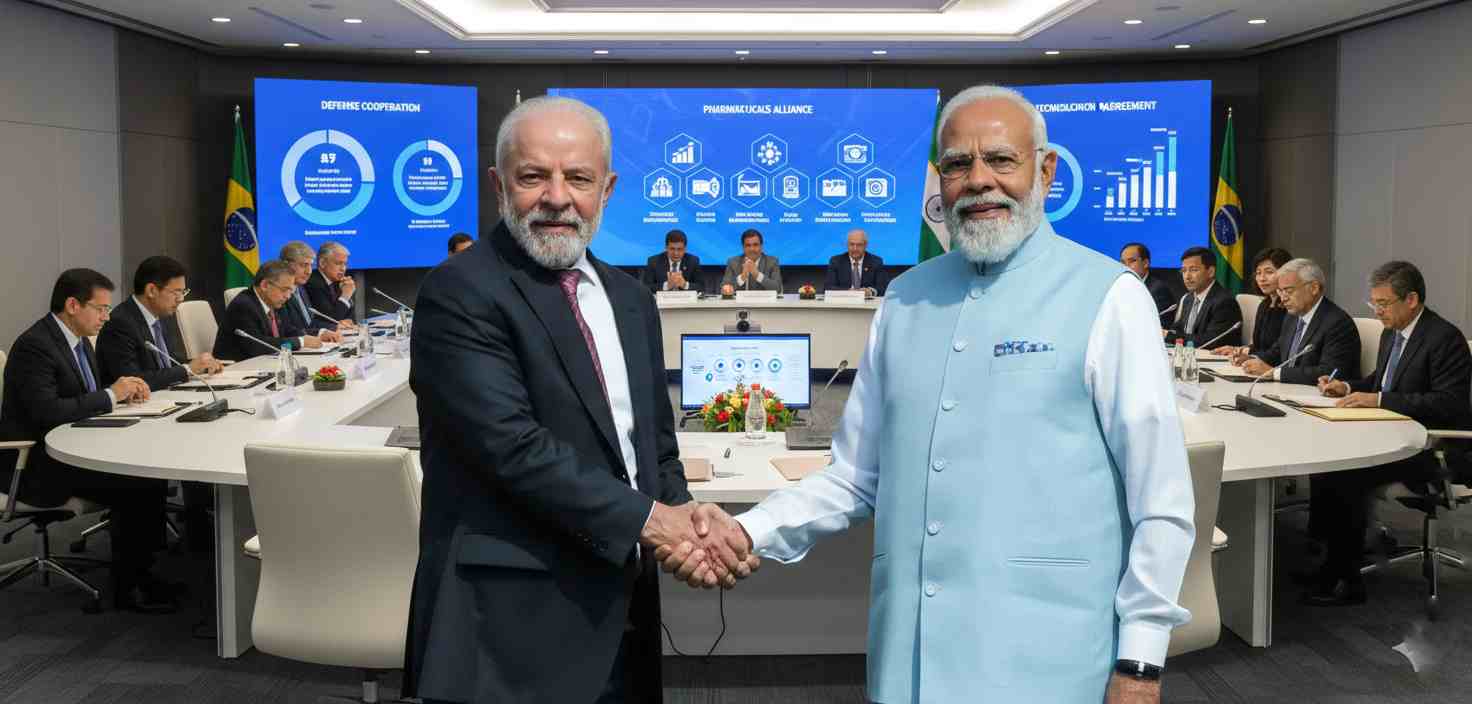
New Delhi, India and Brazil: In a major diplomatic and economic breakthrough, India and Brazil have significantly expanded their strategic partnership, setting a new bilateral trade target of $30 billion by 203. The announcement came during the high-profile state visit of Brazilian President Luiz Inácio Lula da Silva to New Delhi from February 18–22, 2026.
The visit culminated in the exchange of ten landmark agreements spanning critical minerals, digital technology, pharmaceuticals, and defense, marking what both leaders described as a “win-win partnership” for the Global South.
India and Brazil A New Trade Horizon: Chasing $30 Billion
Bilateral trade between the two nations has seen a remarkable surge, reaching $15.21 billion in 2025, a 25.5% increase over the previous year. While a previous goal of $20 billion had been set for 2030, President Lula noted that such a figure “doesn’t seem ambitious enough” given the two nations’ potential. Consequently, both sides agreed to double the current trade volume to $30 billion by the end of the decade.
To achieve this, Prime Minister Narendra Modi and President Lula directed their officials to work toward eliminating non-tariff barriers and expanding the existing India-Mercosur Preferential Trading Agreement (PTA). India currently maintains a trade surplus of approximately $1.5 billion with Brazil.
Securing the Future: The Critical Minerals Pact
Perhaps the most strategically significant outcome of the summit was the agreement on critical minerals and rare earths. This pact is a cornerstone of India’s strategy to diversify its supply chains and reduce its heavy dependence on China for materials essential to:Electronics manufacturing and semiconductors.Clean energy technologies and electric vehicles.
Defense systems and advanced aerospace.
Brazil, which holds approximately 20% of the world’s rare earth reserves but has explored only about 30% of them, is seen as a key partner for “on-groundIndia and Brazil: Redefine Global resource access”. Prime Minister Modi hailed the deal as a “major step towards building resilient supply chains”.
The Digital and Technological Leap
The two nations also launched a Joint Declaration and Action Plan on a Digital Partnership. This collaboration aims to leverage India’s “IndiaStack” framework to cooperate on: Artificial Intelligence (AI) and supercomputing.Semiconductors and blockchain technology.Space Cooperation: Jointly building and launching Brazilian satellites.
In a boost for people-to-people and business ties, Brazil announced the extension of business visas for Indian ordinary passport hoIndia and Brazil: Redefine Global lders to 10 years.
Health, Defense, and Traditional Knowledge
The summit also saw the formalization of an agreement granting Brazil access to India’s Traditional Knowledge Digital Library (TKDL). This partnership will allow the Brazilian Patent Office (INPI) to use India’s repository of over 5.2 lakh medicinal formulations to prevent the “erroneous patenting” and misappropriation of Indian heritage.
In the pharmaceutical sector, a new MoU between India’s CDSCO and Brazil’s ANVISA aims to accelerate regulatory approvals for medical products. Meanwhile, defense cooperation was reaffirmed as a primary pillar, with a focus on “co-design and co-production” between India’s Aatmanirbhar Bharat initiative and Brazil’s defense industrial base.
A Unified Voice for the Global South
Beyond trade, the leaders emphasized their shared vision for an inclusive, multipolar world order. Both nations reiterated their commitment to United Nations reforms, particularly for the UN Security Council. As key members of BRICS, G20, and IBSA, India and Brazil are positioning their partnership as a strategic pillar for the Global South, aiming to shape emerging rules of global trade independently of traditional power centers.
Prime Minister Modi concluded the summit by renewing his invitation to President Lula for the 18th BRICS Summit to be held in India later in 2026