
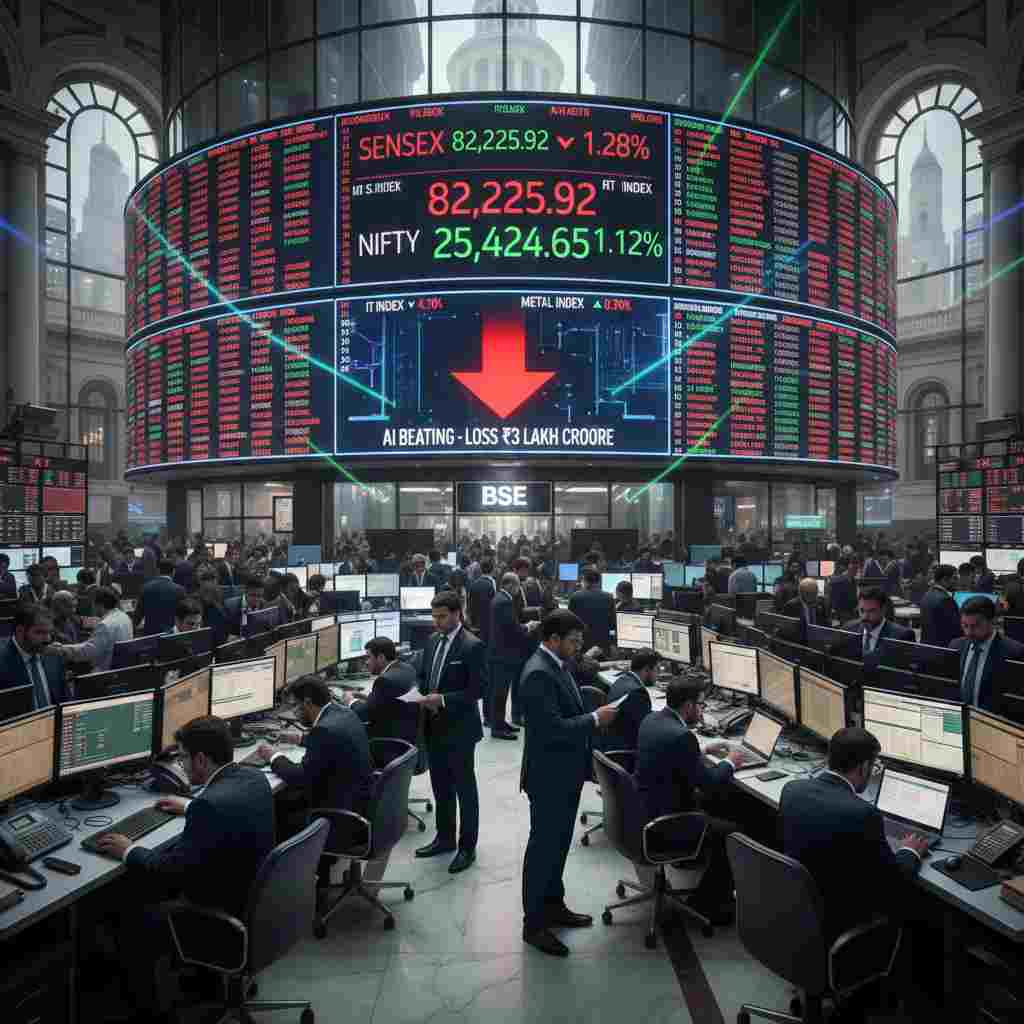
Stock Market Panic : The Indian equity markets faced a brutal drubbing on Tuesday, with the BSE Sensex plunging 1,068.74 points (1.28%) to close at 82,225.92. Its NSE counterpart, the Nifty 50, breached the psychological support of 25,500, ending the day at 25,424.65, down 288.35 points or 1.12%.
The carnage wiped out approximately ₹3 lakh crore of investor wealth in a single session, bringing the total market capitalization of BSE-listed firms down to ₹466 lakh crore.
Stock Market Panic The “AI Beating”: Why IT Stocks are Leading the Crash
The primary antagonist in today’s market narrative was the Nifty IT Index, which crashed by over 4.7%. In February alone, the IT sector has lost nearly 21% of its value.
The Anthropic Trigger
The sell-off was ignited by fears of AI-led disruptions. Specifically, the launch of Anthropic’s “Claude Code” tool has sent shockwaves through the global tech landscape. The tool’s ability to modernize Cobol—a legacy programming language central to IBM’s ecosystem—has led investors to believe that traditional IT service models are under immediate threat.
“The trend of weakness in tech stocks stemming from the potential AI impact continues. The weakness in ADRs of Indian IT companies indicates this segment will remain under pressure,” noted VK Vijayakumar of Geojit Investments.
Biggest IT Losers Today:
Tech Mahindra
Infosys
TCS
HCL Technologies
5 Key Factors Behind the Market Meltdown
Beyond the AI-driven tech rout, several macroeconomic and geopolitical factors converged to create a perfect storm for Indian equities.
1. The Spectre of U.S. Tariffs 2.0
Despite the U.S. Supreme Court (SCOTUS) striking down certain tariffs last week, the Trump administration appears to be doubling down. Reports suggest the use of Section 232 of the Trade Expansion Act to bypass court rulings and impose global tariffs. With President Trump’s State of the Union address scheduled for tonight, markets are bracing for aggressive “America First” rhetoric that could destabilize global trade.
2. The US-Iran Conflict Escalation
Geopolitical instability in the Middle East is reaching a boiling point. As protests sweep Iran and the U.S. threatens military action, the scheduled nuclear talks on February 26 are being viewed with extreme caution. Any escalation could disrupt supply chains and keep global markets on edge.
3. Surging Crude Oil Prices
Brent crude jumped 1%, surpassing the $72 per barrel mark. For a country like India, which imports over 80% of its oil, this is a direct hit to macroeconomic stability. Rising oil prices fuel inflation, widen the current account deficit, and put immense pressure on the Rupee.
4. A Strengthening US Dollar
The Dollar Index rose to 0.20%, nearing the 98 mark. A stronger dollar is historically a “risk-off” signal for emerging markets. It risks reversing the recent trend of Foreign Institutional Investor (FII) inflows, making Indian valuations—which are already considered elevated—look even more expensive.
5. F&O Expiry Volatility
Tuesday also marked a volatile lead-up to the F&O expiry. The Nifty fell to an intraday low of 25,327 before a minor recovery in the final hour, largely driven by “bottom fishing” in defensive sectors like Pharma and FMCG.
Sectoral Performance: Defensives Stand Tall
While IT and Realty (down 2.5%) were the biggest laggards, some sectors managed to stay in the green, acting as a hedge against the broader collapse.
| Sector | Change (%) | Key Gainers |
| IT | -4.7% | None (Major Sell-off) |
| Realty | -2.5% | DLF, Godrej Prop |
| Pharma | +0.2% | Sun Pharma, Dr. Reddy’s |
| Metal | +0.9% | Hindalco, JSW Steel |
| FMCG | +0.2% | HUL, ITC |
Technical Analysis: Levels to Watch for Tomorrow
The technical setup for both Nifty and Sensex remains fragile. Most momentum indicators, including the RSI (Relative Strength Index), are hovering around the 45 zone, suggesting mild weakness and a lack of buying conviction.
Nifty 50 Outlook
According to Ajit Mishra of Religare Broking, the Nifty has retested the crucial 25,400 support.
Immediate Support: 25,245 (coinciding with the 200-day EMA).
Major Support: 25,100 (daily chart gap).
Resistance: 25,600 – 25,800.
Sensex Outlook
Shrikant Chouhan of Kotak Securities highlights the 82,000 level as the “make-or-break” point.
The Pivot: 82,000 (200-day SMA).
Bullish Scenario: If it stays above 82,000, a bounce to 82,500 – 82,800 is possible.
Bearish Scenario: A breach below 82,000 could lead to a slide toward 81,500.
Investor Strategy: “Sell on Rise” or “Buy the Dip”?
The prevailing sentiment among analysts is one of extreme caution. The “Sell on Rise” strategy seems to be the preferred approach until a clear breakout above 25,800 (Nifty) is achieved.
Expert Takeaways:
Kunal Vora (BNP Paribas): While India is seen as a “hedge” against a global AI trade reversal due to strong domestic flows, global investors see better opportunities in Korea and Taiwan for now. There is “no reason to rush in.”
Ponmudi R (Enrich Money): Advised keeping position sizes light. The structure currently shows “lower-highs and lower-lows,” which is a classic bearish signal.
What should you do?
Focus on Defensives: FMCG and Pharma are showing relative strength.
Avoid Catching the Falling Knife: The IT sector may see further correction as the “AI threat” narrative matures.
Watch the Dollar: Keep an eye on the USD/INR and the U.S. State of the Union address for clues on the next leg of the market move.
Conclusion: Will the Market Bounce Back Tomorrow?
The market’s ability to bounce back depends heavily on two factors: the global reaction to President Trump’s speech and whether the Nifty can hold the 25,300–25,400 support zone. While a technical “dead cat bounce” is possible after such a sharp drop, the underlying “AI beating” and geopolitical risks suggest that volatility is here to stay for the short term.
Disclaimer: The views and data expressed in this article are for informational purposes only. This does not constitute an investment recommendation. The stock market is subject to constant fluctuations and risks; therefore, the writer or platform shall not be held responsible for any financial losses incurred. Please consult with your financial planner or a certified expert before making any investment decisions.