
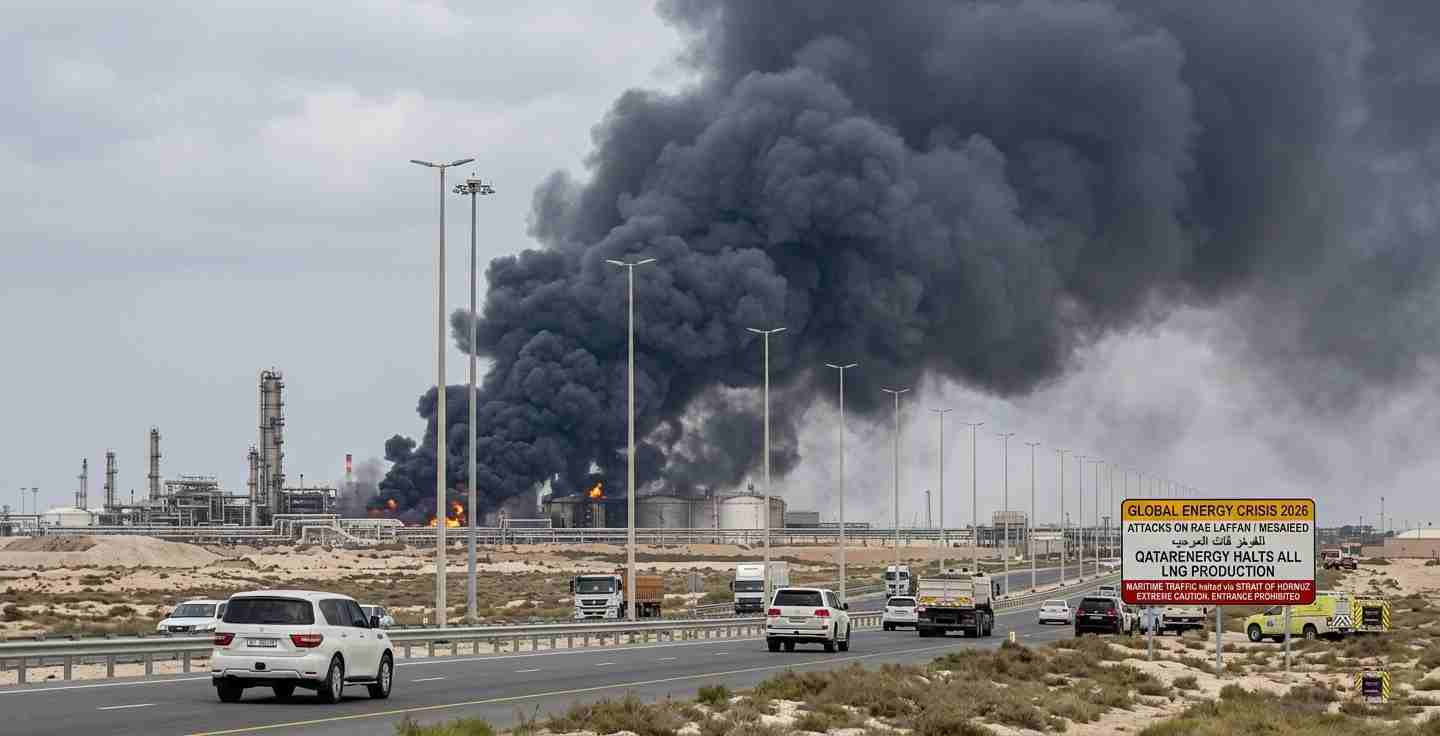
Global Energy Crisis 2026: The world transitioned from a state of geopolitical tension to a full-scale global energy catastrophe on Monday, March 2, 2026. As the military confrontation between the United States, Israel, and Iran entered its third day of unprecedented violence, the collateral damage has effectively paralyzed the backbone of the global economy: the Middle Eastern energy corridor.
In a series of rapid-fire escalations, Qatar—the world’s leading liquefied natural gas (LNG) exporter—announced a total production halt following Iranian strikes. Simultaneously, Saudi Arabia’s massive Ras Tanura refinery was hit by drone attacks. These events have sent shockwaves through international markets, with gas prices in Europe and Asia soaring by nearly 50%, and oil prices surging to levels not seen in over a year.
1. Global Energy Crisis 2026 Qatar’s Energy Shutdown: A Death Blow to Global Gas Supplies
In a move that has sent European and Asian capitals into a state of panic, QatarEnergy officially announced on Monday that it has ceased all production of LNG and associated products.
The Attack on Ras Laffan and Mesaieed
The shutdown follows targeted Iranian drone strikes on Qatar’s crown jewels of infrastructure: Ras Laffan Industrial City and Mesaieed Industrial City. According to the Qatari Ministry of Defence, two drones launched from Iran bypassed regional defenses:
One drone struck a critical water tank at a power plant in Mesaieed.
The second drone targeted a primary energy facility in Ras Laffan.
While no human casualties were reported in these specific strikes, the message was clear: Iran is willing to dismantle the global energy supply chain to pressure the U.S. and Israel.
Market Reaction: Gas Prices Explode
The impact was instantaneous. Shortly after the announcement:
Dutch and British wholesale gas prices skyrocketed by nearly 50%.
Asian LNG benchmarks (JKM) jumped by 39%.
The Dutch TTF contract, the gold standard for European gas pricing, rose over 25% in a single morning session, reaching 39.40 euros per MWh.
For nations like Germany, Japan, and South Korea, which rely heavily on Qatari shipments, this halt represents an existential threat to their industrial sectors and power grids.
2. Saudi Arabia Under Fire: The Ras Tanura Strike
While Qatar dealt with a production halt, the world’s largest oil exporter, Saudi Arabia, faced a direct assault on its eastern coastline. The Ras Tanura refinery, which processes a staggering 550,000 barrels per day, was targeted by Iranian drones on Monday morning.
Plumes of Smoke over Dammam
Verified footage showed thick black smoke rising from the facility near Dammam. The Saudi Ministry of Defence confirmed that while two drones were intercepted, a “small” fire broke out at the refinery, causing “limited damage.”
As a “precautionary measure,” the Saudi Ministry of Energy has temporarily shut down several units of the refinery. While they claim there is no immediate threat to local markets, the global psychological impact has been devastating. Ras Tanura is the cornerstone of Saudi oil processing; even a minor disruption there signals that no facility in the Gulf is safe from Iran’s reach.
3. The Strait of Hormuz: A Maritime Graveyard
The most critical chokepoint in the world—the Strait of Hormuz—has effectively become a no-go zone for commercial shipping. Approximately 20% of the world’s seaborne oil and nearly all of Qatar’s LNG pass through this narrow strip of water.
Tanker Pile-up
Reports indicate that hundreds of oil tankers and LNG carriers are now “piling up” on either side of the Strait, unwilling to risk the transit as Iranian retaliatory strikes continue. This maritime gridlock has pushed Brent Crude prices up 13% intraday, crossing the $82 per barrel threshold. This is the highest price recorded since January 2025, and analysts warn that $100 is now a “conservative” target if the blockade persists.
4. Military Escalation: 555 Dead in Iran as Conflict Spreads
The human cost of this three-day war is mounting rapidly. Within Iran, the joint US-Israeli “precision” air strikes have reportedly killed at least 555 people.
The Refusal of Diplomacy
Despite the carnage, Iran’s security chief, Ali Larijani, has flatly refuted claims that Tehran is seeking a fresh push for nuclear talks with the Trump administration. This suggests that the Iranian leadership has pivoted to a “Total War” footing, prioritizing regional disruption over diplomatic de-escalation.
Casualties Across the Region
The violence is not contained within Iran’s borders:
Lebanon: At least 31 people were killed in Israeli strikes following a massive rocket barrage from Hezbollah. In a shocking turn, the Lebanese Prime Minister has announced a ban on Hezbollah’s military activities, signaling a potential internal collapse or civil strife within Lebanon.
Kuwait: The Ministry of Defence confirmed that “several” US warplanes crashed in the country. In a tragic case of “friendly fire,” the US military admitted these jets were mistakenly shot down by Kuwaiti air defenses amid the chaos of incoming Iranian ballistic missiles.
Qatar: The Qatari Air Force successfully intercepted two Iranian Su24 fighter jets, seven ballistic missiles, and five drones, proving that the war has now fully enveloped the neutral Gulf states.
5. The Geopolitical Strategy: Iran’s “Pressure Point”
Why is Iran attacking neutral energy producers like Qatar and Saudi Arabia? According to Rob Geist Pinfold, a defense expert at King’s College London, the strategy is calculated.
“Iran knows exactly what it’s doing. By attacking the Gulf countries, they are hitting the world where it hurts—the wallet. These countries have no appetite for a long war; it isn’t their fight. Iran is banking on the fact that these nations will eventually pressure the Trump administration for an immediate ceasefire to save their economies.”
However, there are no signs that the U.S. or Israel is backing down. President Trump has vowed to “avenge” every American life lost, suggesting a cycle of retaliation that could last weeks or months.
6. Economic Implications: A Global Recession Looms
The combination of a 50% spike in gas prices and a 13% jump in oil prices in a single day is a recipe for global economic disaster.
Impact on India
For India, which imports the majority of its energy, this crisis is catastrophic. The Stock Market Crash 2026 seen today (Sensex down 1,000+ points) is a direct reflection of this energy insecurity. Higher fuel prices will inevitably lead to:
Hyper-inflation: Transport and manufacturing costs will soar.
Trade Deficit: India’s foreign exchange reserves will be depleted as it pays “war prices” for crude.
Currency Devaluation: The Rupee is already under immense pressure against the Dollar.
Impact on Europe and Asia
Europe, still recovering from the energy shifts of the mid-2020s, now faces a winter of potential blackouts if Qatari LNG does not resume. In Asia, the S&P Global Energy JKM (Asian gas benchmark) at $15.068 per MMBtu is putting immense strain on the industrial hubs of Japan and South Korea.
7. Looking Ahead: Day 4 and Beyond
As we move into the fourth day of the US-Israeli attacks on Iran, the world stands at a crossroads. There are three potential scenarios:
Limited Conflict: The U.S. and Israel achieve their military objectives, Iran’s retaliatory capacity is neutralized, and the Strait of Hormuz reopens within 72 hours. (Market probability: Low)
Prolonged Attrition: A weeks-long exchange of strikes that keeps energy prices at record highs and pushes the global economy into a deep recession. (Market probability: High)
Regional Conflagration: The war draws in Turkey, Jordan, and Egypt, leading to a total collapse of Middle Eastern stability. (Market probability: Moderate)
Summary of Key Data (March 2, 2026):
Brent Crude: $82.00 (Up 13% Intraday)
European Gas: 39.40 Euros/MWh (Up 50% from Friday)
Deaths (Iran): 555
Deaths (Lebanon): 31
Key Losses: QatarEnergy LNG production (100% halt), Ras Tanura (Partial halt).
Conclusion: A Dark Monday for the World The events of March 2, 2026, have proven that in the modern world, war is not just fought with tanks and planes, but with pipelines and tankers. The “Global Energy Crisis 2026″ is no longer a warning—it is a reality. As Qatar’s facilities sit silent and Saudi refineries smolder, the global economy braces for a shock that could take years to recover from.
Disclaimer: This information is based on various inputs from news agency.