
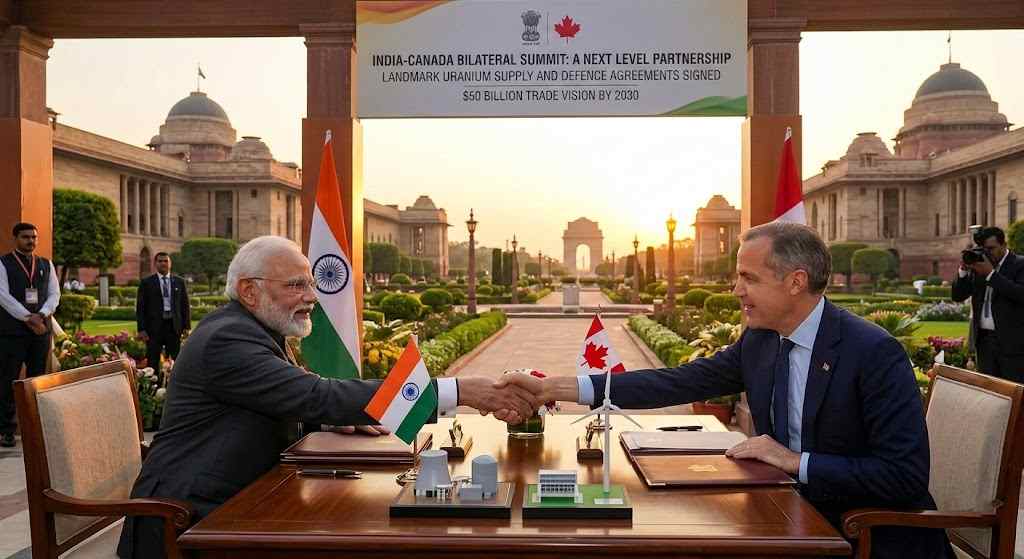
DELHI – India and Canada Seal “New Era” Pact: Landmark Uranium Deal and $50bn Trade Vision Reset Ties: In a move that signals the definitive end to one of the most turbulent chapters in Commonwealth diplomacy, Prime Minister Narendra Modi and Canadian Prime Minister Mark Carney have announced a sweeping “reset” of bilateral ties. The summit in New Delhi on Monday resulted in a series of landmark agreements spanning nuclear energy, defense, and a multi-billion dollar trade vision, effectively burying the “long shadow” of the Trudeau-era diplomatic freeze.
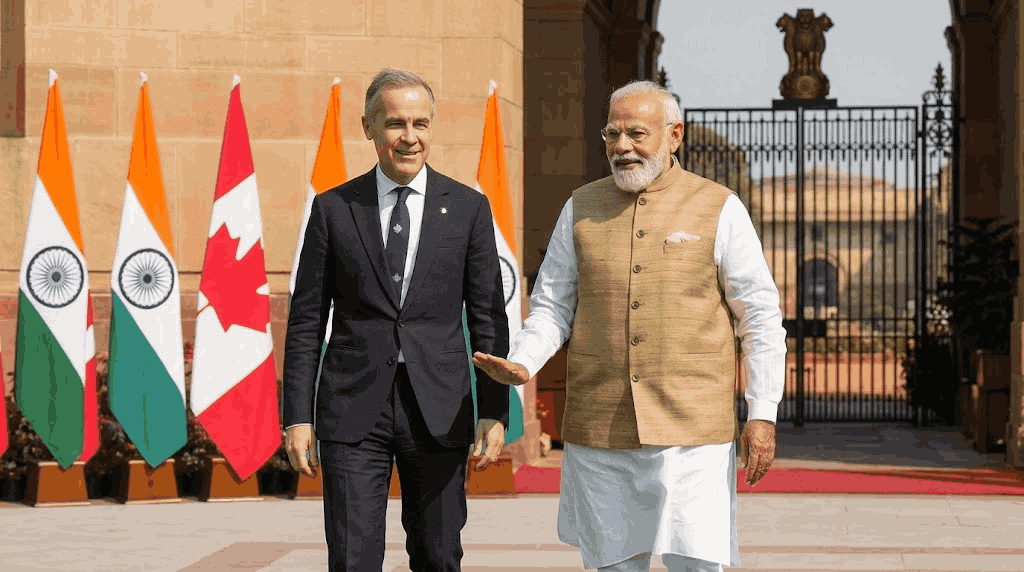
The centerpiece of the visit—a long-term uranium supply deal—marks a strategic pivot for both nations as they look to secure energy and economic stability in an increasingly volatile global landscape.
India and Canada Seal A Landmark Nuclear & Energy Alliance
India and Canada Seal “New Era” Pact: Landmark Uranium Deal and $50bn Trade Vision Reset Ties : Prime Minister Modi hailed the new agreement with Canadian firm Cameco as “landmark,” emphasizing that India’s energy needs are projected to double by 2050. To meet these demands, India is betting heavily on nuclear power, and Canada, home to some of the world’s largest high-grade uranium deposits, has stepped in as a primary guarantor of supply.
Beyond raw materials, the two leaders announced a Strategic Energy Partnership. This includes:
- Civil Nuclear Cooperation: Collaborative research on Small Modular Reactors (SMRs) and advanced reactor technology.
- Renewable Energy: The launch of an India-Canada Renewable Energy and Storage Summit to be held later this year.
- Clean Tech: Membership for Canada in the International Solar Alliance and the Global Biofuel Alliance.
The $50 Billion Trade Vision: Closing the 16-Year Gap
For over a decade, a Comprehensive Economic Partnership Agreement (CEPA) remained a “mirage” in bilateral talks, stalled by technical hurdles and the diplomatic fallout of 2023. Today, that uncertainty ended with a firm deadline.
Prime Minister Carney set an ambitious target to conclude the trade deal by the end of 2026, with an immediate goal of boosting bilateral trade to $50 billion by 2030.
“This ambitious agreement will reduce barriers, increase certainty, and unlock opportunities for exporters, investors, and workers in both our countries,” Carney stated.
The economic math is already substantial. Modi noted that Canadian pension funds have invested over $100 billion in India, a testament to Canada’s belief in the “India growth story.” Both nations are now looking to diversify away from heavy reliance on China and the US, seeking resilience through mutual cooperation in semiconductors and critical minerals.
Security, Defence, and the “Unspoken” Geopolitics
The shift in tone was perhaps most evident in the realm of security. While the 2023-2024 diplomatic standoff centered on allegations regarding separatist figures, the new Carney-Modi era is focusing on shared external threats.
The New Defence Dialogue
The leaders agreed to establish the India-Canada Defence Dialogue, focusing on:
- Maritime Domain Awareness: Enhanced collaboration in the Indo-Pacific, a move widely seen as a strategic counter-balance to China’s regional hegemony.
- Counter-Terrorism: Modi emphasized that “terrorism, extremism, and radicalisation” remain global challenges that both nations must face together.
- Space Sector: Connecting startups and industries to foster innovation in satellite technology and space research.
Education and the “Talent Bridge”
With 400,000 Indian students currently in Canada—double the number in the US—education remains the strongest “people-to-people” pillar. Carney announced the Canada-India Talent and Innovation Strategy, launching 13 new partnerships with top-tier institutions like McGill University, the University of Toronto, and the University of British Columbia.
In a historic first, the leaders discussed the opening of Canadian university campuses in India, focusing on AI, health sciences, and digital architecture. To further agricultural ties, they also announced the establishment of the India-Canada Pulse Protein Centre of Excellence in India.
Analysis: Pragmatism Over Past Tensions
The chemistry between Modi and Carney was palpable, a sharp contrast to the cold interactions of previous years. By quoting Swami Vivekananda—“Arise, awake, and stop not till the goal is reached”—Carney signaled a deep cultural respect intended to mend the fractured trust of the Indian public.
As Carney noted, “If you are not at the table, you are on the menu.” This summit was a clear statement that both India and Canada would rather be the ones setting the table. The “reset” is not just about moving past a difficult period; it is about recognizing that in 2026, the two “confident and complementary nations” need each other more than ever.
| Key Sector | Major Announcement | Goal/Deadline |
| Trade | Comprehensive Economic Partnership (CEPA) | Conclude by end of 2026 |
| Energy | Long-term Uranium Supply Deal | Ongoing Security |
| Investment | Trade Volume Target | $50 Billion by 2030 |
| Education | 13 New University Partnerships | Immediate Implementation |
| Defense | India-Canada Defence Dialogue | Maritime Collaboration |
The Road Ahead
While the “long shadow” of the Nijjar case may still linger in some corners of the Canadian parliament, the Delhi summit has shifted the narrative to realpolitik. With signed deals on uranium and critical minerals, the relationship has moved from “diplomatic ice” to a “strategic fire” intended to fuel both nations’ growth for the next decade.
Disclaimer: This information is based on various inputs from news agency.