
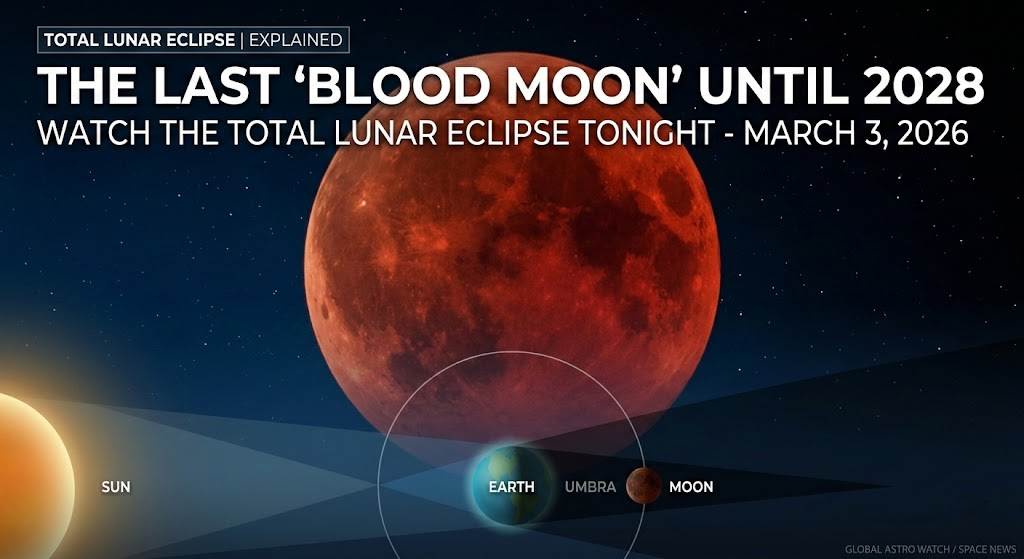
The Last “Blood Moon” Until 2028: If you look up at the night sky tonight, March 3, 2026, you’ll be witnessing more than just a full moon. You’ll be seeing a rare celestial masterpiece. For over 3 billion people across the globe, the moon is set to undergo a dramatic transformation, slipping into the deepest part of Earth’s shadow to become a Total Lunar Eclipse, often referred to as a “Blood Moon.”
This isn’t just another astronomical event—it is a significant milestone for skywatchers. According to astronomical data, tonight’s blood moon will be the last of its kind until New Year’s Eve 2028-2029. If you miss this one, you’ll be waiting nearly three years for the next total immersion.
The Last “Blood Moon”Until 2028:What Exactly is a Total Lunar Eclipse?
A lunar eclipse occurs on a full moon day when the Earth moves directly between the sun and the moon. This alignment causes the Earth’s shadow to fall onto the lunar surface.
While a partial eclipse looks like a “bite” is being taken out of the moon, a total lunar eclipse occurs when the moon passes completely through the Earth’s umbra—the darkest, central part of its shadow. During this phase, known as “totality,” the moon doesn’t disappear. Instead, it turns a haunting, coppery red. This happens because Earth’s atmosphere bends (refracts) sunlight, filtering out blue light and allowing only red wavelengths to pass through and reflect off the moon.
Tonight’s Schedule: When to Watch
For those in the United States and the Western Hemisphere, the action begins in the early hours of March 3. Unlike solar eclipses, you don’t need fancy filters or cardboard glasses. Lunar eclipses are perfectly safe to view with the naked eye.
The Timeline (Eastern Standard Time):
- 4:50 a.m. EST: The Partial Phase begins. You will see the Earth’s shadow gradually encroaching on the lunar disk.
- 6:04 a.m. EST: Totality begins. The moon turns its iconic blood-red color.
- 6:33 a.m. EST: The Peak of Totality. This is the moment the moon is deepest in the umbra.
- Duration: The total phase is expected to last approximately 58 minutes.
For viewers on the U.S. East Coast, the moon will set shortly after totality begins, so the best views in North America will be from the Western U.S., Australia, and the Pacific.
Regional Spotlight: Visibility in India (Hyderabad & Nalgonda)
While North America catches the beginning of the show, India will witness the grand finale. According to the India Meteorological Department (IMD), the eclipse will be visible from most parts of India, except for regions in the extreme west.
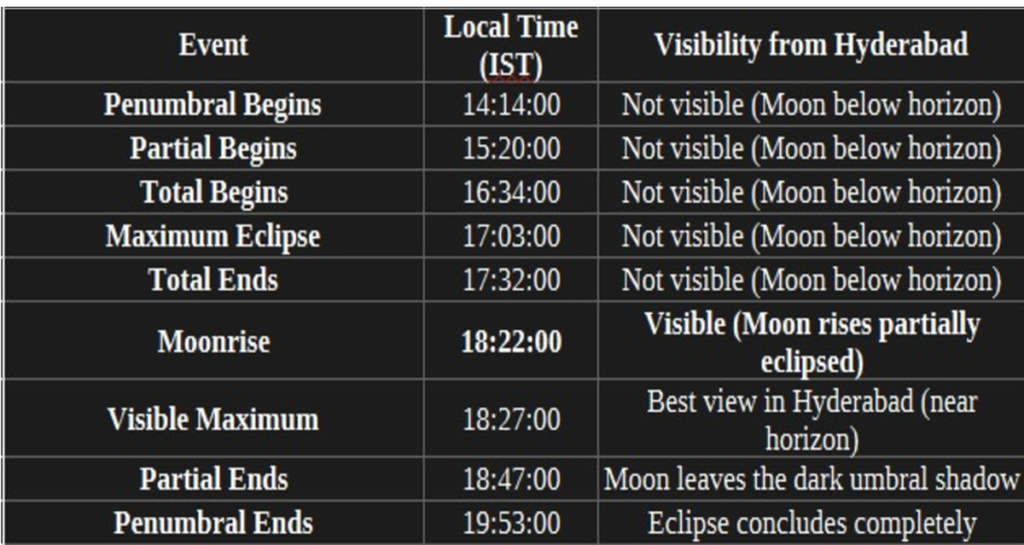
In cities like Hyderabad and Nalgonda, the experience will be a race against the clock. Because the eclipse begins while the moon is still below the horizon for India (starting around 3:20 p.m. IST), residents will only see the concluding stages.
| Location | Moonrise Time | Visibility Window |
| Hyderabad | 6:22 p.m. | ~26 minutes |
| Nalgonda | 6:19 p.m. | ~29 minutes |
The G.P. Birla Archaeological Astronomical and Scientific Research Institute notes that by the time the moon rises in Telangana, the “total” red phase will have concluded. However, observers will see the “Bitten Moon” phase—a striking sight where a large, dark shadow covers a portion of the moon as it emerges from the horizon. To see this, you must have a clear view of the eastern horizon, as the moon will be less than 5° high.
Can’t See It In Person?
Weather is always the ultimate gatekeeper for stargazing. If clouds block your view, or if you live in a region where the eclipse isn’t visible, Space.com is hosting free livestreams and a live blog to track the event as it moves across the globe.
Why This Eclipse Matters
With a magnitude of 1.155, this is a “deep” eclipse, meaning the moon passes well into the center of the shadow, promising a rich, dark coloration.
As we look ahead, the IMD confirms that the next lunar eclipse visible from India will be a partial one on July 6, 2028. Tonight represents our last chance for a long time to see the moon fully cloaked in shadow. So, whether you’re waking up early in New York or catching the moonrise in Hyderabad, don’t forget to look up.