
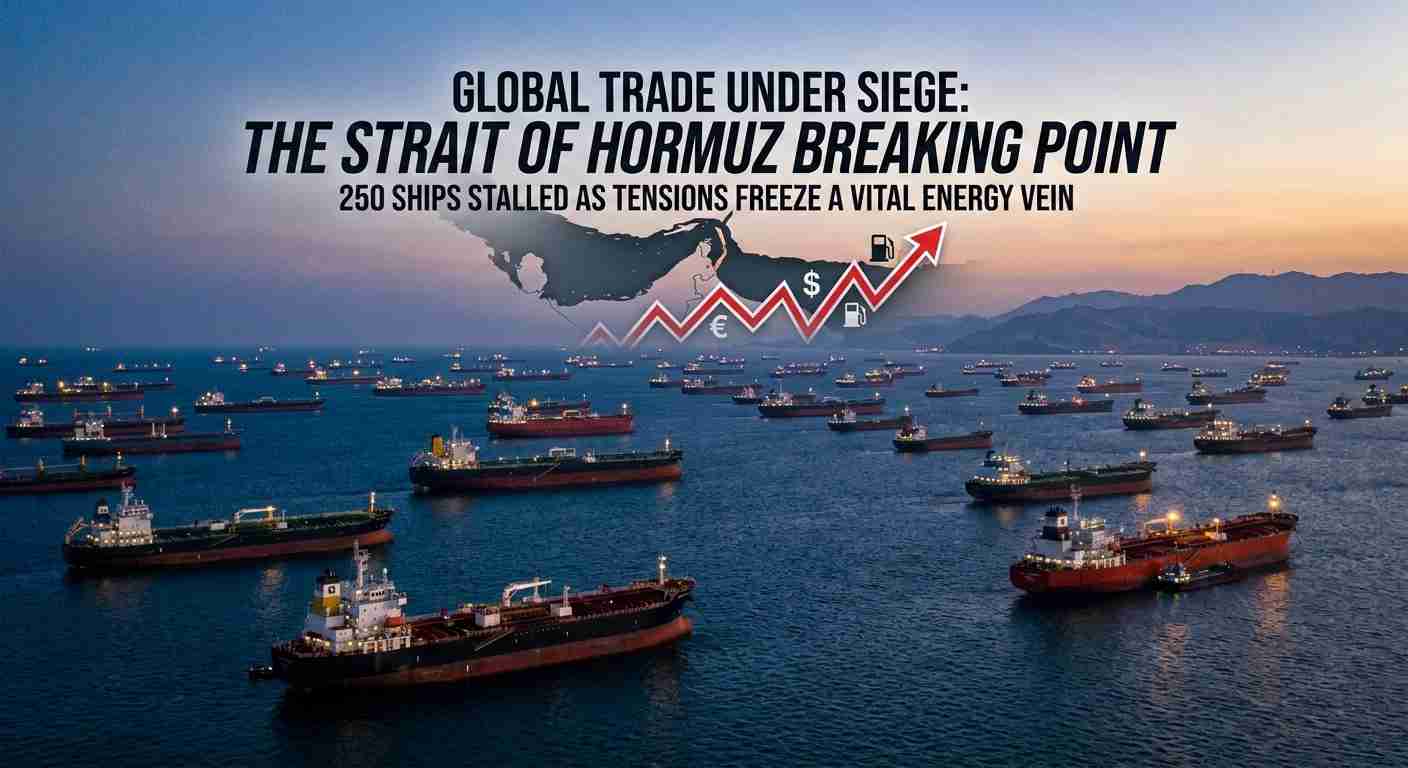
The 33-Kilometer Chokepoint: global economy is currently facing a “heart attack” in its most vital artery. As you read this, a crisis is unfolding in the Strait of Hormuz, the narrow but mighty waterway that serves as the primary exit for the Persian Gulf. For all practical purposes, this corridor—the world’s most important shipping lane—has effectively shut down.
This isn’t just a headline about distant waters; it is a developing economic shockwave that will soon reach your doorstep. From the fuel in your car to the smartphone in your pocket and the food on your table, the “Great Freeze” in West Asia is about to make life more expensive for everyone.
The 33-Kilometer Chokepoint: Global Strategy
To understand the gravity of the situation, look at the geography. The Strait of Hormuz is a tiny silver of water, measuring just 33 kilometers wide at its narrowest point. Yet, its significance is astronomical:
- Energy Lifeline: Nearly 20% of the world’s oil flows through this single stretch.
- Massive Cargo: Beyond crude oil, it carries enormous volumes of Liquefied Natural Gas (LNG) and container ships filled with the world’s consumer goods.
- Geopolitical Trigger: Iran sits on the northern shore, giving it virtual control over who passes through. While a formal, total closure has not been “officially” declared in a legal sense, the reality at sea is one of total paralysis.
The Standoff: 250 Ships and No Way Out
As of today, the movement of goods has ground to a near-halt. Ships are not passing because the risk of being caught in the crossfire of the escalating West Asia conflict is simply too high. Recent reports indicate a massive pile-up:
- Inside the Gulf: Roughly 150 tankers are currently stuck in the waters off Iraq, Saudi Arabia, and Qatar. These are multi-million dollar vessels, fully loaded, essentially acting as floating warehouses with nowhere to go.
- Outside the Gates: Another 100 tankers are anchored along the coastlines of the UAE and Oman, waiting for a “green light” that may not come for weeks.
In total, 250 ships are stalled. They aren’t damaged or sinking; they are waiting for safety assurances in a region where “safety” has become a rare commodity.
The Hidden Costs: Insurance and Rerouting
When ships stop moving, the meter doesn’t stop running. The financial fallout of this blockade is manifesting in two primary ways: rerouting and insurance.
1. The Long Way Around
Some shipping companies have begun the arduous task of rerouting. Instead of passing through the Strait, they are taking longer, more circuitous paths to avoid the conflict zone.
- The Result: Longer delivery times, significantly higher fuel consumption, and ballooning operational costs. Every extra day at sea adds hundreds of thousands of dollars to a voyage’s price tag.
2. The Insurance Spike
You cannot sail a commercial vessel without insurance, but insurers are currently in a state of panic. Some are refusing to offer coverage entirely, while others have hiked “War Risk” premiums to unprecedented levels.
The Math of the Crisis: A vessel valued at $100 million that previously paid $250,000 per voyage in insurance is now seeing bills of $375,000 or more. That is a 30% increase overnight.
Why This Hits Your Wallet
It is a common misconception that these costs stay with the shipping giants. In reality, there is a “Pass-the-Parcel” effect in global trade:
- Shipping Companies pass the cost to Traders.
- Traders pass the cost to Distributors.
- Retailers pass the cost to You.
Whether it is a hike in the price of a gallon of gas or a surcharge on your next electronics purchase, you are effectively paying for a war happening thousands of kilometers away. We have seen similar spikes during the tanker attacks of 2019, but experts warn this current suspension is different—it is widespread, involves hundreds of vessels simultaneously, and has no clear end date.
Looking Ahead: The Ripple Effect
If the conflict cools today, traffic could resume relatively quickly. But if the freeze continues, we will move from a “logistics delay” to a “market crisis.” We could see genuine supply shortages in sectors like automotive parts and industrial components, further fueling global inflation.
The Strait of Hormuz is a reminder of how fragile our “connected” world truly is. When 33 kilometers of water freeze over, the ripples are felt in every home on the planet.