
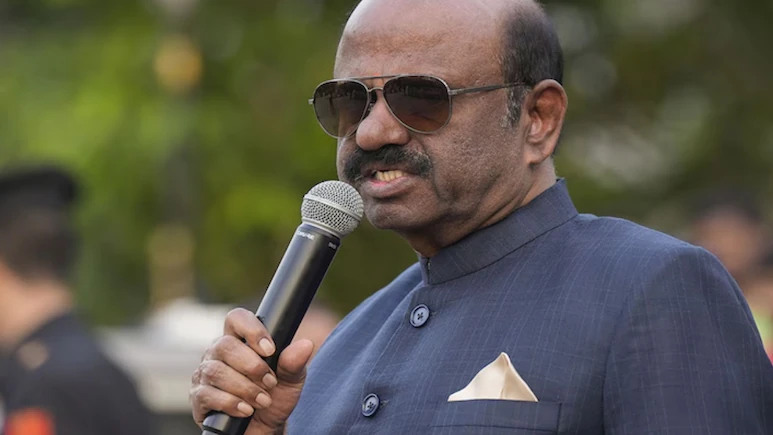
KOLKATA — Bengal Governance in Turmoil: Governor Ananda Bose Resigns Amid Mamata’s Claims of ‘Amit Shah Pressure : In a development that has sent shockwaves through the corridors of power in West Bengal, Governor C. V. Ananda Bose tendered his resignation on Thursday, March 5. Coming just weeks before the high-stakes West Bengal Assembly elections, the sudden exit has ignited a fierce political war of words between the ruling Trinamool Congress (TMC) and the Bharatiya Janata Party (BJP)-led Central government.
Chief Minister Mamata Banerjee was quick to react, expressing deep “shock” and suggesting that the resignation was not as voluntary as it appeared. In a blistering social media post, she alleged that Bose may have been coerced by Union Home Minister Amit Shah to step down to further the BJP’s “political interests” ahead of the polls.
The Resignation: Health Concerns or Political Strategy?
Bengal Governance in Turmoil: Governor Ananda Bose Resigns Amid Mamata’s Claims of ‘Amit Shah Pressure: C. V. Ananda Bose, a former Indian Administrative Service (IAS) officer who took charge of the Raj Bhavan in November 2022, reportedly submitted his resignation to President Droupadi Murmu while on a visit to New Delhi. Speaking to the news agency PTI, Bose confirmed his departure but remained cryptic about the specific catalysts.
“Yes, I have resigned. I have been the Governor of Bengal for three-and-a-half years; it’s enough for me,” Bose stated, adding that he felt he had “spent enough time” in the role.
While the official reason cited by sources close to the Governor is “ill health,” the timing has raised eyebrows across the political spectrum. Bose had recently enrolled himself as a local voter in Bengal, a move that many interpreted as a sign he intended to stay in the state for the long haul.
BJP State President Samik Bhattacharya defended the Governor’s decision, pointing to previous medical check-ups Bose underwent at Kolkata’s Eastern Command Hospital. “He is the representative of the President. We all respect him. If he has cited ill health, we must accept that,” Bhattacharya said, dismissing the Chief Minister’s allegations of foul play.
Mamata Banerjee Slams “Unilateral” Appointment of R. N. Ravi
The controversy deepened when Chief Minister Mamata Banerjee revealed that she had been informed by Home Minister Amit Shah that R. N. Ravi, the current Governor of Tamil Nadu, would be replacing Bose in West Bengal.
Banerjee’s primary grievance lies in the lack of consultation. Under the established conventions of Indian federalism, the Centre typically consults the State Government before appointing a Governor.
“The Union Home Minister just informed me that Shri R. N. Ravi is being appointed as Governor of West Bengal. He never consulted with me as per the established convention,” Banerjee posted on X. She characterized the move as a direct hit on the “foundation of our federal structure,” accusing the Centre of eroding the dignity of states through unilateral decisions.
Who is R. N. Ravi?
The choice of R. N. Ravi as a successor is particularly provocative. A former IPS officer with a background in the CBI and Intelligence Bureau (IB), Ravi has earned a reputation as a “tough” administrator. However, his tenure in Tamil Nadu has been defined by an intensely adversarial relationship with Chief Minister M. K. Stalin.
- Legislative Deadlocks: Ravi has repeatedly clashed with the Tamil Nadu government over the withholding of assent to Bills.
- Protocol Wars: Disputes over state policy and public statements have led to frequent “Raj Bhavan vs. Secretariat” face-offs.
Political analysts suggest that by sending Ravi to Bengal—a state already known for its volatile relationship between the Governor and the Chief Minister—the Centre may be signaling a more confrontational approach leading up to the elections.
A Legacy of Friction: Bose’s Tenure in Bengal
- V. Ananda Bose’s tenure was far from peaceful. He succeeded Jagdeep Dhankhar, who left the post to become the Vice President of India. While Bose initially appeared to seek a more cordial path, his relationship with the TMC government soured over familiar flashpoints:
- University Control: Like his predecessor, Bose clashed with the state over the appointment of Vice Chancellors. The state government even moved the Supreme Court, alleging that Bose was withholding assent to eight Bills designed to replace the Governor with the Chief Minister as the Chancellor of state universities.
- Law and Order: Bose was a vocal critic of the state’s handling of political violence, often making spot visits to affected areas—a move the TMC viewed as overstepping his constitutional boundaries.
- The Molestation Allegation: In May 2024, a temporary staff member at Raj Bhavan filed a police complaint alleging that Bose had molested her. While Bose denied the claims and cited constitutional immunity under Article 361 (which protects Governors from criminal proceedings while in office), the incident became a massive political weapon for the TMC.
The Road to the Assembly Polls
The timing of this transition is critical. With Assembly elections around the corner, the Governor’s role becomes pivotal in overseeing the transition of power and handling potential constitutional crises.
Mamata Banerjee’s “pressure” theory hinges on the idea that the Centre wants a “strongman” Governor like R. N. Ravi to act as a check on her administration during the election period. “I would not be surprised if the Governor [Bose] has been subjected to some pressure to serve certain political interests on the eve of the forthcoming State Assembly elections,” she remarked.
As Bengal prepares for another high-octane electoral battle, the departure of Ananda Bose and the impending arrival of R. N. Ravi ensures that the Raj Bhavan will remain the epicenter of the state’s political drama.
Disclaimer: This information is based on various inputs from news agency.