
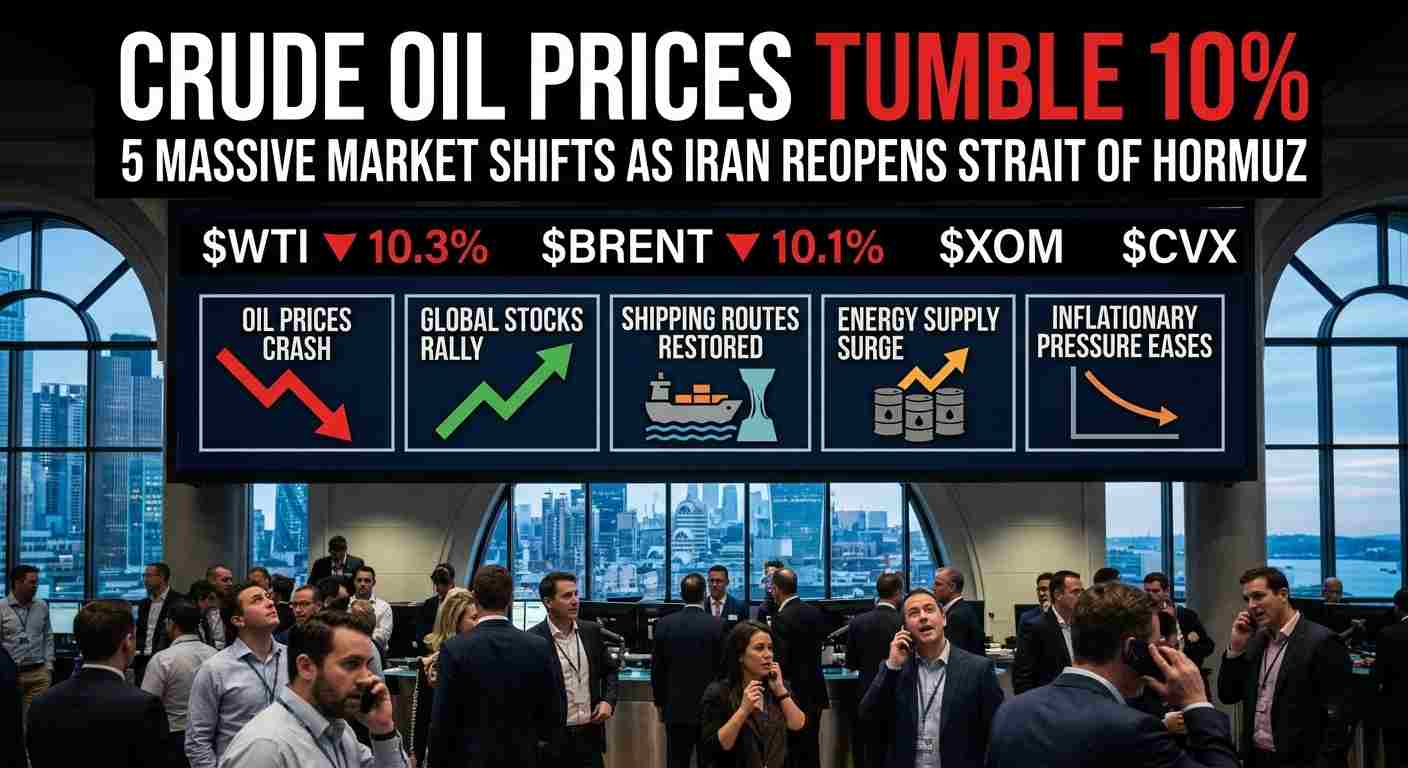
Friday, April 17, 2026: A massive 10% plunge in crude oil prices. The global energy landscape witnessed a dramatic shift as crude oil prices plummeted by more than 10% in a single trading session. This steep decline follows immediately on the heels of a major diplomatic triumph: Iran has officially reopened the Strait of Hormuz for the duration of a recently concluded ceasefire agreement. For a world long gripped by fears of protracted Middle Eastern conflicts and soaring inflation, this news has emerged as the most tangible sign of hope seen in many months.
As tankers begin to move through the world’s most vital maritime chokepoint once again, the ripple effects are being felt from Wall Street to Dalal Street. In this comprehensive report, we break down the geopolitical maneuvers, the immediate impact on global stock markets, and what this means for the future of energy prices in 2026.
Crude Oil Prices The Geopolitical Breakthrough: 10 Days of Calm
The primary catalyst for the 10.8% drop in US crude was an announcement that few saw coming so suddenly. Following high-stakes negotiations in Washington, US President Donald Trump confirmed that the leaders of Israel and Lebanon have agreed to a 10-day temporary truce.
The Role of the Strait of Hormuz
The Strait of Hormuz is arguably the most important oil artery on the planet. Connecting the Persian Gulf with the Gulf of Oman and the Arabian Sea, it carries roughly one-fifth of the world’s total oil consumption. When Iran previously restricted access, the global “war premium” on oil sent prices toward triple digits.
On Friday, Iranian Foreign Minister Seyed Abbas Araghchi took to X (formerly Twitter) to clarify the regime’s stance:
“In line with the ceasefire in Lebanon, the passage for all commercial vessels through Strait of Hormuz is declared completely open for the remaining period of ceasefire, on the coordinated route as already announced by Ports and Maritime Organisation of the Islamic Rep. of Iran.”
This move effectively allows trapped oil tankers to exit the Persian Gulf, flooding the market with much-needed supply and instantly deflating the speculative bubble that had kept prices high.
Crude Oil Prices: A Breakdown of the Crash
The numbers from Friday’s close tell a story of relief and rapid recalibration.
| Benchmark | Closing Price | Percentage Drop |
| WTI Crude (US) | $81.28 | -10.8% |
| Brent Crude (International) | $89.13 | -10.3% |
While a drop to $81 and $89 respectively is a massive win for importing nations, analysts are quick to point out that Crude Oil Prices are still significantly higher than the $70-per-barrel average seen before the outbreak of hostilities. This suggests that while the “panic” has subsided, a “cautionary premium” remains as traders wait to see if the 10-day ceasefire can be converted into a permanent peace deal.
Wall Street’s Explosive Reaction
While oil speculators were licking their wounds, equity investors were popping champagne. US stocks rallied aggressively on Friday, marking the third consecutive week of gains—the longest winning streak since late 2025.
Key Index Movements
S&P 500: Climbed 0.8%, buoyed by the prospect of lower energy costs for corporations.
Dow Jones Industrial Average: Surged 678 points (1.4%), driven by industrial giants that benefit from lower shipping and fuel costs.
Nasdaq Composite: Rose 1% as tech investors felt a reprieve from the inflationary pressures that usually accompany high oil prices.
President Trump further fueled the fire of optimism during a late-Thursday speech, stating that the war “should be ending pretty soon.” For a market that had hit a floor in late March, the news was the perfect fuel for an 11% recovery over the last few weeks.
The Earnings Factor: Beyond Geopolitics
It wasn’t just the news from the Middle East driving the bulls. The early 2026 earnings season has started with a bang, proving that corporate America is more resilient than many feared.
Financials Lead the Way
Banking and financial services reported robust numbers. State Street saw its shares rise 2.9%, while Fifth Third Bancorp added 1.9%. These gains helped the market absorb a significant blow from Netflix, which tumbled 11.5%. Despite beating profit expectations, the streaming giant failed to raise its revenue guidance and announced that co-founder Reed Hastings would be stepping down from the board in June.
Global Impact: From Europe to Asia
The timing of the announcement created a staggered reaction across global time zones.
Europe: Markets in London, Paris, and Frankfurt had the full benefit of the news during their trading hours. France’s CAC 40 jumped 2%, while Germany’s DAX surged 2.2%.
Asia: The announcement came after most Asian markets had already closed. Consequently, Japan’s Nikkei 225 (-1.8%) and Hong Kong’s Hang Seng (-0.9%) didn’t get to participate in the “Hormuz Rally.” Expectations are high for a massive “catch-up” opening on Monday.
India’s Market Resilience: A Premature Celebration?
In India, the SENSEX and NIFTY50 managed to rally nearly 1% on Friday, even before the official word on the Strait of Hormuz was released. The Indian markets closed at 3:30 PM IST, just hours before the announcement, but the “optimism in the air” was already palpable.
Domestic Statistics
BSE Sensex: Jumped 504.86 points to settle at 78,493.54.
NSE Nifty: Climbed 156.80 points to end at 24,353.55.
Market Breadth: On the BSE, 3,043 stocks advanced compared to 1,284 declines, showing broad-based participation.
For India, a massive importer of crude, a 10% drop in Crude Oil Prices is a direct injection of adrenaline into the economy. It helps cool domestic inflation, reduces the current account deficit, and allows the RBI more breathing room regarding interest rate decisions.
What Happens Next? The 10-Day Countdown
While the reopening of the Strait of Hormuz is a monumental win for the global economy, the word “temporary” looms large. The ceasefire is currently set for only 10 days.
The Risks Ahead
Fragility of the Truce: Historically, Middle Eastern ceasefires have been prone to sudden collapses. Any “accidental” skirmish could see the Strait closed again within hours.
Volatility: As noted by several market analysts, the “vicious and sudden swings” in prices for stocks and bonds are likely to continue until a permanent diplomatic framework is signed.
Supply Chain Lag: Even with the Strait open, it will take time for the global supply chain to normalize. Tankers that were rerouted around the Cape of Good Hope cannot simply “turn around” instantly.
The Opportunity
If the 10-day period passes without incident, we could see Crude Oil Prices test the $75 support level. This would likely trigger a massive rotation out of “safe-haven” assets like gold and back into high-growth equities and emerging markets.
Conclusion: A Turning Point for 2026
The events of Friday, April 17, 2026, will likely be remembered as the moment the global economy took its first deep breath in a long time. The combination of falling Crude Oil Prices, a reopening of a critical trade artery, and a strong start to the US earnings season has created a “perfect storm” of positivity.
For consumers, this could eventually mean lower prices at the pump and a slowing of the cost-of-living crisis. For investors, it marks a shift from “survival mode” back to “growth mode.” However, as the $89 Brent price suggests, the world is still keeping one eye on the headlines, waiting to see if this 10-day window of peace can become the foundation for a new era of stability.