
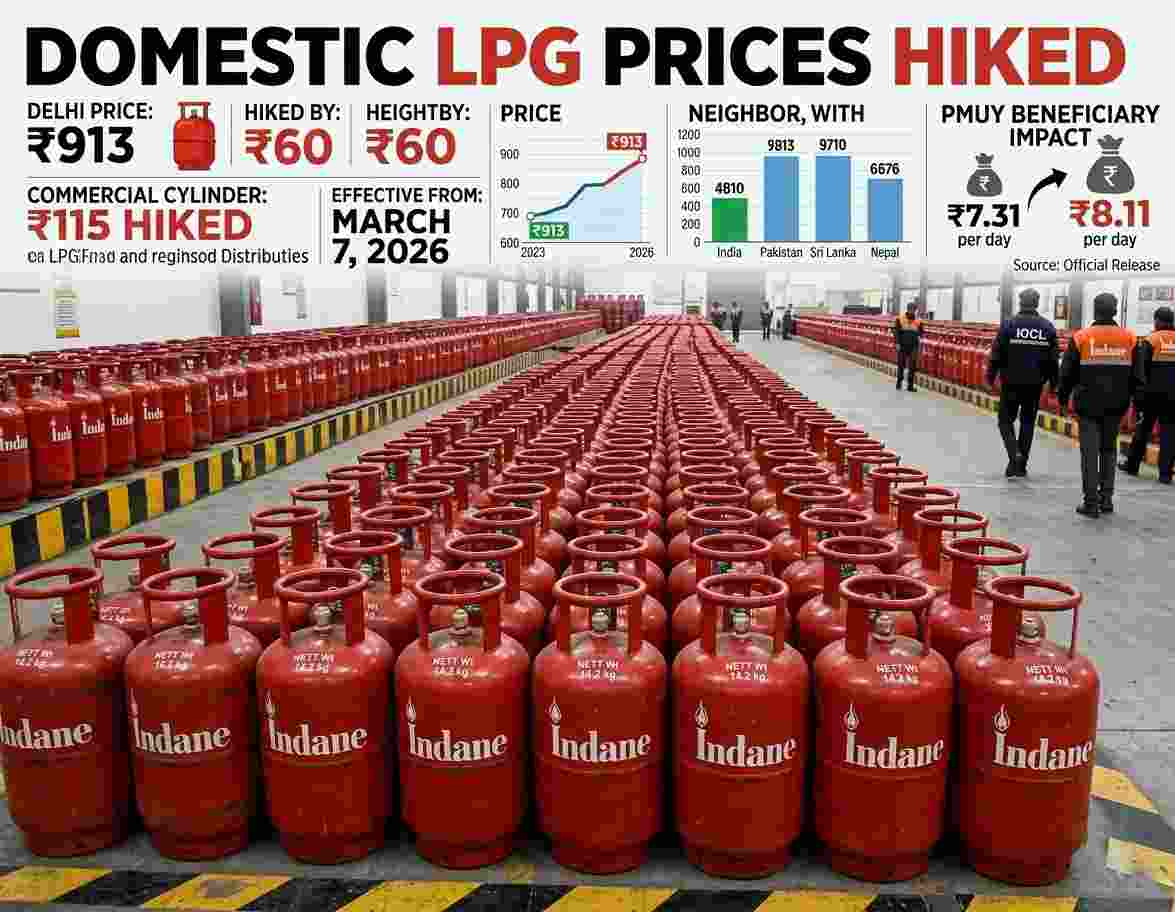
New Delhi, March 7, 2026 —Domestic LPG Prices Hiked : In a move that reflects the ongoing pressure of global energy markets, the prices of Liquefied Petroleum Gas (LPG) in India have seen a significant revision effective today. The price of a domestic 14.2 kg LPG cylinder has been hiked by ₹60, while the commercial cylinder has seen a steeper increase of ₹115.
While any price hike in essential commodities sparks concern among households, a deeper look into the pricing structure, regional comparisons, and the government’s subsidy mechanism suggests a calibrated effort to balance the financial health of Oil Marketing Companies (OMCs) with the protection of the common man’s pocket.
Breaking Down the Numbers: What Does it Mean for Your Kitchen?
Domestic LPG Prices Hiked: Despite the sticker shock of a ₹60 increase, officials and experts familiar with the matter have provided a granular breakdown of how this affects daily life. For an average Indian family, the hike translates to an increase of approximately 80 paise per day. When broken down further to an individual level, the impact is roughly 20 paise per person per day for cooking expenses.
In the national capital, Delhi, a 14.2 kg domestic cylinder will now cost ₹913. While this is an upward shift from the previous price of ₹853, the hike has been restricted to nearly half of what market indicators suggested was necessary.
A Regional Comparison: India vs. Its Neighbors
One of the most compelling arguments presented by government sources is the comparison of India’s LPG rates with those in neighboring South Asian countries. Even after the current hike, Indian consumers continue to pay significantly less than their counterparts across the borders.
| Country | Price of 14.2 kg Cylinder (Approx. in INR) |
| India (Delhi) | ₹913 |
| Pakistan | ₹1,046 |
| Sri Lanka | ₹1,241 |
| Nepal | ₹1,207 |
These figures highlight that the Indian government is continuing to absorb a substantial portion of the international price volatility to ensure that the domestic cost remains among the lowest in the region.
The Gap Between Market Price and Consumer Price
A critical aspect of the current energy landscape in India is the difference between the “market-determined price” and the “actual selling price.” As of March 6, 2026, the market-linked price for a domestic cylinder in Delhi stood at approximately ₹987. However, consumers were being charged ₹853.
This created a gap of ₹134 per cylinder. While the logical step to eliminate under-recoveries would have been to increase the price by the full ₹134, the government opted for a more conservative hike of ₹60. By doing so, the state continues to absorb ₹74 per cylinder to cushion the impact on the middle and lower-income groups.
Protecting the Vulnerable: The PMUY Impact
The Pradhan Mantri Ujjwala Yojana (PMUY), which provides LPG connections to women from Below Poverty Line (BPL) households, remains a priority for the administration. For these beneficiaries, the daily cooking cost remains remarkably modest.
Before the hike, the estimated cost of cooking per day for a PMUY household was around ₹7.31. Following today’s revision, this figure is expected to rise to ₹8.11. An increase of less than ₹1 per day ensures that the shift from traditional, polluting fuels to clean LPG remains economically viable for India’s most vulnerable populations.
The Global Context: Why Prices are Rising
The primary driver behind the domestic price revision is India’s heavy reliance on energy imports. India currently imports more than 60% of its LPG requirements. This makes the domestic market highly sensitive to international benchmarks, specifically the Saudi Contract Price (CP), which serves as the global standard for LPG pricing.
The trajectory of global prices has been on a sharp upward curve:
2020-21: ~USD 415 per metric tonne
2022-23: ~USD 712 per metric tonne
While the global prices witnessed extreme volatility and reached record highs, the Indian government maintained a policy of “calibrated adjustment,” meaning the full weight of these international spikes was never passed directly to the consumer.
The Financial Burden on Oil Marketing Companies (OMCs)
Keeping domestic prices artificially low comes at a significant cost to the treasury and the state-run OMCs (such as IOCL, BPCL, and HPCL). During the 2024-25 fiscal year, OMCs incurred losses (under-recoveries) of approximately ₹40,000 crore while maintaining affordable domestic rates.
To prevent a liquidity crisis within these companies and to ensure an uninterrupted supply of fuel across the nation, the government approved a compensation package of about ₹30,000 crore. This follows a similar trend from the 2022-23 fiscal year, where the government provided a ₹22,000 crore one-time grant to OMCs to cover losses.
“The revision is a necessary step for the financial sustainability of the oil sector, yet it has been designed to be as painless as possible for the end consumer,” noted a senior official.
Looking Ahead: Energy Security and Sustainability
The decision to hike prices, while unpopular, underscores the challenge of managing energy security in an era of geopolitical instability and fluctuating commodity prices. The government’s strategy appears twofold:
Fiscal Prudence: Gradually aligning prices with market realities to reduce the subsidy burden and ensure OMCs remain profitable enough to invest in infrastructure.
Social Welfare: Maintaining a “buffer” that prevents domestic prices from skyrocketing to the levels seen in neighboring nations.
As the world transitions toward cleaner energy, the role of LPG as a “bridge fuel” in India remains vital. Ensuring its affordability while managing the macro-economic impact of imports will continue to be a delicate tightrope walk for policymakers in the years to come.
Summary of Key Takeaways
Domestic Hike: ₹60 per 14.2 kg cylinder.
Commercial Hike: ₹115 per cylinder.
Daily Impact: ~80 paise per family; ~20 paise per person.
Market Gap: Government is still absorbing ~₹74 of the market-linked price.
Global Context: India imports 60%+ of LPG; prices are tied to the Saudi CP.
Subsidy Support: OMCs received ₹30,000 crore in compensation for 2024-25 losses.