
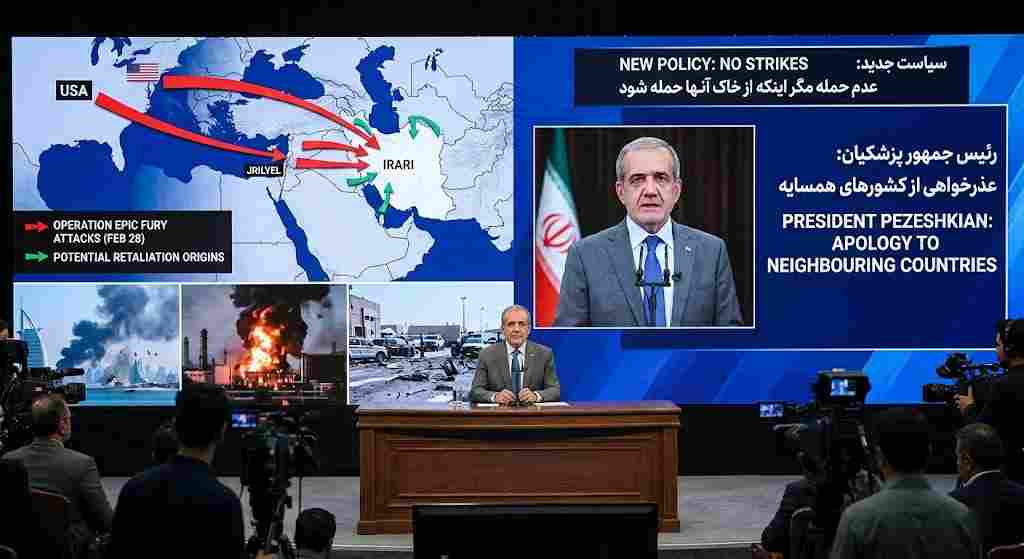
TEHRAN —Iran’s President Pezeshkian :In a dramatic pivot aimed at de-escalating tensions with its Arab neighbors, Iranian President Masoud Pezeshkian issued a public apology on Saturday for recent missile and drone strikes that have hit regional states. Speaking during a televised address as the Middle East enters the second week of a high-stakes conflict, Pezeshkian announced a new policy: Iran will refrain from striking neighboring countries unless attacks against the Islamic Republic originate from their soil.
The statement comes at a time of unprecedented chaos. The regional war, ignited by a massive joint U.S.-Israeli operation on February 28, 2026, has seen the death of Iran’s Supreme Leader, the destruction of strategic assets, and retaliatory fire that has reached the doorsteps of the world’s most luxurious cities.
Iran’s President Pezeshkian The “New Policy” of the Interim Leadership Council
President Pezeshkian, who is currently serving as one of three members of a newly formed Interim Leadership Council, sought to reassure regional governments that Tehran holds no inherent hostility toward them. The council was established to manage the state following the death of Ayatollah Ali Khamenei during the opening wave of the conflict.
“I apologize… to the neighboring countries that were attacked by Iran,” Pezeshkian said in the broadcast. “The interim leadership council agreed yesterday that no more attacks will be made on neighboring countries, and no missiles will be fired unless an attack on Iran originates from those countries.”
The move is widely seen by analysts as an attempt to decouple the Gulf states from the U.S.-Israeli military coalition. Since the conflict began, Iran has launched hundreds of projectiles, many of which have landed in or been intercepted over the United Arab Emirates (UAE), Bahrain, Qatar, Kuwait, and Saudi Arabia.
Iran’s President Pezeshkian : A Week of Fire: From ‘Epic Fury’ to Regional Retaliation
The current escalation began with “Operation Epic Fury,” a coordinated series of nearly 900 airstrikes launched by the United States and Israel. The operation successfully targeted high-level leadership in Tehran, resulting in the death of Supreme Leader Ayatollah Ali Khamenei, along with several family members.
In the days following, Iran’s Islamic Revolutionary Guard Corps (IRGC) launched a relentless counter-campaign. The results have been visible across the Gulf:
- Dubai & Abu Dhabi: Shrapnel and debris from interceptions have caused fires near the Burj Al Arab and the Palm Jumeirah. Last week, an incident at Dubai International Airport—the world’s busiest—injured four staff members and forced a temporary suspension of flights.
- Bahrain: An Iranian missile reportedly struck a state-run oil refinery on Thursday, marking one of the most direct hits on regional energy infrastructure.
- Qatar: Authorities confirmed that 14 ballistic missiles and four drones were fired at the country, with one impact reported near the Al-Udeid Air Base, which houses thousands of U.S. troops.
- Saudi Arabia: While Tehran denied involvement, reports surfaced of strikes near Saudi Aramco facilities. Saudi Defense Minister Prince Khalid bin Salman has since warned Iran against further “miscalculations.”
Defiance Against Washington: “Take the Wish to the Grave”
While the tone toward neighbors was conciliatory, Pezeshkian remained combative toward Washington. His speech served as a direct rebuttal to U.S. President Donald Trump, who recently posted on social media that he would not negotiate with the Iranian regime without its “UNCONDITIONAL SURRENDER.”
Trump’s administration has signaled a goal of total regime change, with officials suggesting they should be involved in selecting Iran’s next permanent Supreme Leader. Pezeshkian’s response was blunt:
“Iran’s enemies must take their wish for the unconditional surrender of the Iranian people to their graves,” he declared. He emphasized that while Iran seeks to avoid a broader regional war, it would never capitulate to external pressure or “surrender its sovereignty” to the United States or Israel.
The Internal Power Struggle
Despite the President’s apology, questions remain regarding the unity of Iran’s command structure. Some observers note that the IRGC, which oversees Iran’s missile program, has historically operated with a high degree of autonomy.
The fact that Pezeshkian’s apology coincided with continued reports of missile launches toward Gulf states suggests a potential rift between the civilian-led interim council and the military elite. Military analysts suggest the IRGC may be choosing targets independently as they “avenge” the death of Khamenei, regardless of the diplomatic overtures being made from Tehran.
Summary of Recent Strikes in the Region
| Country | Key Incidents | Current Status |
| UAE | Strikes near Dubai Airport; debris at Burj Al Arab. | Limited flights resumed; high alert. |
| Bahrain | Missile hit on state oil refinery. | Defenses reinforced; 200+ drones intercepted. |
| Qatar | 14 ballistic missiles fired; Al-Udeid Base targeted. | Guidance issued for civilian safety. |
| Saudi Arabia | Drone attacks on Ras Tanura refinery. | Thwarted multiple launches; warning issued. |
A Region on the Brink
As the conflict enters its second week, the human and economic costs are mounting. The death toll in Iran has reportedly surpassed 1,200, and global oil prices are fluctuating wildly as markets react to the threat to the Strait of Hormuz.
External Affairs Minister S. Jaishankar of India recently commented on the “reality of the Indian Ocean,” noting that the IRIS Lavan has docked in Kochi on humanitarian grounds after a sister ship was sunk by U.S. forces. This highlights the truly global reach of a conflict that began in the heart of Tehran.
Whether Pezeshkian’s apology will be enough to mend fences with his neighbors—or if the momentum of “Operation Epic Fury” will continue to push the region toward a total war—remains the defining question of the hour.