
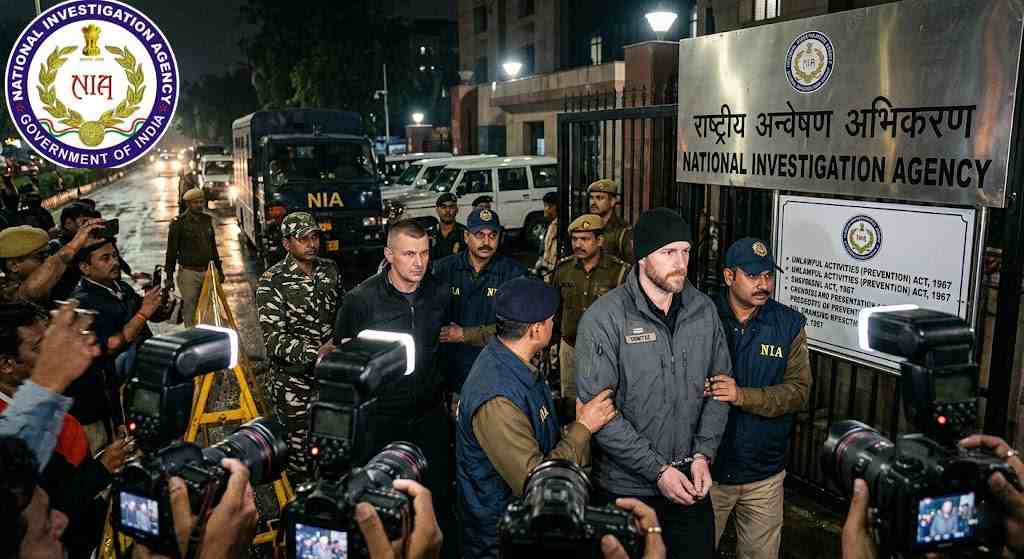
NEW DELHI —NIA Busts Global Mercenary Network: In a high-stakes counter-terrorism operation that reads like a geopolitical thriller, the National Investigation Agency (NIA) has apprehended seven foreign nationals—including a high-profile American mercenary—for allegedly conspiring to carry out terrorist activities against India. The group stands accused of infiltrating the sensitive Indo-Myanmar border to train ethnic armed groups in advanced drone warfare and smuggling specialized military hardware from Europe.
The arrests, which took place across three major Indian airports on Friday, March 13, 2026, have sent shockwaves through diplomatic circles. The accused were intercepted at the airports of Lucknow, Delhi, and Kolkata as they reportedly attempted to leave the country following a covert mission in the Northeast.
The Faces Behind the Operation
NIA Busts Global Mercenary Network: US National and 6 Ukrainians Held Under UAPA: At the center of the investigation is Matthew Aaron VanDyke, a 46-year-old American national from Baltimore. VanDyke is no stranger to global conflict zones; he is the founder of Sons of Liberty International (SOLI), a self-styled non-profit military contracting firm. A Georgetown-educated security analyst and documentary filmmaker, VanDyke first gained international notoriety during the 2011 Libyan Civil War, where he fought alongside rebels against Muammar Gaddafi and survived a harrowing stint in solitary confinement.
Joining VanDyke in NIA custody are six Ukrainian nationals, identified by authorities as:
- Petro Hurba
- Taras Slyviak
- Ivan Sukmanovskyi
- Marian Stefankiv
- Maksim Honcharuk
- Viktor Kaminskyi
These individuals, described in some reports as war veterans with experience in the ongoing conflict against Russia, were intercepted in two groups of three at Lucknow and Delhi airports, while VanDyke was apprehended by the Bureau of Immigration at Kolkata’s Netaji Subhas Chandra Bose International Airport.
A Trail of Shadows: From Mizoram to Myanmar
NIA Busts Global Mercenary Network: US National and 6 Ukrainians Held Under UAPA:According to the First Information Report (FIR) filed by the NIA, the group entered India on tourist visas before flying to Guwahati. From there, they allegedly traveled by road to Mizoram, a state that shares a porous 510-km border with Myanmar’s Chin State.
Mizoram is a “Restricted Area” under Indian law. Foreigners are mandatorily required to obtain a Restricted Area Permit (RAP) from the Foreigners Registration Office (FRO) to enter. The NIA alleges that the seven men bypassed these legal requirements, entering the state and subsequently crossing the international border into Myanmar illegally.
Once inside Myanmar, the group reportedly established contact with Ethnic Armed Groups (EAGs). While Myanmar has been embroiled in civil strife since the 2021 military coup, the NIA’s concern lies in the “inimical” nature of these interactions. The agency alleges that these EAGs maintain deep-rooted links with Indian Insurgent Groups (IIGs) operating in the Northeast, posing a direct threat to India’s internal security.
The Drone Connection: “Asymmetric Warfare”
The most alarming aspect of the NIA’s allegations involves the use of advanced technology. The agency claims the group facilitated the delivery of multiple consignments of drones from Europe into Mizoram, which were then smuggled into Myanmar.
The investigation suggests that the foreigners weren’t just delivering hardware; they were providing specialized training in:
- Drone Assembly and Operations: Building and flying tactical UAVs.
- Asymmetric Warfare: Tactical training for insurgent-style combat.
- Jamming Technology: Systems designed to neutralize enemy communications and counter-drone measures.
“The EAGs they were training and supplying are known to support banned Indian Insurgent Groups. This network aimed to enhance the operational capabilities of militias that actively target Indian interests,” an NIA official stated.
Legal Battle and Diplomatic Ripples
On Monday, March 16, the seven accused were produced before a Special NIA Court at Patiala House in New Delhi. While the NIA sought 15 days of custody to unearth the full scale of the conspiracy and locate eight other Ukrainian nationals believed to be part of the same 15-member cell, the court granted 11 days of custody, lasting until March 27.
The accused have been booked under Section 18 of the Unlawful Activities (Prevention) Act (UAPA), which pertains to conspiracy or any act preparatory to the commission of a terrorist act.
Senior advocate Pramod Kumar Dubey, representing the accused, has challenged the legality of the arrests. He argued before the court that the NIA failed to comply with the Vienna Convention on Consular Relations, which mandates that a foreigner’s embassy be notified immediately upon their arrest.
The diplomatic fallout is already brewing:
- The United States: A spokesperson for the US Embassy confirmed they are aware of VanDyke’s detention but declined further comment, citing privacy concerns.
- Ukraine: The Ukrainian government has lodged a formal protest. Ambassador Dr. Oleksandr Polishchuk met with India’s Ministry of External Affairs, demanding “unimpeded consular access” and the immediate release of the six Ukrainian citizens, claiming they were not officially notified of the detentions in a timely manner.
Why This Matters
The arrest of a well-known Western mercenary and a team of European veterans marks a significant escalation in the complexity of border security in Northeast India. It suggests that the conflict in Myanmar is no longer just a regional civil war but a magnet for private military contractors and “guns for hire” who may be using Indian soil as a transit point or staging ground.
As the NIA interrogates the suspects, the focus will remain on their digital footprints—specifically their communications on platforms like X and WhatsApp—to identify who funded the European drone shipments and whether other “freelance” combatants remain active within India’s borders.