
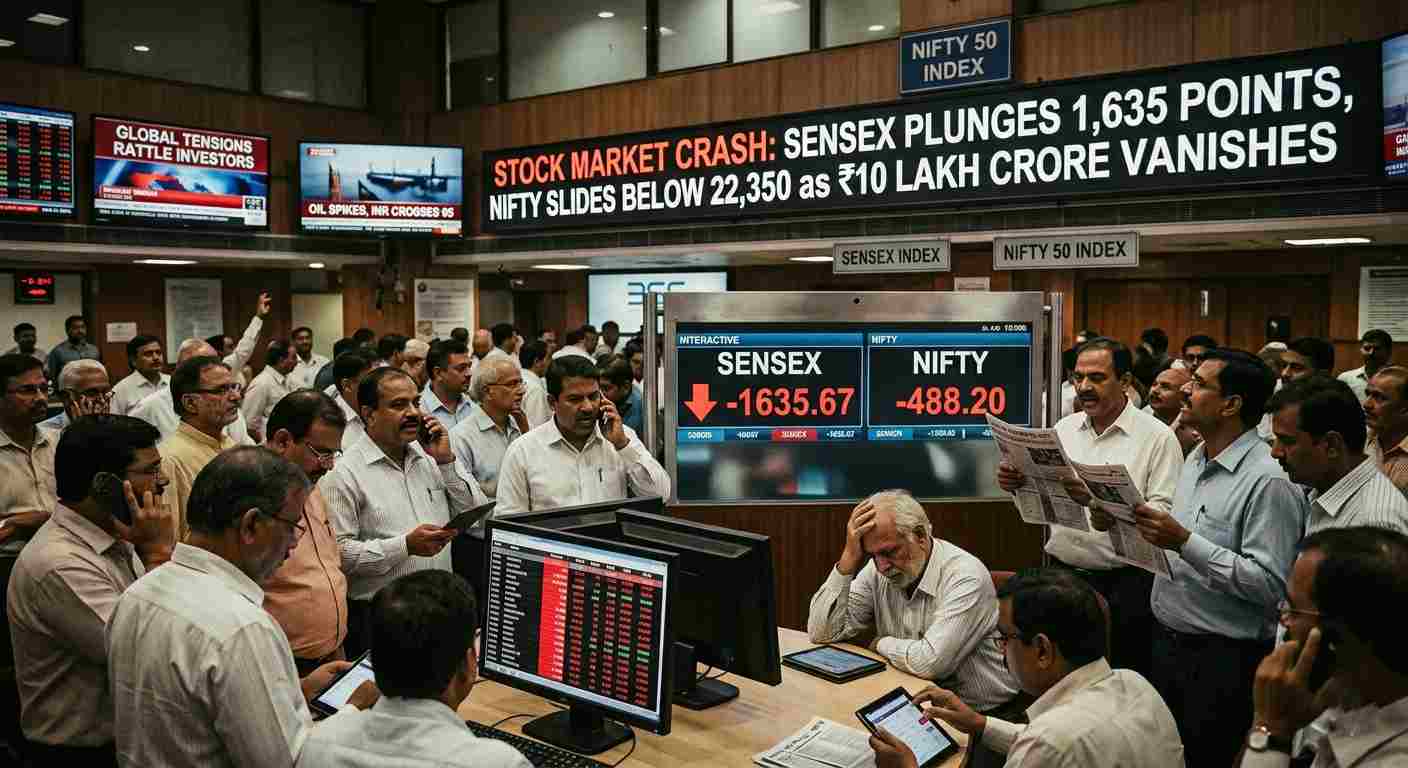
Stock Market Crash: The Indian equity markets concluded the financial year 2025-26 on a haunting note, as a “perfect storm” of geopolitical tensions and regulatory shocks triggered a massive sell-off. On Monday, March 30, the final trading session of the fiscal year, Dalal Street witnessed one of its most brutal single-day crashes, wiping out approximately ₹10 lakh crore in investor wealth.
With the Sensex and Nifty ending at multi-month lows, the day marked a grim finale to a year that had already been tested by global macro headwinds.
Stock Market Crash The Final Scoreboard: Markets in Deep Red
The benchmark indices opened with a significant gap down and failed to find any support throughout the day. By the closing bell, the carnage was visible across all sectors.
| Index | Closing Level | Point Drop | Percentage Fall |
| BSE Sensex | 71,947.55 | -1,635.67 | 2.22% |
| NSE Nifty 50 | 22,331.40 | -488.20 | 2.14% |
| Nifty Bank | 50,275.35 | -1,999.00 | 3.82% |
| Nifty PSU Bank | 6,542.00 | -314.00 | 4.56% |
The advance-decline ratio was a staggering 1:4, with over 3,400 stocks declining against a mere 837 gainers. Small-cap and Mid-cap indices were not spared either, crashing nearly 3% as panic reached the broader market.
5 Critical Factors Behind the Market Meltdown
The collapse wasn’t a result of a single event but a synchronized hit from multiple global and domestic fronts.

1. The “War Premium”: Crude Oil Surges to $116
The primary catalyst remains the escalating conflict in West Asia. As the US-Israeli operations against Iran entered their fifth week, the involvement of Yemen’s Houthi rebels over the weekend turned a regional conflict into a global shipping crisis.
Brent Crude jumped over 3% to hit an intraday high of $116.70 per barrel.
Fears of the closure of the Strait of Hormuz have led analysts at Macquarie to warn of a potential spike to $200 per barrel if the war persists.
For India, which imports over 80% of its oil, this translates to higher inflation and a wider Current Account Deficit (CAD).
2. RBI’s Forex “Shock” to the Banking Sector
In a surprise move late Friday, the Reserve Bank of India (RBI) directed banks to cap their net open rupee positions in the foreign exchange market at $100 million by April 10.
The Impact: This move aims to curb rupee speculation but forces banks to unwind massive arbitrage positions estimated between $25 billion and $50 billion.
The Loss: Analysts at Jefferies estimate that the banking sector could face mark-to-market (MTM) losses of up to ₹4,000 crore in the March quarter alone due to this disorderly unwinding. This sent the Nifty Bank into a tailspin, falling nearly 4%.
3. Rupee Breaches the 95 Mark
For the first time in history, the Indian Rupee crossed the psychological barrier of 95 per US Dollar.
The currency touched a record low of 95.2, driven by the exit of foreign capital and the soaring cost of oil imports.
A weak rupee is a double-edged sword; while it helps exporters, the sheer volatility has spooked the equity and bond markets. The 10-year bond yield also crossed the 7% mark for the first time in 21 months.
4. Relentless FPI Selling
Foreign Portfolio Investors (FPIs) have been on a selling spree throughout March 2026.
On Friday alone, FIIs offloaded shares worth ₹4,367 crore.
The total FPI outflow for March has crossed a record ₹1.18 lakh crore, as global investors shift funds toward “safe-haven” assets like US Treasury bonds and Gold amidst war uncertainty.
5. F&O Expiry Volatility
Monday coincided with the Monthly Nifty F&O Expiry, which traditionally brings high volatility. The India VIX (Volatility Index) surged over 8% to 28.78, indicating high levels of fear and uncertainty among traders.
Sectoral Highlights: No Place to Hide
The bloodbath was truly democratic, affecting almost every sector. NSE India Official Website
Financials & Banks: The biggest laggards. Bajaj Finance led the losers, crashing 5%, while giants like SBI, HDFC Bank, and ICICI Bank saw cuts of 3–4%.
PSU Banks: The Nifty PSU Bank index was the worst-hit sectoral index, tumbling 4.56% as investors booked profits amid fears of treasury losses.
Auto & Consumption: Rising fuel prices and the threat of an interest rate hike (to support the rupee) dragged the Auto index down by 2.5%.
Safe Havens? Even Gold and Silver futures traded lower (down 2% and 1.3% respectively) as investors scrambled for cash to cover margin calls in the equity segment.
The FY26 Post-Mortem
With Monday’s close, the curtains fall on a difficult financial year for Indian investors.
Nifty 50 finished FY26 with a 5.1% loss.
BSE Sensex performed even worse, ending the year 7.1% lower.
This marks the worst performance for Indian benchmarks since the 2020 COVID-19 crash, highlighting the severity of the current geopolitical and macroeconomic crisis.
Technical Outlook: What Lies Ahead for FY27?
The technical structure of the market has weakened significantly. The Nifty has settled at an 11-month low, while the Sensex is at a two-year low.
According to market analysts, the sentiment will remain bearish until the Nifty decisively crosses and sustains above the 24,000 mark. For now, the immediate support for Nifty lies at 22,250, while the Bank Nifty eyes the 50,000 psychological support.
“The Goldilocks macro scenario—high growth and low inflation—that India enjoyed before the war has effectively vanished. We are now looking at a cycle of lower GDP growth and higher deficits,” said VK Vijayakumar, Chief Investment Strategist at Geojit.
Strategy for Investors
Experts advise against “catching a falling knife.” Given the 53–60% monthly rise in oil prices and the ongoing Middle East escalation, it is prudent to:
Maintain Cash: Wait for the volatility to settle before making large entries.
Focus on Value: Financials and certain IT pockets are approaching “fair” valuations, but selective accumulation is key.
Watch the News: Any de-escalation in the Iran conflict or a cooling of crude below $100 will be the first signal for a sustainable bounce.
Note: The Indian markets will remain shut on Tuesday, March 31, for a public holiday. Trading for the new financial year (FY27) will commence on Wednesday, April 1.
Disclaimer: The views and data expressed in this article are for informational purposes only. This does not constitute an investment recommendation. The stock market is subject to constant fluctuations and risks; therefore, the writer or platform shall not be held responsible for any financial losses incurred. Please consult with your financial planner or a certified expert before making any investment decisions.