
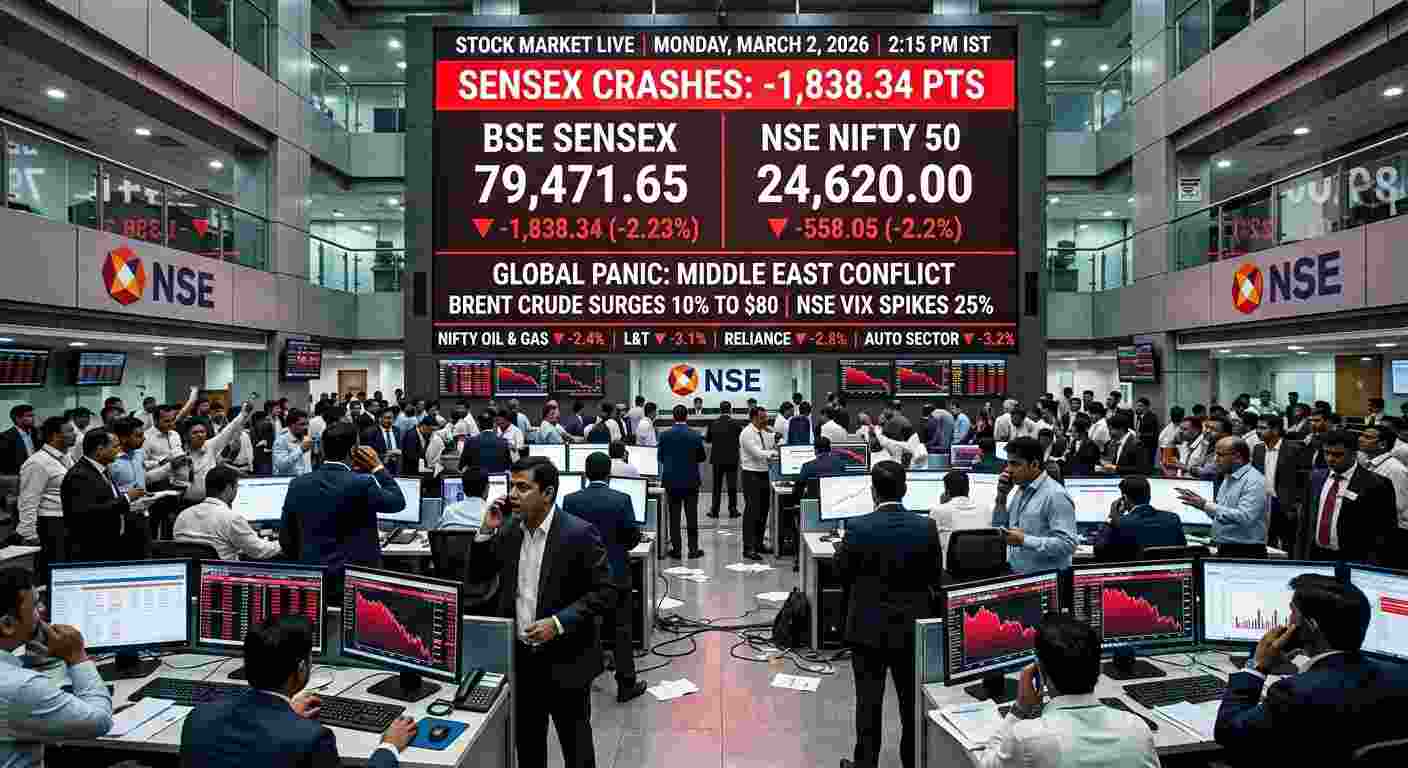
Stock Market Crash 2026:The global financial landscape was set ablaze on Monday, March 2, 2026, as the Indian equity markets suffered one of their most harrowing trading sessions in recent history. A “perfect storm” of geopolitical catastrophe, surging energy costs, and a breakdown in investor confidence sent the BSE Sensex and NSE Nifty 50 into a freefall. As the dust settles on a day characterized by panic selling and a flight to safety, the implications of a direct military confrontation in the Middle East have moved from theoretical risks to a grim reality for millions of investors.
By mid-afternoon, the carnage was evident on every ticker tape across the country. The Sensex plummeted over 1,800 points, while the Nifty 50 struggled to stay above the critical 24,600 mark. The trigger? A weekend military operation that has fundamentally altered the geopolitical order of the 21st century.
Stock Market Crash 2026: Assassination of Iran’s Supreme Leader
The primary driver behind this massive stock market crash 2026 was the shocking news that broke over the weekend. In a joint military operation that has stunned the world, the United States and Israel conducted a precision strike resulting in the death of Iran’s Supreme Leader, Ayatollah Ali Khamenei, along with several high-ranking Iranian officials.
This unprecedented escalation has moved the “shadow war” between these nations into a direct, hot conflict. The news was further exacerbated by statements from U.S. President Donald Trump, who vowed to avenge the deaths of U.S. servicemen lost during Iran’s immediate retaliatory strikes. With both sides signaling a commitment to further military action, the prospect of a de-escalation seems remote. For the financial markets, this translates to “Extreme Risk,” as the stability of the world’s most critical energy-producing region now hangs by a thread.
Sensex and Nifty: A Detailed Look at the Carnage
As of 2:00 PM on Monday, the BSE Sensex was trading at 79,471.65, down a staggering 1,838.34 points or 2.23%. The Nifty 50 followed a similar trajectory, shedding 558.05 points (2.2%) to trade at 24,620. While the indices managed to pare some losses from their absolute daily lows—thanks to a marginal recovery in metal stocks—the sentiment remained overwhelmingly bearish.
The sheer velocity of the decline was captured by the NSE Nifty India Volatility Index (VIX), often referred to as the “Fear Gauge.” The VIX jumped by a massive 25% on Monday, hitting 17.09. This spike indicates that traders are bracing for continued wild swings and are pricing in significant uncertainty for the weeks ahead.
Sectoral Analysis: No Stone Left Unturned
In a rare display of uniform weakness, almost all sectoral indices on the National Stock Exchange (NSE) traded in the red. The selling was broad-based, indicating that institutional investors were liquidating positions across the board rather than rotating out of specific sectors.
1. Auto Sector: The Worst Hit
The Nifty Auto index emerged as the biggest loser, plunging over 3%. The sector is reeling from the dual blow of rising input costs (driven by oil and metals) and the threat of dampened consumer sentiment. Giants like Maruti Suzuki India and Mahindra & Mahindra (M&M) were the primary anchors dragging the index down. Investors fear that if the conflict leads to a sustained period of high inflation, discretionary spending on automobiles will be the first casualty.
2. Oil and Gas: The Brent Crude Shock
The Nifty Oil and Gas index was the second worst performer, declining by over 2%. This might seem counterintuitive given that oil prices are rising, but for India—a massive net importer of crude—higher prices are a nightmare for downstream companies. Brent crude prices surged by 9% to 10% on Monday, hitting the $80 per barrel mark. This surge is directly linked to the effective closure of the Strait of Hormuz, a narrow waterway through which a fifth of the world’s oil consumption passes.
3. Infrastructure and Heavyweights: L&T and Reliance
Heavyweight stocks, which usually provide stability, were the very ones leading the decline. Larsen & Toubro (L&T) and Reliance Industries (RIL) were the top draggers on the Nifty index. L&T, with its significant exposure to infrastructure projects in the Middle East, is particularly vulnerable to regional instability. Reliance, meanwhile, faces uncertainty regarding its refining margins and the broader macro impact of an oil price shock on the Indian economy.
4. Metals: The Lone (Relative) Outperformer
The Nifty Metal index fell the least among all sectors. In fact, it was described as the “best performing index” simply because its losses were contained. Metals often act as a partial hedge during times of war due to their utility in defense and the potential for supply disruptions from other regions, providing a slight cushion to the broader market fall.
The Economic Fallout: Rupee, Gold, and Treasury Bonds
The impact of the Middle East crisis extended far beyond the equity ticker. The Indian Rupee (INR) came under severe pressure, sinking against the US Dollar. The combination of higher oil import bills and a potential hit to Indian exports to the Gulf region has soured the macroeconomic outlook. Analysts worry that a wider trade deficit and capital outflows will force the Reserve Bank of India (RBI) into a difficult position regarding interest rate management.
In times of market panic, investors traditionally flock to “Safe Haven” assets:
Gold: The precious metal rose 2% to trade around $5,390 an ounce, reflecting its status as the ultimate store of value.
Treasury Bonds: Investors dumped equities to buy government debt, seeking the guaranteed safety of sovereign bonds.
Why This Time is Different: Key Factors Behind the Bear Grip
Market analysts have identified four critical factors that transformed a standard market correction into a full-blown stock market crash 2026:
Direct Superpower Involvement: Unlike previous skirmishes, the direct involvement of the U.S. suggests a long-term conflict rather than a short-term flare-up.
Energy Security: The potential closure of the Strait of Hormuz is a “doomsday scenario” for energy markets.
Market Valuation: Before this crash, Indian markets were trading at relatively high valuations, leaving little room for error.
Systemic Panic: The 25% jump in the VIX indicates a breakdown in “rational” trading as algorithmic trading and margin calls accelerate the slide.
Global Context: A Worldwide Sell-off
India was not alone in its misery. The interconnectedness of global finance meant that the shockwaves from the Middle East were felt in every major trading hub:
Asia: The Nikkei, Hang Seng, and Kospi all closed sharply lower.
Europe: The Euro Stoxx 50 futures fell 2.3% as energy concerns mounted.
United States: Wall Street signaled a painful opening, with S&P 500 futures down 1.4% and Nasdaq 100 futures dropping 1.7%.
Investor Wealth Eroded: Rs 4 Lakh Crore Gone in Hours
The human and economic cost of the crash is staggering. In a single trading session, the market capitalization of Nifty-listed companies eroded by approximately Rs 4 lakh crore. This represents a massive blow to household wealth and institutional portfolios alike. Retail investors, who have entered the market in record numbers over the last few years, are now facing their first true “test of fire.”
Looking Ahead: What Should Investors Expect?
The immediate future of the Indian stock market depends entirely on the headlines coming out of Washington, Jerusalem, and Tehran. If the conflict remains contained, we may see a “dead cat bounce” or a stabilization of prices. However, several red flags remain:
Retaliation Cycles: If Iran or its proxies target global shipping further, oil prices could spiral.
Foreign Portfolio Investors (FPIs): FPIs are likely to continue their selling spree as they pull capital back to the “safety” of the US Dollar.
Domestic Consumption: If fuel prices are hiked in India, it will lead to “Cost-Push” inflation, reducing the purchasing power of the middle class.
Conclusion: A Turning Point for 2026
March 2, 2026, will be remembered as the day the “Geopolitical Risk” column in investment brochures became a lived reality. The Indian markets, while resilient in the face of many domestic challenges, remain deeply tethered to the stability of the global energy supply.
As the Sensex hovers below 80,000 and the Nifty struggles to find a floor, the message for investors is clear: Caution is the order of the day. The “Buy the Dip” mentality is being challenged by a much darker, more complex global narrative.
Summary of Key Market Data (as of 2:10 PM, March 2, 2026):
BSE Sensex: 79,471.65 (Down 1,838.34 pts)
NSE Nifty 50: 24,620.00 (Down 558.05 pts)
India VIX: 17.09 (Up 24.7%)
Brent Crude: ~$80/barrel (Up 10%)
Gold: ~$5,390/ounce (Up 2%)
Top Losers: L&T, Reliance, InterGlobe Aviation, Adani Ports, Maruti Suzuki.
Disclaimer: The views and data expressed in this article are for informational purposes only. This does not constitute an investment recommendation. The stock market is subject to constant fluctuations and risks; therefore, the writer or platform shall not be held responsible for any financial losses incurred. Please consult with your financial planner or a certified expert before making any investment decisions.