
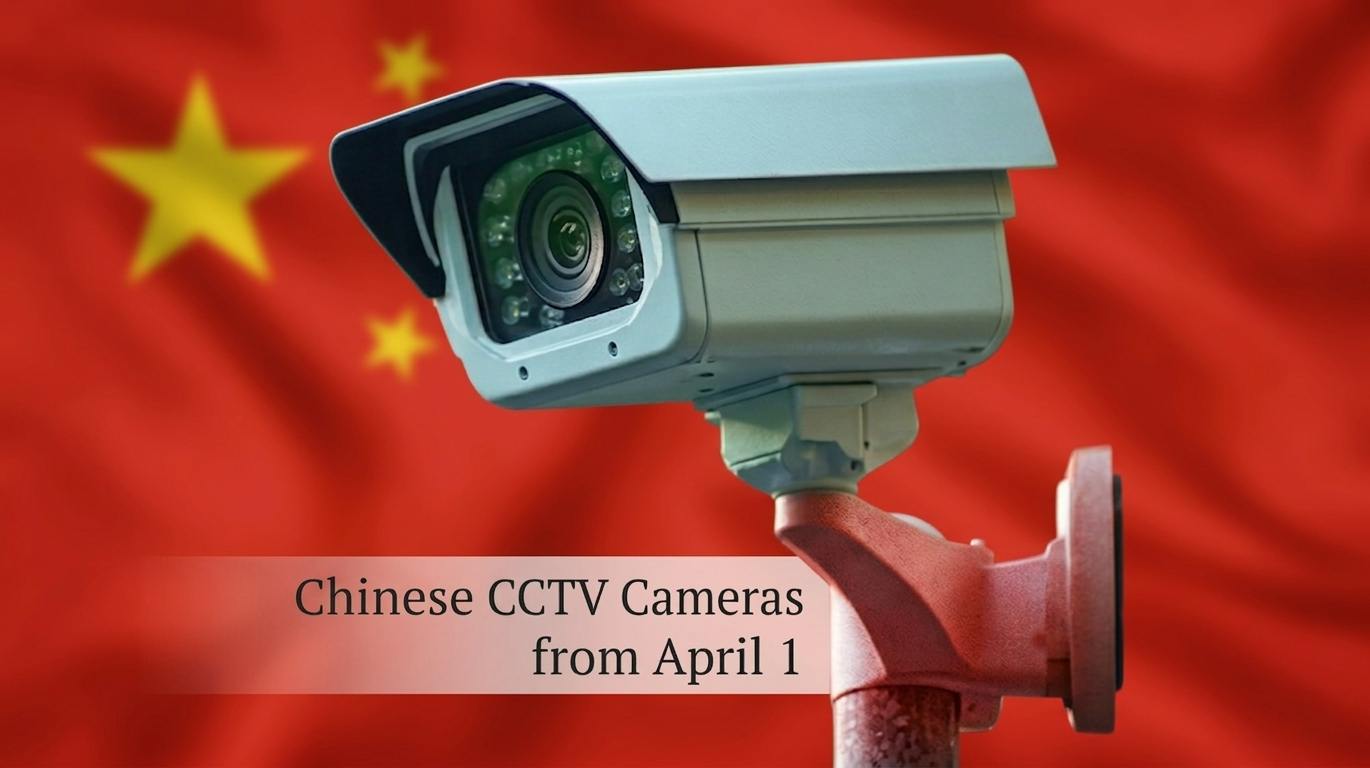
Banning Chinese CCTV Cameras from April 1: As the clock strikes midnight on April 1, 2026, the Indian surveillance landscape will undergo its most radical transformation in decades. In a decisive move to bolster national security and digital sovereignty, the Indian government is effectively pulling the plug on Chinese-made internet-connected CCTV cameras. This isn’t just a regulatory tweak; it is a fundamental restructuring of who watches over India.
1. The Death Knell for “Made in China” Surveillance
For years, Chinese giants like Hikvision and Dahua dominated Indian streets, offices, and homes. Known for their aggressive pricing and advanced features, they once commanded nearly one-third of the total market share. However, as of April 1, these brands will be effectively barred from selling any internet-connected (IP) cameras in India.
The reason is a new, iron-clad mandate: Standardisation Testing and Quality Certification (STQC). Under these rules, any surveillance device that connects to the web must receive a security clearance. The catch? Authorities are systematically refusing certification to products containing Chinese-origin components, specifically targeting chipsets and firmware.
2. Decoding the New Rules: Security over Savings
The STQC framework is designed to eliminate “backdoor” vulnerabilities. The new regulations require manufacturers to be transparent in ways they never were before:
Component Disclosure: Companies must reveal the exact origin of every key component, from the silicon chip to the code in the firmware.
Cybersecurity Drills: Every device must pass rigorous tests to ensure it cannot be hijacked by foreign actors.
Anti-Remote Access Protections: The rules mandate that devices must be shielded against unauthorized remote access—a direct response to fears that data could be “phoned home” to servers in Beijing.
Because Chinese manufacturers rely on indigenous ecosystems that are now deemed high-risk by Indian security agencies, they find themselves in a regulatory stalemate.
3. The National Security Imperative
Why the sudden urgency? The Indian government views connected CCTV systems as more than just cameras; they are data endpoints.
In the modern era of “Gray Zone” warfare, a compromised camera system is a goldmine for intelligence. An internet-connected camera in a sensitive government building or a strategic private enterprise could theoretically be accessed remotely to map layouts, track personnel movements, or even serve as an entry point for larger cyberattacks on Indian infrastructure. By enforcing these rules, India is cutting the digital umbilical cord that linked its surveillance data to foreign entities.
4. The Two-Year Transition: A Quiet Revolution
This move didn’t happen overnight. The groundwork was laid in 2024 with the introduction of Essential Requirements (ER) norms. The government provided the industry with a two-year “grace period” to diversify supply chains.
While the public was largely unaware, the industry was in a frenzy. While global brands scrambled to audit their factories, domestic players saw an opening. That transition period has now expired, and the “soft landing” is over. From April 1, enforcement will be absolute.
5. The Rise of the “Desi” Giants
The most striking outcome of this policy is the meteoric rise of Indian brands. A market that was once a playground for foreign firms is now firmly in the hands of domestic players.
| Brand | Previous Market Share | Current Market Share (approx.) |
| CP Plus | 20–25% | 45–50% |
| Domestic Combined | ~50% | 80%+ |
Companies like CP Plus, Qubo, Prama, Matrix, and Sparsh have successfully pivoted. They have shifted their supply chains away from China, opting instead for Taiwanese chipsets and developing localized firmware that meets Indian security standards.
6. The Victims of the Shift: Hikvision and Dahua
The impact on Chinese leaders has been nothing short of catastrophic:
Hikvision: Once the undisputed market leader, it was recently denied certification for a massive manufacturing facility capable of producing 2 million cameras per month. To stay relevant, they are now desperately seeking joint ventures with Indian partners to “Indianize” their operations.
Dahua: Their business has reportedly contracted by 80%. They are now relegated to selling analog cameras—older technology that doesn’t require internet connectivity but is rapidly becoming obsolete in a world that demands “smart” features.
Smartphone Brands: Popular names like Xiaomi and Realme, which had ventured into the smart home camera segment, have largely exited the category after failing to meet the stringent STQC criteria.
7. The Cost of Security: Will Prices Rise?
There is no such thing as a free lunch in geopolitics. While the ban is a win for security, it comes at a financial cost to the consumer.
Industry analysts estimate a 15–20% increase in the Bill of Materials (BoM). Chinese chipsets were incredibly cheap due to massive state subsidies and scale. Replacing them with Taiwanese (like Ambarella or Novatek) or U.S. alternatives (like Qualcomm) is expensive.
Entry-Level Segment: Prices remain relatively stable due to high-volume local assembly.
Mid-to-High-End Segment: Businesses and government projects will see sharp price hikes as they transition to certified, high-performance hardware.
8. What Happens to Existing Users?
If you have a Chinese camera installed in your home or shop today, don’t panic. The government is not sending teams to rip cameras off your walls. Existing devices will continue to function.
However, the “long tail” of this ban will affect you in three ways:
Software Updates: As Chinese firms scale back Indian operations, firmware updates to fix bugs or new security holes may become rare.
After-Sales Service: Finding original spare parts for older Chinese models will become increasingly difficult.
Future Integration: If you want to expand your system, new cameras will likely be from different brands, potentially leading to compatibility headaches.
9. The High-End Vacuum: Bosch and Honeywell
While Indian brands have captured the “mass” market, the premium, high-security segment (used in airports, power plants, and data centers) is being carved up by Western giants like Bosch and Honeywell. These firms have long maintained non-Chinese supply chains, making them the natural choice for organizations where budget is secondary to absolute security.
10. Conclusion: India’s Sovereign Silicon Vision
The April 1 ban is a landmark moment in India’s journey toward Atmanirbhar Bharat (Self-Reliant India). By leveraging its massive market size, India has forced a “de-risking” of its surveillance infrastructure.
While the transition may be painful for some—marked by higher prices and the exit of familiar brands—the long-term goal is clear: an India where the eyes on the street are not only watching for safety but are also safe from foreign interference. As we move into 2026, the message to the global tech industry is loud and clear: Access to the Indian market now requires an Indian seal of trust.
Banning Chinese CCTV Cameras from April 1Quick Summary for Readers
The Date: April 1, 2026.
The Action: Ban on internet-connected CCTV cameras with Chinese chipsets/firmware.
The Reason: National security and data privacy concerns.
The Winners: Indian brands like CP Plus and Sparsh (now 80% of the market).
The Losers: Hikvision, Dahua, and small traders.
The Impact: 15-20% price hike in premium models; safer digital infrastructure.