
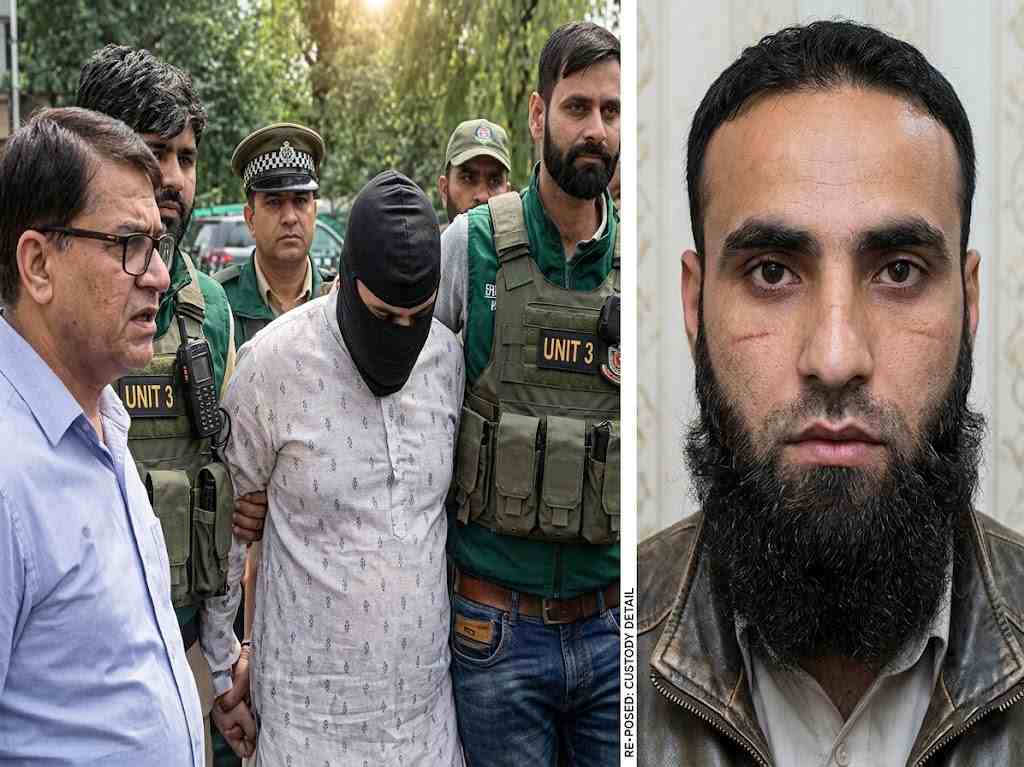
Delhi Police Special Cell Foils Major Terror Plot: In a high-stakes, late-night operation that has sent ripples through India’s internal security apparatus, the Delhi Police Special Cell has successfully apprehended one of the nation’s most wanted terror suspects: Shabbir Ahmed Lone. Arrested at the Ghazipur border area of the national capital, Lone is believed to be the mastermind behind a sophisticated, multi-national sleeper cell aimed at orchestrating large-scale terror attacks across India.
This arrest is not merely a routine pickup of a local radical; it is being hailed as a categorical strategic victory. Officials suggest that Lone was the linchpin of a plot that spanned three countries—Pakistan, Bangladesh, and India—and aimed to strike at the very heart of Indian democracy and its religious institutions.
The Arrest at Ghazipur: A Midnight Breakthrough
Delhi Police Special Cell Foils Major Terror Plot: The Rise and Fall of Shabbir Ahmed Lone: The Special Cell, acting on specific intelligence gathered over weeks of electronic and human surveillance, intercepted Shabbir Ahmed Lone as he attempted to move through the Ghazipur border. The timing was critical. Intelligence suggested that the group was in the final “activation” phase of their mission.
Upon his arrest, investigators recovered a cache of incriminating evidence that points toward a deep-rooted international conspiracy. The recovery of multiple foreign currencies, including Bangladeshi Taka, Pakistani Rupees, and Nepalese currency, provides a paper trail of Lone’s recent movements and his financial backing from handlers across the border.
Unmasking the International Network
Delhi Police Special Cell Foils Major Terror Plot: The Rise and Fall of Shabbir Ahmed Lone: The investigation into Lone has revealed a chilling blueprint of how modern proxy warfare is being conducted against India. Lone was not a “lone wolf”; he was an asset of Pakistan’s intelligence agency, the ISI.
The Training Pipeline
Reports indicate that Lone had undergone rigorous terror training sessions on Pakistani soil. However, instead of returning directly to India—where he was already a known figure to security agencies—he was diverted to Bangladesh.
The Recruitment Strategy
In Bangladesh, Lone’s mission was to build a fresh, “clean” cell that would not immediately pop up on the radar of Indian intelligence. He successfully:
- Recruited seven Bangladeshi nationals, radicalizing them and providing tactical training.
- Infiltrated the Indian border through the porous stretches of West Bengal.
- Integrated an Indian accomplice to provide local logistics, bringing the core operative group to eight members.
The Supreme Court Connection: How the Plot Unraveled
The first sign of this coordinated effort appeared on February 8, 2026. Residents and security personnel near the Supreme Court Metro Station and Janpath in New Delhi were shocked to find inflammatory, anti-India and pro-Pakistan posters plastered in high-security zones.
While initially viewed as an act of vandalism, the Special Cell recognized it as a “stress test” of Delhi’s security or a psychological operation (PsyOps) intended to precede a physical attack. This triggered a massive pan-India investigation:
- Kolkata Leads: Two suspects were detained in West Bengal, providing the first link to the Bangladeshi recruits.
- Tamil Nadu Crackdown: Six more operatives were apprehended in the southern state.
- The Mastermind Identified: Under sustained interrogation, these ten detainees independently pointed toward a single commander: Shabbir Ahmed Lone.
A History of Extremism: The Failure of the Bail System
One of the most concerning aspects of the Shabbir Ahmed Lone case is his extensive criminal history. This was not his first encounter with the law, raising serious questions about how repeat offenders in terror cases manage to slip through the cracks of the judicial system.
A Timeline of Terror:
- 2015: Lone was first arrested alongside an associate. While his partner managed to flee to Pakistan and join the notorious group The Resistance Front (TRF), Lone was eventually released.
- 2017: Lone was caught in Srinagar in possession of an AK-47 rifle and multiple hand grenades. Despite the gravity of these charges, he was again granted bail.
- The Bangladesh Shift: Following his release on bail, Lone vanished from the Kashmir Valley, resurfacing in Bangladesh to rebuild the ISI-backed network that led to his current arrest in Delhi.
“The fact that a man caught with an AK-47 in 2017 was free to coordinate an international terror cell in 2026 is a wake-up call for our legal framework regarding national security,” noted a senior security analyst.
Safe Havens and Surveillance: The Shaheen Bagh Connection
Investigations have further revealed that Lone was no stranger to Delhi. He had visited the capital multiple times over the last year, often staying in the Shaheen Bagh area. He reportedly used this densely populated neighborhood as a logistical base to conduct reconnaissance on “sensitive locations.”
Primary Targets Included:
- Major religious sites during peak festival seasons.
- High-traffic government installations.
- Public transport hubs to maximize civilian casualties.
The Special Cell believes that by staying in Shaheen Bagh, Lone hoped to blend into the urban sprawl, making it difficult for agencies to track his meetings with the other eight operatives who had infiltrated from West Bengal.
A Major Disaster Averted
Security experts draw parallels between the intended plot and the tragic events of the past. The level of coordination—multiple foreign nationals, local logistics, and ISI funding—suggests a plan for a Fidayeen-style attack or coordinated bombings.
The timely intervention by the Delhi Police has dismantled the “brain” of this operation. Without Lone’s leadership and the financial resources found on him, the remaining elements of the cell are effectively neutralized. However, the hunt continues for any remaining sleeper cells that may have been inspired or funded by this network.
The Road Ahead: Calls for Stricter Legislation
With the arrest of Lone, there is a mounting public and political demand for a re-evaluation of how terror suspects are handled by the courts. There is a strong push for the National Investigation Agency (NIA) to take over the formal prosecution to ensure a watertight case.
The recurring theme of “arrest-bail-reoffend” in Lone’s life has led to calls for:
- Special Courts for expedited terror trials.
- Strict No-Bail Clauses for individuals caught with prohibited military-grade weaponry.
- Enhanced Monitoring of individuals previously linked to cross-border agencies.
Saluting the Unsung Heroes
As the city of Delhi sleeps safely today, it is due to the tireless work of the Special Cell and central intelligence agencies. These officers often work for months in the shadows, tracking digital footprints and navigating dangerous border zones to prevent a single day of tragedy.
The successful apprehension of Shabbir Ahmed Lone is a testament to the “Zero Tolerance” policy against terrorism. It sends a clear message to handlers across the border: India’s security grid is tighter, more coordinated, and more vigilant than ever before.
As we move forward, this operation serves as a reminder that the price of freedom is eternal vigilance. The dismantling of this ISI-backed plot is a victory for every Indian citizen.
Key Takeaways from the Operation:
| Feature | Details |
| Main Accused | Shabbir Ahmed Lone |
| Affiliation | ISI (Pakistan), links to TRF |
| Arrest Location | Ghazipur Border, Delhi |
| Items Recovered | Foreign currency (Taka, PKR, Nepalese Rupees) |
| Scope of Plot | Recruitment in Bangladesh, infiltration via WB, targets in Delhi |
| Prior Records | Arrested in 2015 and 2017 (AK-47 recovery) |