
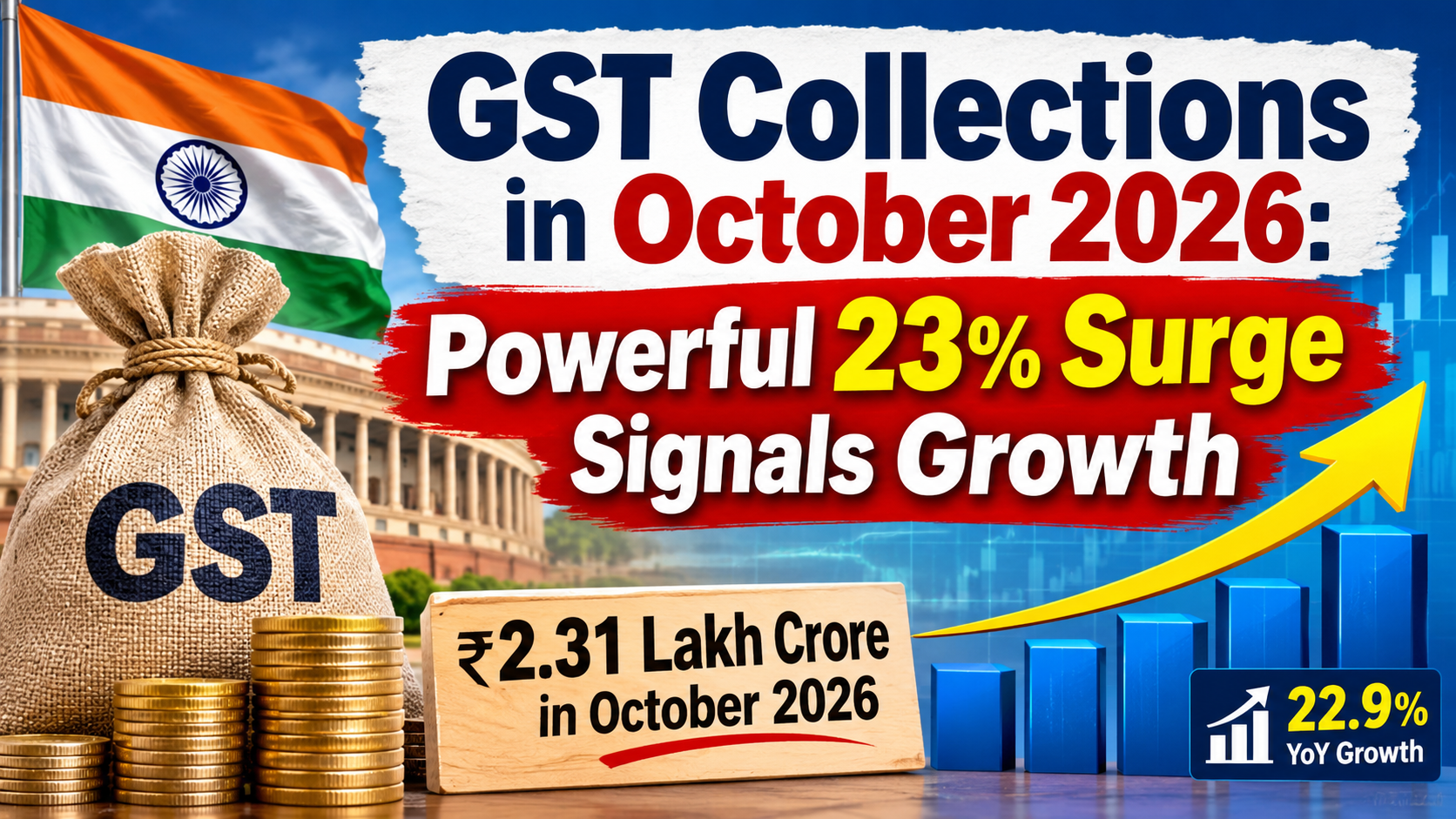
India’s GST Collections in October 2026 delivered a significant boost to the country’s indirect tax revenue, with gross collections rising 22.9% year-on-year to approximately ₹2.31 lakh crore. The latest figures, released on November 1, indicate a substantial improvement in tax revenue performance, supported by stronger import-related collections, domestic economic activity and improved tax compliance.
The October performance is particularly noteworthy because it represents the fastest year-on-year growth in GST collections in more than four years. It also marks the fourth consecutive month in which India’s monthly GST revenue has remained above the ₹2 lakh crore threshold.
The latest numbers suggest that India’s indirect tax collection system continues to generate strong revenue despite uncertainties in the international economic environment. However, the growth was not evenly distributed across different sources of revenue. Import-related GST collections recorded a much faster increase than domestic collections, making international trade an important contributor to October’s overall performance.
For businesses, policymakers, investors and economic observers, the latest GST figures offer useful insights into India’s consumption trends, trade activity and overall revenue position during the first seven months of FY27.
October GST Collection: Key Figures at a Glance
India’s October GST performance can be understood through the following important numbers:
- Total Gross GST Collection: ₹2.31 lakh crore.
- Year-on-Year Growth: 22.9%.
- Domestic GST Revenue: Approximately ₹1.59 lakh crore.
- Growth in Domestic Revenue: 15.8%.
- GST Revenue from Imports: ₹72,246 crore.
- Growth in Import Revenue: 42.2%.
- Net GST Collection: Approximately ₹2.03 lakh crore.
- Growth in Net Revenue: 25.6%.
- Total GST Refunds: ₹27,934 crore.
- April–October Gross GST Collection: ₹14.78 lakh crore.
- April–October Gross Revenue Growth: 13.2%.
These figures demonstrate that October was a particularly strong month for India’s indirect tax system. The 22.9% increase in gross collections also represents a considerable acceleration compared with the 14.7% growth recorded in September.
Why Did Indias GST Collections Increase So Sharply in October?
The main reason for Octobers performance was a rise in money collected from imports.
GST revenue from imported goods grew 42.2 percent year on year to ₹72,246 crore up from ₹50,796 crore in October 2025.
This means GST revenue from imports rose by more than 21,000 crore rupees compared with the month last year.
GST collections from imports can change because of things, such as how much imported goods are worth how much trade happens abroad movements in exchange rates shifts in product prices and the mix of imports.
A higher import revenue can show that import activity is stronger or that the value and mix of imported goods have changed.. This should not automatically mean that domestic manufacturing or buying is stronger.
Domestic GST collections also added to the good performance.
GST revenue from transactions grew about 15.8 percent to 1.59 lakh crore rupees up from about 1.37 lakh crore rupees in October 2025.
The gap between import growth rates matters. Domestic revenue kept growing at a speed but the much faster rise, in import GST collections gave a big extra lift to the total tax numbers.
Domestic GST Revenue Crosses ₹1.59 Lakh Crore
Domestic transactions remained the source of India’s GST revenue in October.
Collections from sales and economic activities increased to approximately ₹1.59 lakh crore registering growth of around 15.8 percent compared with the previous year.
This improvement suggests activity across several parts of the economy including retail trade, manufacturing, transportation, construction and services.
GST revenue is closely connected with economic transactions. When businesses report taxable sales and services the government’s indirect tax collections can increase.
However GST revenue growth should not be treated as a measure of GDP growth. Changes in tax compliance, refunds, inflation, product prices and the composition of activity can also influence the final numbers.
Nevertheless the October domestic collection figures provide an indication of revenue generation across India’s formal business economy.
For the government sustained GST growth is important because it supports regular revenue inflows and provides resources, for public expenditure, infrastructure development and other development programmes.
Import-Related GST Revenue Jumps 42.2%
One of the highlights of the October report was the exceptional growth in GST revenue from imports.
Import-related collections reached ₹72,246 crore representing an increase of 42.2% from ₹50,796 crore in October year.
This growth was considerably higher than the increase recorded in GST revenue.
There are reasons why import-related tax collections can rise faster than domestic collections.
First a rise in the value of imported products can increase the import base. Second higher international commodity prices may affect the value of goods entering India. Third changes in the quantity and composition of imported products can influence the tax collected.
Import GST revenue is also important because it reflects Indias participation in trade and the movement of taxable goods across its borders.
However the latest figures do not independently establish which individual products or sectors contributed most to the increase. A detailed commodity-wise breakdown would be required to identify the drivers.
The key takeaway is that imports played an important role, in strengthening Indias October GST performance.
Net GST Collections Reach ₹2.03 Lakh Crore
Apart from gross revenue, net GST collections also recorded strong growth during October.
After adjusting for refunds, the government’s net GST revenue increased 25.6% year-on-year to approximately ₹2.03 lakh crore, compared with around ₹1.62 lakh crore in October 2025.
The distinction between gross and net GST revenue is important.
Gross GST collections represent the total tax revenue collected before refunds are deducted. Net GST collections provide a clearer picture of the revenue remaining after refunds are adjusted.
During October, total GST refunds increased 6.5% to ₹27,934 crore.
The comparatively slower growth in refunds, against the much faster increase in gross collections, contributed to the stronger growth in net revenue.
Refunds are an important part of the GST framework, particularly for exporters and businesses that accumulate eligible input tax credits. Timely refunds help businesses maintain working capital and reduce the possibility of tax-related financial pressure.
Therefore, a healthy GST system requires not only strong revenue collections but also an efficient refund mechanism.
Central GST, State GST and Integrated GST: Revenue Breakdown
October’s overall GST collections included revenue from different components of the indirect tax system.
The reported figures were:
- Central GST (CGST): ₹42,935 crore.
- State GST (SGST): ₹51,340 crore.
- Integrated GST (IGST): More than ₹1.37 lakh crore.
CGST represents the central government’s share of tax collected on eligible intra-state transactions.
SGST represents the corresponding state government’s share of GST collected on intra-state supplies.
IGST applies to inter-state supplies and imports, with revenue subsequently distributed according to the applicable GST settlement mechanism.
The relatively large IGST component is consistent with the strong contribution from import-related collections during October.
These different components are essential to understanding how GST revenue is distributed across India’s federal tax structure.
It is also important to remember that the components should not be interpreted as separate additional revenue streams beyond the reported gross GST total. They form part of the overall GST collection framework.
Maharashtra Remains India’s Largest State Contributor
Among the major states, Maharashtra continued to hold the leading position in domestic GST collections during October.
The state recorded GST revenue of ₹35,150 crore, representing an increase of approximately 13% compared with the corresponding period last year.
Maharashtra’s position reflects its large and diversified economic base, which includes manufacturing, financial services, wholesale and retail trade, logistics and other commercial activities.
Several other major states also recorded encouraging growth.
State-Wise GST Collection Performance in October 2026
1. Maharashtra
Maharashtra collected ₹35,150 crore, registering 13% growth year-on-year. It remained the largest contributor among the states covered in the reported figures.
2. Karnataka
Karnataka recorded collections of ₹15,922 crore, representing an increase of 18%. The state’s technology, manufacturing, services and commercial sectors contribute to its substantial tax base.
3. Gujarat
Gujarat generated ₹13,516 crore in GST revenue, up 16% year-on-year. Its industrial, manufacturing, trading and port-related activities form important parts of its economic structure.
4. Uttar Pradesh
Uttar Pradesh recorded GST collections of ₹10,235 crore, registering growth of 24%. This was stronger than the growth recorded by several other major states.
5. Delhi
Delhi’s GST collections reached ₹9,298 crore, reflecting a 10% increase compared with October last year.
6. Assam
Assam recorded one of the strongest increases among the states mentioned in the report. Its collections rose 47% to ₹1,934 crore.
7. Jharkhand
Jharkhand registered 31% growth in GST revenue, indicating a substantial improvement in collections compared with the previous year.
8. Madhya Pradesh
Madhya Pradesh recorded 29% growth, making it another state with a strong year-on-year improvement.
The state-wise performance shows that GST revenue growth was not limited to India’s largest industrial and commercial centres. Several other states also reported significant increases.
Not every state saw GST growth.
While the national GST numbers looked good the gains were not the same in all states.
Tamil Nadu had a growth of 3% with GST collections reaching ₹11,661 crore.
At the time Himachal Pradesh saw a 2% drop in GST collections.
These differences are common. GST revenue at the state level depends on factors.
These factors include the kind of industries in the state how big the taxable business activity’s how much people are buying how much is being made how much is being imported and when taxes are paid.
A state with a manufacturing or service sector may see different results, than a state that relies more on farming, tourism or small businesses.
So national GST growth must always be looked at with state-level performance. This helps give a view of the overall economy.
GST Revenue Growth Accelerates After September
Another important development is the improvement in India’s monthly GST growth trend.
The reported year-on-year growth rates during recent months were:
- June 2026: 13.9%.
- July 2026: 15.4%.
- August 2026: 14.3%.
- September 2026: 14.7%.
- October 2026: 22.9%.
October’s performance represents a significant acceleration compared with the preceding months.
The increase from September’s 14.7% growth to October’s 22.9% indicates stronger year-on-year revenue momentum.
However, monthly comparisons should be interpreted carefully. GST collections can fluctuate because of payment schedules, seasonal demand, import activity and differences in the previous year’s comparison base.
Even with these considerations, the October figures stand out because they represent the strongest growth in more than four years, according to the reported data.
April–October FY27 GST Collections Reach ₹14.78 Lakh Crore
Beyond the figures Indias cumulative GST revenue for the first seven months of FY27 stayed strong.
From April to October 2026 gross GST collections were ₹14.78 lakh crore, up from ₹13.05 lakh crore in the same period last year.
GST collections increased by 13.2%.
Net GST collections were ₹12.69 lakh crore, up by about 12.6% compared to last year.
Cumulative figures matter a lot because they show a view of revenue performance not just month‑to‑month swings.
For the government steady growth in GST collections gives revenue visibility and helps with financial planning.
For businesses these numbers show the scale of economic activity in the country.
The gap between net collections shows why it is important to monitor tax refunds as well, as overall revenue.
October GST Collection Is the Second-Highest in FY27
October’s gross GST collection of ₹2.31 lakh crore was the second‑highest collection recorded during the current financial year up to October.
April 2026 remained the month with collections reaching approximately ₹2.43 lakh crore.
The fact that October collections crossed ₹2.30 lakh crore again is significant because it indicates that India’s tax revenue performance has remained strong, beyond the beginning of the year.
Furthermore GST collections have remained above ₹2 lakh crore for four months.
This consistency is important because a strong monthly revenue number can sometimes be influenced by factors. A sustained period of collections provides a broader indication of the strength of tax revenue generation.
Nevertheless the sustainability of this trend will depend on demand, trade activity, business profitability, compliance levels and broader economic conditions.
What Do Higher GST Collections Mean for the Indian Economy?
Higher GST collections can have several implications for India’s economic environment.
1. Stronger Government Revenue
GST is one of India’s major sources of indirect tax revenue. Higher collections can improve the government’s revenue position and provide additional fiscal flexibility.
This can support spending on infrastructure, public services and development-related programmes, subject to overall budgetary priorities.
2. Better Visibility of Formal Economic Activity
GST reporting provides information about taxable transactions across different industries.
An increase in collections may indicate stronger reported business activity, improved compliance or a combination of both.
This makes GST data a useful indicator for understanding developments in the formal economy.
3. Positive Signals for Businesses
Rising domestic GST revenue can be encouraging for companies operating in manufacturing, retail, logistics and services.
However, the impact will vary between sectors, and tax collection growth alone does not establish that every industry is experiencing stronger demand.
4. Improved Revenue Position for States
GST revenue is important for both central and state governments.
Sustained growth can strengthen the overall tax revenue pool and support the fiscal position of states through the GST distribution and settlement framework.
5. Stronger Compliance Environment
Improvements in digital invoicing, return filing, data matching and tax administration can contribute to better GST compliance.
As more transactions enter the formal reporting system, the government may be able to improve revenue collection without depending entirely on higher tax rates.
Will GST Collections Remain Above ₹2 Lakh Crore in the Coming Months?
The October figures give a starting point for assessing Indias GST revenue outlook for the remaining months of FY27.
The festive season continued commercial activity and international trade could support revenue generation in the coming period.
However it would be premature to assume that every subsequent month will automatically record the growth rate.
Several factors will influence GST collections.
These include consumption, industrial production, import demand, global commodity prices the performance of major industries and changes in compliance patterns.
The comparison base from the year will also matter when calculating year‑on‑year growth.
As highlighted by Saurabh Agarwal, Partner, at EY India festive‑season demand could help maintain revenue momentum. Businesses should also focus on compliance and reconciliation processes to ensure that the benefits of stronger economic activity are sustained.
The coming months will provide an indication of whether Octobers acceleration represents a sustained improvement or a temporary increase influenced by import‑related revenue.
What Should Businesses and Investors Watch Next?
The latest GST figures offer several indicators worth monitoring over the coming months.
Domestic GST growth: Businesses and analysts should watch whether domestic collections maintain growth in the mid-teens or accelerate further.
Import-related revenue: The 42.2% increase in import collections was a major contributor to October’s performance. Future figures will help establish whether this trend continues.
GST refunds: A stable and efficient refund process remains important for exporters and businesses that regularly claim input tax credits.
State-level performance: The growth recorded by Uttar Pradesh, Assam, Jharkhand and Madhya Pradesh deserves attention, while the relatively slower performance of Tamil Nadu and Himachal Pradesh highlights regional differences.
Cumulative FY27 revenue: The April–October growth rate of 13.2% provides a useful benchmark for assessing the government’s indirect tax revenue trajectory.
For investors, GST figures can be one of several indicators used to assess business activity and the broader economic environment. They should not be considered a standalone indicator for making investment decisions.
October GST Numbers Highlight Strong Revenue Momentum
India’s GST collections in October 2026 delivered an impressive performance, with gross revenue rising 22.9% to ₹2.31 lakh crore. The increase was driven primarily by a sharp 42.2% rise in import-related revenue, while domestic GST collections also recorded healthy growth of approximately 15.8%.
Net collections increased 25.6% to around ₹2.03 lakh crore, and cumulative gross collections during April–October reached ₹14.78 lakh crore.
Maharashtra remained the largest state contributor, while Uttar Pradesh, Assam, Jharkhand and Madhya Pradesh recorded particularly strong growth rates.
The latest figures indicate continued strength in India’s indirect tax revenue system and an improvement in monthly collection momentum. However, the difference between domestic and import growth rates, along with uneven state-level performance, will remain important factors to monitor.
Ultimately, the next few months will determine whether October’s exceptional growth can translate into a sustained revenue trend for the remainder of FY27.
For now, the October GST report offers an encouraging picture of India’s revenue performance, with collections remaining above ₹2 lakh crore for the fourth consecutive month.