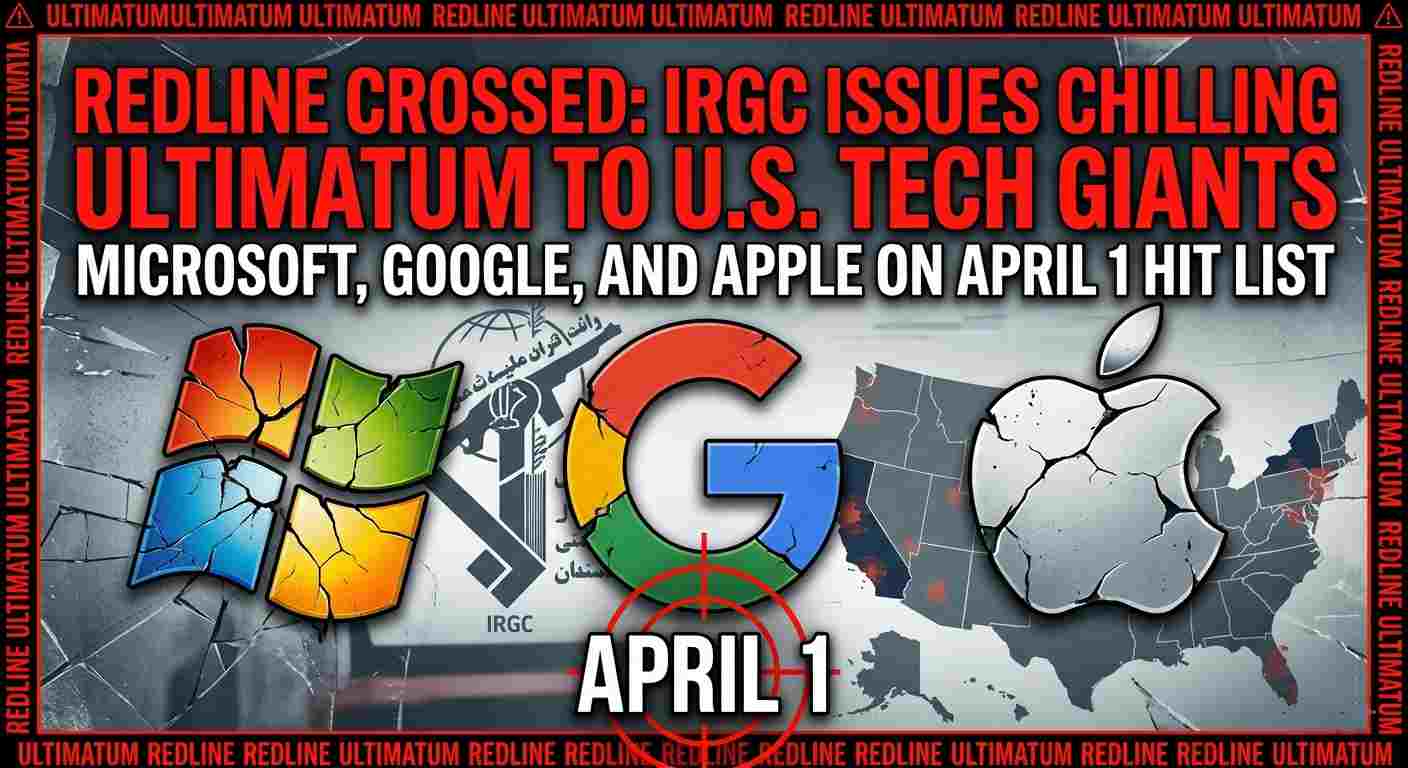
Redline Crossed: IRGC Issues Chilling Ultimatum to U.S. Tech Giants; Microsoft, Google, and Apple on April 1 Hit ListIn a massive escalation of the ongoing conflict in West Asia, the Islamic Revolutionary Guard Corps (IRGC) has issued a definitive and terrifying ultimatum to the titans of American industry. Starting April 1, 2026, Iran’s elite military wing has declared that it will begin targeting the regional units and infrastructure of 18 major U.S. corporations, including Microsoft, Google, and Apple, in direct retaliation for “targeted assassinations” of Iranian leadership.
The announcement, released through state-run media outlets like IRNA and Tasnim, marks a fundamental shift in Tehran’s war strategy. By moving beyond traditional military targets and focusing on the economic and technological engines of the United States, Iran is signaling a “total war” footing that threatens to dismantle the commercial fabric of the Gulf region.
The “Hit List”: 18 Companies in the Crosshairs
Redline Crossed: IRGC Issues Chilling Ultimatum to U.S. Tech Giants; Microsoft, Google, and Apple on April 1 Hit List : The IRGC’s statement was surgical in its naming of targets. The list of 18 companies represents the backbone of American technological and industrial might. According to the IRGC, these institutions are no longer viewed as mere commercial entities but as “legitimate military targets” due to their alleged role in supporting U.S. and Israeli intelligence operations.
The Featured “List of 18” Includes:
- Big Tech: Apple, Microsoft, Google (Alphabet), Meta Platforms (Facebook, WhatsApp, Instagram).
- Hardware & Infrastructure: Dell Technologies, Hewlett Packard (HP), Cisco, Intel, IBM, Oracle.
- Finance & Industry: JPMorgan Chase, General Electric (GE), Boeing.
- Automotive & Innovation: Tesla.
The IRGC was explicit about the consequences: “These companies should expect the destruction of their respective units in exchange for each terror act in Iran.” ### The April 1 Deadline The threat comes with a specific “zero hour.” The operations are scheduled to commence at 8:00 PM Tehran time on Wednesday, April 1. For global markets and employees, the conversion of this timeline is critical:
- Tehran: 8:00 PM
- GMT/UTC: 4:30 PM
- India (IST): 10:30 PM
In an ominous warning to civilians, the IRGC added: “We advise the employees of these institutions to immediately leave their workplaces to preserve their lives.”
The AI Connection: Why Tech is the New Frontline
Redline Crossed: IRGC Issues Chilling Ultimatum to U.S. Tech Giants; Microsoft, Google, and Apple on April 1 Hit List : The IRGC’s justification for targeting Silicon Valley icons like OpenAI, Anthropic, Google, and Microsoft centers on the evolution of modern warfare. The Iranian military leadership argues that Information and Communication Technology (ICT) and Artificial Intelligence (AI) are the primary tools used by the U.S. and Israel to track and eliminate Iranian officials.
The IRGC’s statement stressed that AI companies have transitioned from being vendors to active participants in “designing and tracking targets.” This refers to the “Kill Chain”—the process of identifying, tracking, and striking a target—which has been significantly shortened by AI algorithms.
How AI Fuels the Conflict
- Pattern Recognition: AI processes vast amounts of satellite imagery and intercepted communications to spot anomalies in the movement of high-value targets.
- Autonomous Systems: Tech companies provide the cloud infrastructure and algorithmic frameworks that power unmanned drones.
- Predictive Analysis: Algorithms can flag potential targets based on historical behavior and real-time data analysis.
By targeting these firms, Iran aims to strike at the “brains” of the American military machine, arguing that without the data centers and software provided by these 18 companies, the U.S. would lose its precision-strike capability.
The Catalyst: Assassination of Jamshid Eshaghi
This ultimatum follows the confirmed killing of another high-ranking Iranian official earlier on Tuesday. The IRGC confirmed the death of Brigadier General Jamshid Eshaghi, the head of budget and financial affairs at Iran’s armed forces general staff.
Eshaghi was a pivotal figure in Tehran’s financial network. In February 2025, the U.S. Treasury sanctioned him for orchestrating an international network that shipped millions of barrels of Iranian crude oil to China. The profits from these sales—estimated in the hundreds of millions of dollars—were allegedly used to fund regional proxies, including:
- Hezbollah in Lebanon
- Hamas in Gaza
- Houthis in Yemen
Eshaghi was reportedly killed alongside members of his family in a joint U.S.-Israeli airstrike. His death follows a catastrophic string of losses for the Iranian regime, beginning with the death of Supreme Leader Ali Khamenei on the first day of the war (February 28, 2026) and security chief Ali Larijani earlier this month.
Regional Impact: Dubai and Abu Dhabi at Risk
The threat poses an immediate and existential danger to the economic hubs of the United Arab Emirates (UAE). Both Microsoft and Apple maintain a massive corporate and retail footprint in Dubai and Abu Dhabi.
The UAE has spent decades positioning itself as a safe, neutral ground for global commerce. If the IRGC follows through on its threat to destroy “units” of these companies, the skyscrapers of the Burj Khalifa district and the tech hubs of Abu Dhabi could become the next theaters of war. This would not only result in a humanitarian crisis but would likely trigger a total collapse of the regional insurance and shipping markets.
Global Economic Fallout: A Summary of Risks
If the IRGC’s “April 1” deadline holds, the global economy faces a multifaceted disaster. The targeting of these 18 firms represents a direct hit on the world’s most valuable stocks.
| Company Sector | Potential Impact of Targeting |
| Financial (JPMorgan) | Disruption of regional petrodollar recycling and trade finance. |
| Logistics (Boeing/GE) | Paralysis of regional aviation; threat to commercial air travel. |
| Tech (Google/Microsoft) | Massive data breaches; disruption of cloud services across West Asia. |
| Energy (Tesla/GE) | Targeting of sustainable energy and power grid infrastructure. |
Conclusion: A Precarious Countdown
While the IRGC has made similar threats in the past, the inclusion of a specific deadline and a detailed list of private-sector targets gives this warning unprecedented weight. Analysts suggest that Iran is attempting to leverage the “economic pain” of American voters and shareholders to force a ceasefire.
However, by targeting civilian workplaces and global tech pioneers, Iran risks a massive counter-escalation that could draw the U.S. deeper into the conflict. As the clock ticks toward 8 PM Tehran time on April 1, the world waits to see if this is a desperate bluff or the beginning of a devastating new chapter in kinetic and cyber warfare.