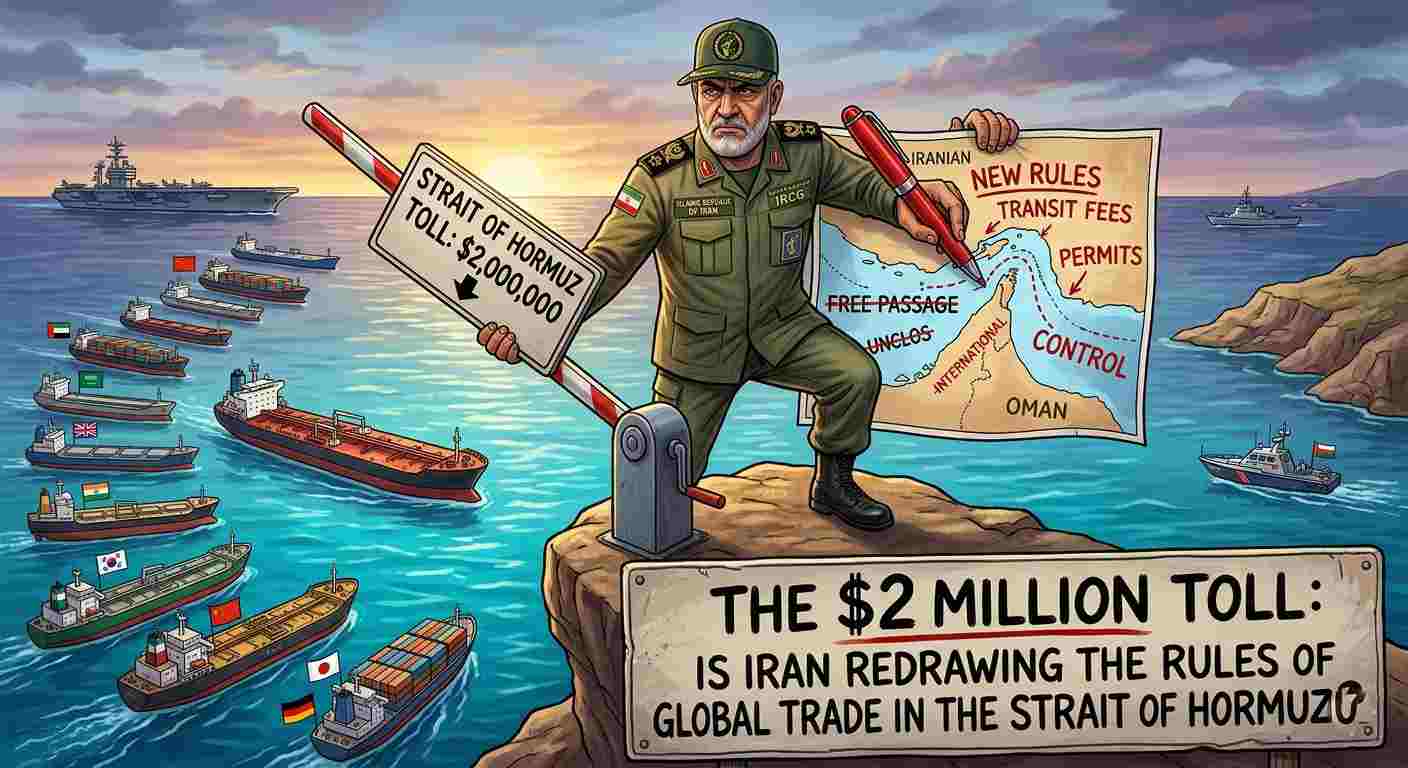
TEHRAN —The $2 Million Toll Is Iran: The ripples of the recent conflict between Iran, Israel, and the United States have reached a new, high-stakes shore. As a fragile ceasefire begins to take hold, the conversation has shifted from missile trajectories to maritime tolls. Tehran has floated a radical proposal: a “Pay to Pass” system for the Strait of Hormuz.
The proposal, which includes a reported $2 million fee per vessel, has sent shockwaves through the global energy sector and sparked a fierce debate over international maritime law. Is Iran simply seeking funds for post-war reconstruction, or is it attempting a fundamental power grab over the world’s most vital energy chokepoint?
The Proposal: A ‘Controlled Transit’ System
The $2 Million Toll Is Iran: Redrawing the Rules of Global Trade in the Strait of Hormuz?
According to reports emerging from Tehran, the Iranian Parliament has approved a draft bill to formalize a toll for ships traversing the Strait of Hormuz. This “controlled transit” system would be coordinated by the Iranian armed forces, requiring ships to obtain permits and licenses to pass.
Kazem Gharibabadi, Iran’s Deputy Foreign Minister, framed the move as an effort to “facilitate rather than restrict transit,” suggesting a partnership with Oman to oversee the waterway. However, the details remain opaque. The proposed fee would reportedly vary based on:
The type of vessel (tanker, container, or cargo).
The nature of the cargo being transported.
Prevailing conditions (a vague term that many fear allows for political leverage).
For a country reeling from weeks of US and Israeli strikes, the revenue—estimated in the billions annually—is intended to fund the massive rebuilding effort required to restore national infrastructure.
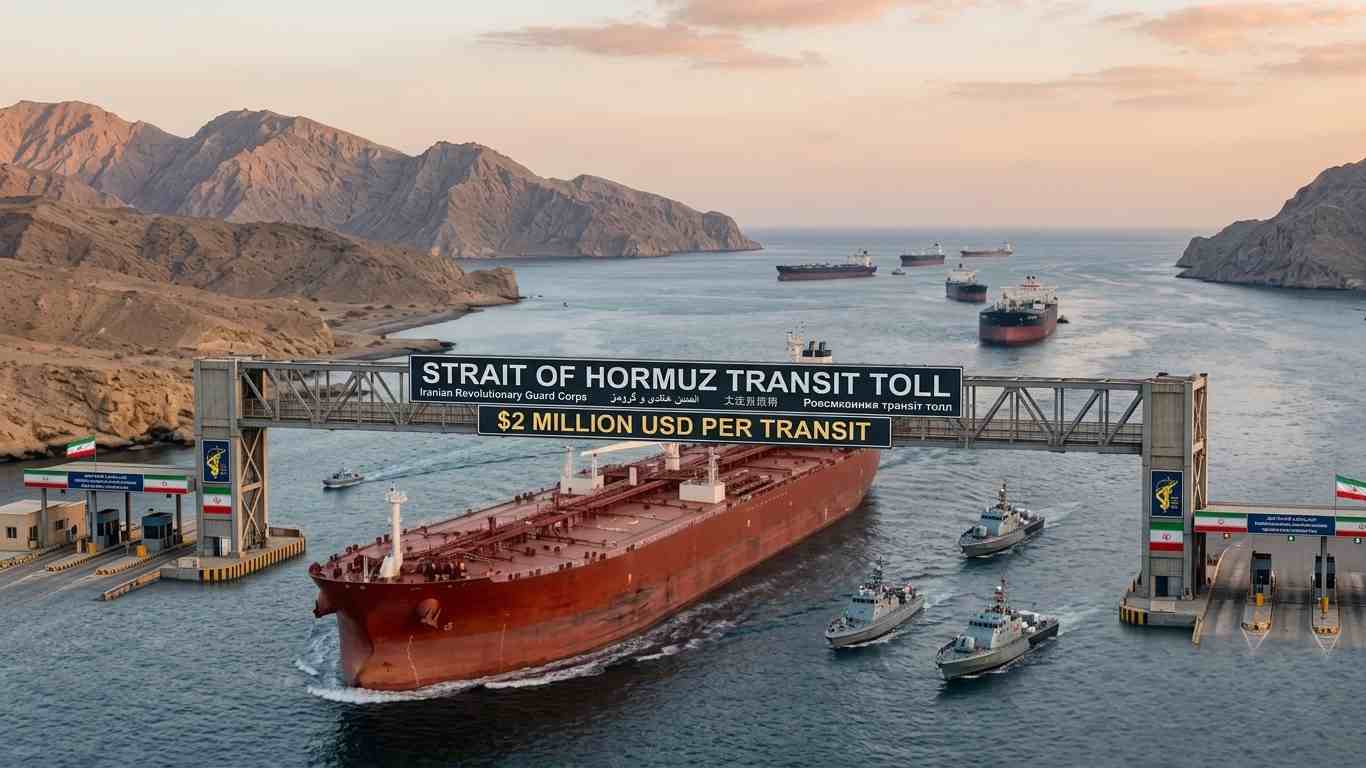
Why the Strait of Hormuz Matters
To understand the gravity of this move, one must look at the geography of the region. The Strait of Hormuz is a narrow strip of water, just 34 km (21 miles) wide at its narrowest point, separating Iran and Oman. It is the only sea passage from the Persian Gulf to the open ocean.
The Global Impact by the Numbers:
20% of Global Oil: Roughly one-fifth of the world’s total oil consumption passes through this corridor daily.
Vital Goods: Beyond oil, the strait is a primary route for liquefied natural gas (LNG) and fertilizers, essential for global food security.
Strategic Chokepoint: Unlike other routes, there are no easy “workarounds.” While pipelines exist, they cannot match the sheer volume of tanker traffic.
The Legal Battlefield: UNCLOS vs. Sovereignty
The central question facing international lawyers is simple: Is this legal?
The short answer, according to the United Nations Convention on the Law of the Sea (UNCLOS), is a resounding no. Here is why Iran’s proposal clashes with established international norms:
1. Natural vs. Man-Made Waterways
Proponents of the toll often point to the Suez Canal or the Panama Canal as precedents. However, legal experts note a critical distinction. The Suez and Panama canals are man-made. Egypt and Panama spent billions to dig and maintain these channels; therefore, they have the right to charge for their “service.”
The Strait of Hormuz is a natural international strait. Under UNCLOS, such waterways are subject to the right of “transit passage,” which must be continuous, expeditious, and—most importantly—unimpeded.
2. Article 26 of UNCLOS
This specific article explicitly prohibits coastal states from charging fees for “simple passage.” A country can only levy charges if it provides a specific service, such as:
Pilotage (navigating the ship through tricky waters).
Towing services.
Port assistance.
Charging a $2 million fee just for the “right” to exist in the water would be a direct violation of this treaty.
International Backlash and the Trump Factor
The global community has reacted with predictable alarm. US President Donald Trump has been vocal, stating that the free flow of oil must be a non-negotiable pillar of any permanent peace deal. “Free traffic… must be part of any deal,” Trump noted, signaling that the US might be willing to return to military action if the waterway remains obstructed by “financial barriers.”
The Gulf States, whose economies depend entirely on these exports, are equally concerned. The United Arab Emirates (UAE) issued a stern reminder that the waterway “cannot be held hostage by any country,” while Qatar insisted that financial discussions must be tabled until the route is fully reopened and stabilized.
“No such unilateral move to demand fees to traverse a strait has been made in modern history.” — Shipping Industry Official.
The China Wildcard
While the West leans on legal frameworks and military threats, the true power player might be Beijing. China is the world’s largest importer of energy passing through the Strait and maintains a complex, strategic relationship with Iran.
If Iran enforces a toll that hurts Chinese bottom lines, Tehran risks alienating its most significant economic ally. However, if China negotiates a “preferred rate” or an exemption, it could effectively validate Iran’s control over the strait, creating a two-tier global shipping system that favors Eastern powers over Western ones.
Practical Challenges: Can Iran Actually Enforce This?
Even if the law is passed in Tehran, enforcement is a logistical nightmare.
Shared Waters: The shipping lanes in the Strait actually pass through both Iranian and Omani territorial waters. For Iran to collect a toll, it would need the total cooperation of Oman—a country that has traditionally acted as a neutral mediator and is unlikely to support a move that invites global military intervention.
Military Escalation: Any attempt to board or block a ship for non-payment would likely trigger “Freedom of Navigation” operations by the US Navy and its allies.
Market Volatility: The mere mention of a toll has caused insurance premiums for tankers to skyrocket. If implemented, the cost of oil would likely spike globally, potentially triggering a global recession that would hurt Iran’s own trading partners.
Economic Policy or Strategic Ploy?
Most maritime analysts believe the “Pay to Pass” proposal is less about the $2 million and more about leverage. By putting a price tag on the Strait, Iran is:
Testing the Ceasefire: Seeing how far the US and Israel will go to maintain “peace.”
Setting a Barter Point: Offering to “drop the toll” in exchange for the lifting of economic sanctions.
Asserting Dominance: Reminding the world that while they may have been “pounded” by strikes, they still hold the key to the world’s gas tank.
Conclusion: A Dangerous Precedent
If Iran successfully imposes a toll on the Strait of Hormuz, it will fundamentally change the nature of international waters. It would transform a global common into a private toll road, setting a precedent that could be followed in other chokepoints like the Bab el-Mandeb or even the Strait of Malacca.
As the world watches the waters of the Gulf, the question remains: Will the international community defend the centuries-old principle of “Freedom of the Seas,” or will the cost of peace be a $2 million ticket to pass through the gates of the Indian Ocean?
For now, the Strait remains a “fragile corridor,” where the next move could either solidify a lasting peace or ignite the next phase of a global economic war.
Quick Look: Tolls in International Waterways
| Waterway | Type | Status | Fee Structure |
| Suez Canal | Man-made | Legal | Based on tonnage and ship type. |
| Panama Canal | Man-made | Legal | Based on TEU capacity or displacement. |
| Turkish Straits | Natural | Montreux Convention | Fees allowed only for services (sanitary, lighthouse). |
| Strait of Hormuz | Natural | UNCLOS | No general transit fees allowed. |
| Singapore Strait | Natural | UNCLOS | No transit fees. |