
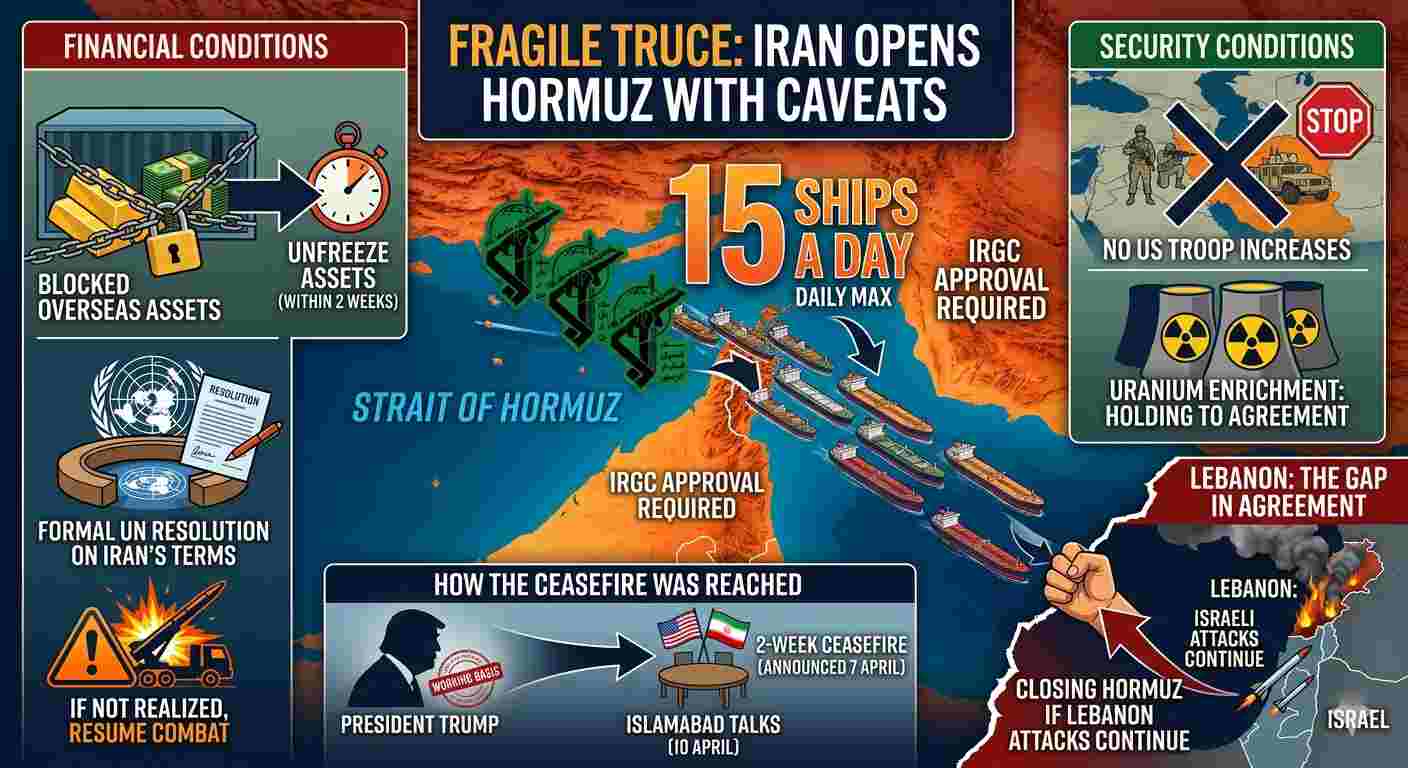
TEHRAN / ISLAMABAD —The 15-Ship Ceiling and Iran’s: The world’s most vital energy artery has a new, restrictive pulse. As a fragile two-week ceasefire between the United States and Iran takes hold, the Islamic Republic has officially set the terms for maritime traffic in the Strait of Hormuz. The headline figure—15 ships per day—represents a fraction of the waterway’s pre-war capacity, signaling that while the guns may be silent for now, the global economy remains in a chokehold.
This development comes as diplomats prepare to descend upon Islamabad on April 10 for high-stakes negotiations. However, the optimism surrounding President Trump’s recent announcement of a “working basis” for peace is being met with a cold reality: Tehran is not just demanding a pause in hostilities; it is demanding a total restructuring of the regional status quo.
The New Maritime Reality: 15 Ships and IRGC Oversight
A Fragile Calm: The 15-Ship Ceiling and Iran’s Hardline Demands in the Strait of Hormuz: Before the outbreak of conflict 40 days ago, the Strait of Hormuz was a bustling maritime highway, seeing upwards of 80 to 100 vessels daily. Under the new ceasefire protocols, that number has been slashed to just 15.
According to a senior Iranian source speaking to the Russian news agency TASS, this limit is non-negotiable and marks the end of “business as usual.”
The Protocol of Control
The passage of these 15 vessels is far from guaranteed. Each transit now requires:
- Explicit IRGC Approval: The Islamic Revolutionary Guard Corps (IRGC) has been given full regulatory authority over the waterway.
- Strict Protocol Compliance: Vessels must adhere to a new, rigorous framework that has already been communicated to regional stakeholders.
- Selective Access: Sources indicate that the IRGC is prioritizing “non-hostile” nations, while vessels with even tangential links to the U.S. or Israel face significant hurdles.
“There will be no return to the pre-war status quo,” the Iranian official stated. For a waterway that handles roughly 20% of the world’s seaborne crude oil, this “regulated passage” is a clear signal that Tehran intends to use its geographic advantage as a permanent diplomatic lever.
The Financial Ultimatums: Assets and UN Resolutions
A Fragile Calm: The 15-Ship Ceiling and Iran’s Hardline Demands in the Strait of Hormuz : The ceasefire is currently tethered to a ticking clock. Tehran has made it clear that the current pause in strikes is contingent upon immediate financial concessions.
The Two-Week Deadline for Frozen Assets
Iran is demanding the unfreezing of its blocked overseas assets before the fourteen-day ceasefire expires. The Iranian source described the release of these funds—estimated to be in the tens of billions of dollars across various international accounts—as a “critical executive guarantee.”
If the funds are not released within this timeframe, the IRGC has warned that the “technical limitations” currently allowing 15 ships a day could easily tighten back into a total blockade.
The Security Council Requirement
Beyond the money, Tehran is seeking a formal “surrender” in the halls of the United Nations. They are insisting that the end of the war be codified through a UN Security Council resolution drafted on their terms. This includes:
- Formal Recognition: An official acknowledgement of the end of hostilities that validates Iran’s 10-point proposal.
- Sanctions Relief: Integrated language that begins the process of dismantling primary and secondary U.S. sanctions.
- Binding Status: Making the ceasefire terms a matter of international law, preventing a future U.S. administration from unilaterally withdrawing.
“If the termination of the war is not codified into a UN Security Council resolution based on our stipulated terms, we are fully prepared to resume combat against the US and the Zionist regime—with even greater intensity,” the Iranian source warned.
The “Civilization-Ending” Deadline: How We Got Here
The path to the Islamabad talks was paved with apocalyptic rhetoric. Just hours before his self-imposed “civilization-ending” deadline on April 7, President Trump pivoted toward diplomacy.
In a move that surprised both his critics and allies, Trump announced the ceasefire, describing Iran’s ten-point proposal as a “working basis” for negotiations. This pivot was largely credited to back-channel mediation by Pakistani Prime Minister Shehbaz Sharif and General Asim Munir, who urged Washington to trade military escalation for the reopening of the Strait.
However, while Trump has touted the ceasefire as a victory, the Iranian side views it as a “strategic retreat” by Washington. The upcoming Islamabad talks will be the first time the two sides meet face-to-face to determine if this “working basis” can actually be forged into a lasting peace.
The Lebanon Gap: A Truce on Life Support
The most immediate threat to the ceasefire is not the Strait or the assets, but a geographical “gap” in the agreement: Lebanon.
While Pakistan and Iran maintain that the truce is comprehensive, the U.S. and Israel have been vocal in their disagreement. The Israeli Prime Minister’s office has explicitly stated that Lebanon was never part of the ceasefire.
Continued Conflict in the North
Since the truce was announced, Israel has continued its strikes against Hezbollah targets in Lebanon. This has placed Tehran in a precarious position. Iran has warned that if Israel does not halt its operations in Lebanon, it will:
- Immediately close the Strait of Hormuz entirely.
- Resume missile strikes against Israel and other regional nations.
For Tehran, Lebanon is a “red line.” For Israel, the “Iranian war” and the “Hezbollah war” are two separate theaters, only one of which is currently paused. This disconnect makes the Islamabad summit on April 10 less of a victory lap and more of a desperate attempt to keep the regional conflict from restarting before it ever truly stopped.
Military Constraints: No US Troop Increases
Finally, the ceasefire carries a “no-growth” clause for the Pentagon. Iran has demanded that the U.S. freeze its military footprint in the Middle East for the duration of the two weeks.
In exchange, Tehran has offered a rare olive branch regarding its nuclear program. The Iranian source confirmed that they remain “strictly committed” to the text of the exchanged agreement regarding uranium enrichment, holding their levels steady as a show of good faith—or, perhaps, as a final piece of leverage to be traded in Islamabad.
The Road Ahead: April 10
As the world watches the 15 ships a day trickle through the Strait, all eyes are on Pakistan. The “Islamabad Protocol” will either be the beginning of a new Middle Eastern architecture or the final, quiet moment before a much larger storm.
Ceasefire Status Dashboard (April 2026)
| 🚢 Hormuz Traffic | 👮 Oversight | 💰 Financial Demand |
| Capped: 15 ships/day | IRGC Direct Supervision | Unfreeze: 14-day limit |
| Diplomatic Goal | Lebanon Status | U.S. Presence |
| UNSC Binding Resolution | Disputed (Strikes ongoing) | No Troop Increases |