
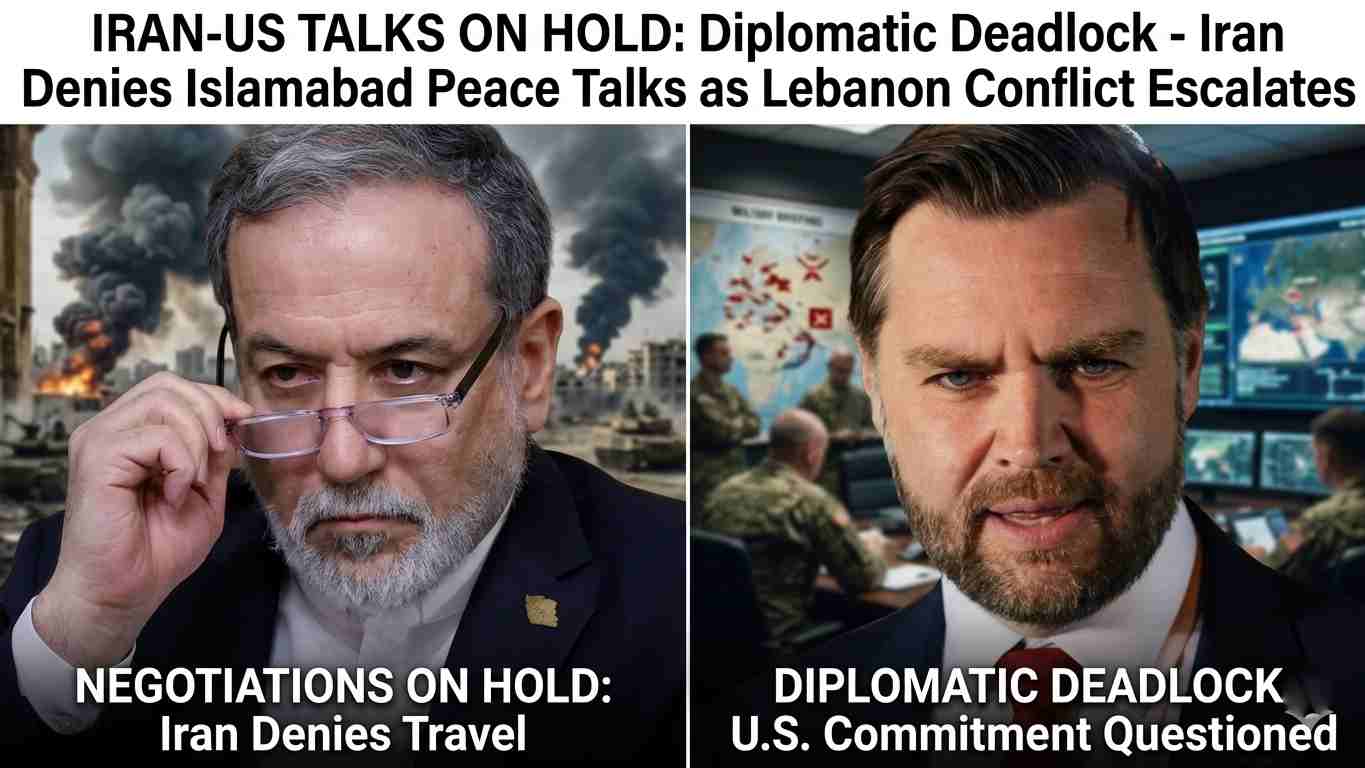
Iran-US talks on hold : The corridors of power in Islamabad are draped in heavy security, but the seats across the negotiating table remain empty. Despite weeks of international anticipation and high-stakes preparation by Pakistan, Iran has officially frozen the proposed peace dialogue with the United States. In a series of sharp rebuttals issued through state-run media, Tehran clarified on Friday that no senior delegation has traveled to Pakistan, citing America’s failure to secure a ceasefire in Lebanon as the primary deal-breaker.
.What was meant to be a historic diplomatic breakthrough in Islamabad now teeters on the edge of collapse, leaving the Middle East and global oil markets in a state of profound uncertainty.
Iran-US talks on hold Tehran’s Firm Rejection: “No Travels, No Talks”
The confusion began late Thursday when Western media outlets, including The Wall Street Journal, reported that a high-level Iranian delegation had arrived in the Pakistani capital. However, Iran’s state-affiliated news agencies—Tasnim, Fars, and Press TV—quickly moved to dismantle these claims.
According to a “well-informed source” cited by Tasnim News Agency, neither Foreign Minister Abbas Araghchi nor Parliament Speaker Mohammad Baqer Qalibaf have left Iranian soil. The source was quoted as saying:
“The news from some media outlets that an Iranian negotiating team has arrived in Islamabad to negotiate with the Americans is completely false. As long as the United States does not fulfill its commitment to the ceasefire in Lebanon and the Zionist regime continues its attacks, the negotiations are on hold.”
This sentiment was echoed by Fars News Agency, which reiterated that Tehran has “no plans” to engage with the American side until the situation in Lebanon is stabilized. The message from the Islamic Republic is clear: diplomacy cannot occur in a vacuum while regional allies are under fire.
The Lebanon Sticking Point: A Truce in Name Only?
The primary catalyst for this diplomatic freeze is the rapidly deteriorating situation in Lebanon. While a temporary ceasefire was announced between Washington and Tehran earlier this week, the interpretation of that agreement differs wildly between the two camps.
Iran’s Position: Tehran views the ceasefire as a comprehensive halt to hostilities, specifically including an end to Israeli military operations against Hezbollah in Lebanon.
The US-Israeli Position: Conversely, President Donald Trump and Prime Minister Benjamin Netanyahu have explicitly stated that the two-week truce does not extend to Lebanon.
Within 48 hours of the ceasefire taking effect, Israel launched its most intense aerial bombardment of Lebanon since the conflict escalated in March, resulting in hundreds of casualties. Iranian President Masoud Pezeshkian warned that these strikes have effectively sabotaged the diplomatic process. “Our hands remain on the trigger,” Pezeshkian stated, emphasizing that Iran would not abandon its “Lebanese brothers and sisters” for the sake of a lopsided peace deal.
Mixed Signals and Deleted Tweets
The confusion was further fueled by internal inconsistencies within Iran’s own diplomatic corps. Iran’s Ambassador to Pakistan, Reza Amir Moghadam, initially posted on X (formerly Twitter) that a 10-member delegation was indeed arriving in Islamabad at the invitation of Prime Minister Shehbaz Sharif.
The post mentioned that the talks would be based on a “10-point proposal” from Iran. However, as Israeli strikes intensified in Lebanon, the post was abruptly deleted. This suggests a sudden pivot in Tehran’s strategy—a retreat from the table in response to what they perceive as American and Israeli bad faith.
The American Side: JD Vance Takes the Lead
On the other side of the Atlantic, the United States has signaled its seriousness by reportedly appointing Vice President JD Vance to lead the American delegation. Vance, known for his “America First” skepticism toward open-ended foreign military interventions, was expected to be joined by:
Steve Witkoff: Special Envoy with close ties to the administration’s Middle East policy.
Jared Kushner: A key architect of previous regional diplomatic frameworks.
The White House has remained tight-lipped about whether these talks would be direct or mediated through Pakistani officials. However, the pressure on the Trump administration is mounting. With the Strait of Hormuz currently shut down by Iran—threatening global energy supplies—the US is desperate to find a resolution that reopens the vital waterway.
Trump recently took to social media to criticize Tehran’s maritime blockade, stating that Iran was doing a “very poor job” of allowing oil tankers through and warning, “That is not the agreement we have!”
Pakistan’s Preparation: A Host Ready for a Ghost
Despite the denial from Tehran, Pakistan has spared no effort in preparing for the summit. Prime Minister Shehbaz Sharif, who played a pivotal role in brokering the initial invitation, had designated April 10 as the start date for the dialogue.
Security and Logistics in Islamabad:
Red Alert: Islamabad has been placed under a high-security lockdown.
Personnel: Over 10,000 police, army, and Rangers personnel have been deployed to secure the “Red Zone.”
Visa Waivers: Deputy PM and Foreign Minister Ishaq Dar announced “Visa on Arrival” for all delegates and international journalists, signaling Pakistan’s readiness to facilitate the world’s media.
However, as of Friday, the “Visa on Arrival” desks remain largely unoccupied by the expected Iranian officials.
The Geopolitical Stakes: Why the Talks Matter
The collapse of these talks would have repercussions far beyond the borders of Iran and the US.
The closure of the Strait of Hormuz has already sent jitters through global markets. If the Islamabad talks fail to materialize, the “fragile truce” could transform into a direct military confrontation—a scenario both sides have claimed they want to avoid, yet seem to be gravitating toward.
Conclusion: A Waiting Game
As it stands, the “Peace Dialogue in Islamabad” exists only on paper and in the logistical arrangements of the Pakistani government. Tehran has effectively drawn a line in the sand: there will be no diplomatic progress while Lebanon is under fire.
The world now watches the White House and the Kremlin, as well as regional mediators, to see if a last-minute concession can bring the Iranian delegation back to the table. For now, the “hands on the trigger” rhetoric has drowned out the whispers of diplomacy. If the April 10 deadline passes without a meeting, the two-week ceasefire may go down in history as a mere breathing space before a much larger storm.