
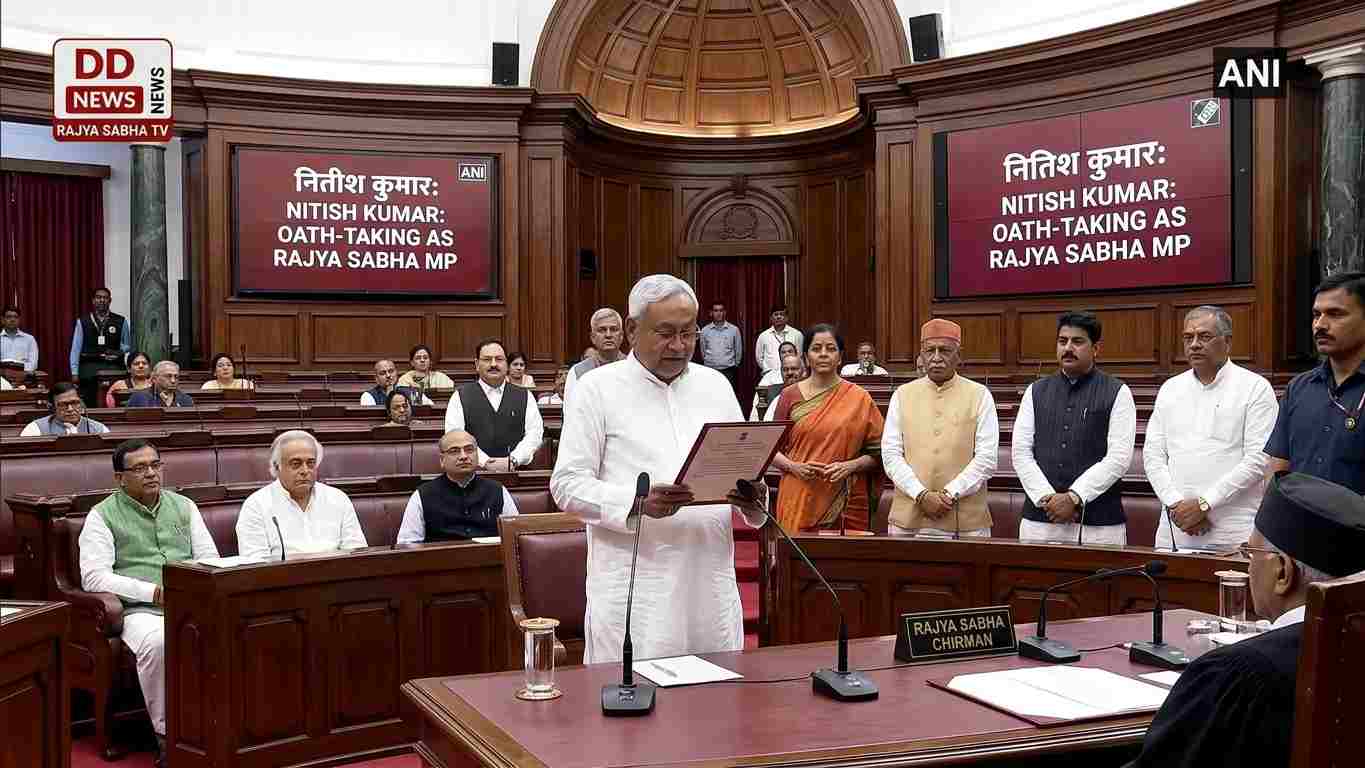
Nitish Kumar Becomes Rajya Sabha MP :The political landscape of Bihar, and indeed India, shifted significantly this Friday as Nitish Kumar, the state’s longest-serving Chief Minister, officially took his oath as a Member of the Rajya Sabha. This transition marks a calculated move from regional dominance to central governance, effectively signaling his exit from the Chief Minister’s office and paving the way for a fresh administration in Patna.
Nitish Kumar Becomes Rajya Sabha MP : The Ceremony in New Delhi
The oath-taking ceremony took place in the national capital, held within the chambers of the Rajya Sabha Chairman, CP Radhakrishnan. While brief, the event was attended by a “who’s who” of the National Democratic Alliance (NDA) and other political heavyweights, highlighting the gravity of Kumar’s move.
Key attendees included:
JP Nadda: BJP National President.
Nirmala Sitharaman: Union Finance Minister.
Arjun Ram Meghwal: Minister of State for Law and Justice.
Vijay Kumar Sinha & Samrat Choudhary: Bihar’s Deputy Chief Ministers.
Sanjay Kumar Jha: JDU Working President.
Jairam Ramesh: Senior Congress leader.
The presence of leaders from across the aisle, including the Congress party, underscores the respect Nitish Kumar commands as a veteran statesman, despite the often-turbulent nature of coalition politics in Bihar.
“I Have Accomplished a Lot”: Why Nitish is Moving to Delhi
For years, speculation has swirled regarding Nitish Kumar’s “national ambitions.” By moving to the Rajya Sabha, those ambitions appear to be taking a concrete shape. Speaking to reporters in Delhi, Kumar was candid about his motivations.
“I have accomplished a lot of work in Bihar. Now I felt that I should remain here [in Delhi]. I will step down from my role there and work here. I will resign in three or four days.”
Kumar’s statement reflects a sense of completion. Having steered Bihar through various phases of development—from the “Jungle Raj” transition to the “Sushasan” (Good Governance) era—he seems ready to hand over the baton. He confirmed that a new Chief Minister and a fresh cabinet would be appointed shortly after his formal resignation.
The Succession Plan: Who Will Lead Bihar?
With Nitish Kumar’s departure, the immediate question is: Who next?
The NDA is scheduled to meet on April 14 to officially elect the new Chief Minister. While names are currently being discussed behind closed doors, the political vacuum left by a leader of Kumar’s stature is immense.
The new leadership will face the daunting task of maintaining the delicate balance between the JD(U) and the BJP, while addressing the ever-present challenges of unemployment, industrialization, and caste dynamics that define Bihar’s socio-political fabric.
A Legacy Defined by Resilience: The Political Journey of Nitish Kumar
To understand the weight of this transition, one must look at the timeline of Nitish Kumar’s career. He is not just a politician; he has been the pivot around which Bihar politics revolved for twenty years.
1. Early Beginnings and the JP Movement
Like many of his contemporaries, Nitish Kumar emerged from the crucible of the 1974 JP Movement. He first entered the Bihar Legislative Assembly as an MLA in 1985. His early years were defined by his association with socialist ideals and his eventual break from Lalu Prasad Yadav to form the Samata Party (later JD(U)).
2. The Union Years
Before becoming the face of Bihar, Kumar proved his mettle at the Center. Serving as the Union Railway Minister and Minister for Surface Transport under Atal Bihari Vajpayee, he earned a reputation for efficiency and integrity. His implementation of the Tatkal scheme and various railway safety reforms remain part of his administrative legacy.
3. The “Sushasan Babu” Era (2005–Present)
Nitish Kumar took the oath as Chief Minister for the first time in 2005. At that time, Bihar was struggling with a breakdown of law and order. His first two terms were characterized by:
Infrastructure Boom: A massive overhaul of state highways and rural roads.
Education Reform: The famous “Cycle Scheme” for girls, which drastically reduced dropout rates.
Women’s Empowerment: Providing 50% reservation for women in Panchayati Raj institutions.
4. The Master of Coalitions
Perhaps the most discussed aspect of his career is his ability to navigate shifting alliances. Whether partnering with the BJP or the RJD, Kumar managed to remain the center of gravity in the state. While critics labeled him “Paltu Ram” for his frequent U-turns, his supporters argue that his primary goal was always the stability and development of Bihar.
What This Means for the NDA and the 2029 Outlook
Nitish Kumar’s shift to the Rajya Sabha isn’t just about Bihar; it’s a strategic move for the NDA. By bringing a veteran with deep grassroots knowledge to Delhi, the BJP and JD(U) are likely looking to strengthen their upper-house presence and utilize his experience for national policy-making.
In Bihar, this opens up a “Post-Nitish” era. For the BJP, it is an opportunity to potentially install their own Chief Minister for the first time in the state, or at least play a much more dominant role in the administration. For the JD(U), it is a test of whether the party can survive and thrive without its founding patriarch at the helm of the state.
Conclusion
As Nitish Kumar prepares to submit his resignation in the coming days, Bihar stands at a crossroads. The man who defined “Good Governance” in the state for two decades is moving on. Whether his successor can fill his shoes—and whether Kumar will play a “Kingmaker” role from the corridors of power in Delhi—remains to be seen.
One thing is certain: April 14 will mark a “New Year” in more ways than one for the people of Bihar.