
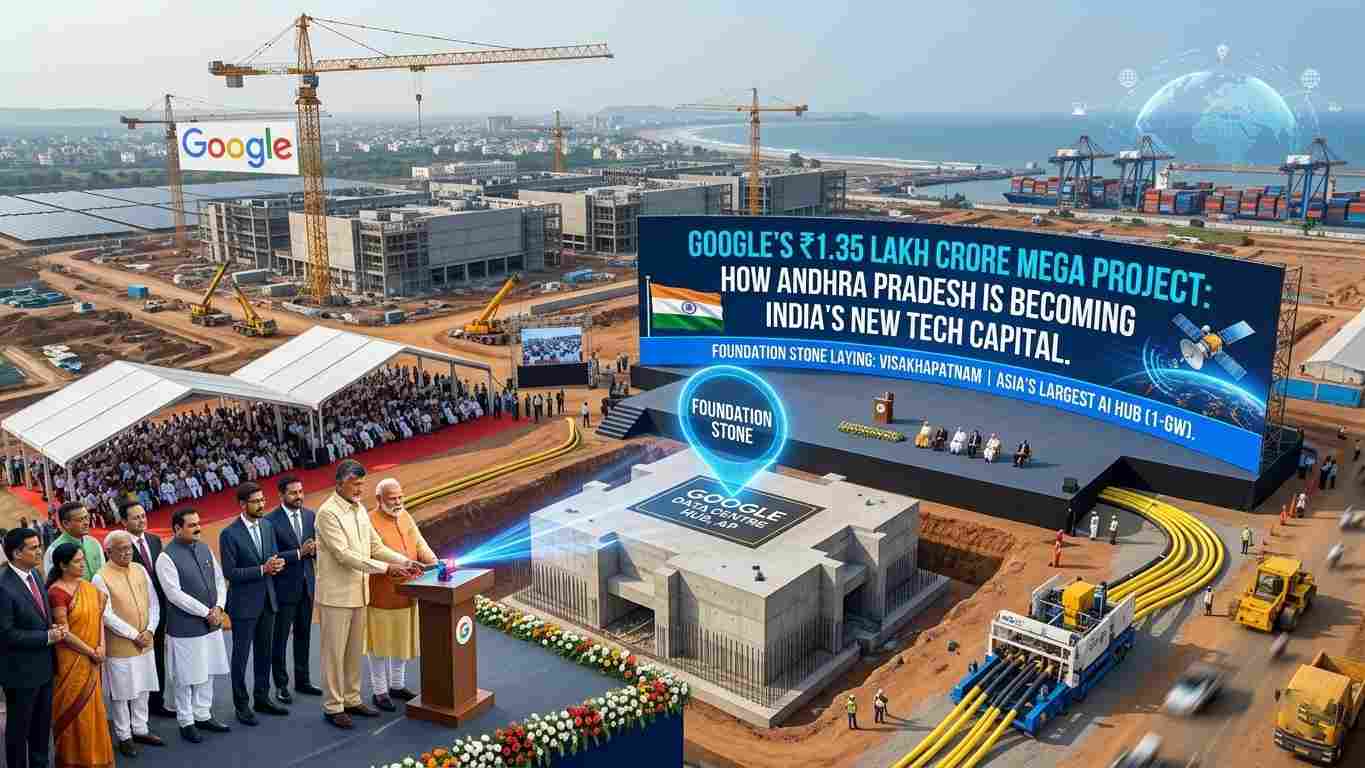
Google’s ₹1.35 Lakh Crore Mega Project : Visakhapatnam, Andhra Pradesh – In a move set to redefine the global digital map, Andhra Pradesh Chief Minister N. Chandrababu Naidu is scheduled to lay the foundation stone for Google’s massive data centre hub on April 28, 2026. With a staggering investment of $15 billion (approximately ₹1.35 lakh crore), this project stands as the largest foreign direct investment (FDI) in the history of both Andhra Pradesh and India.
The project is more than just a storage facility; it is envisioned as Asia’s largest AI and data centre cluster and India’s first-ever 1-Gigawatt (GW) hyperscale hub.
Google’s ₹1.35 Lakh Crore Mega Project :Andhra Pradesh gove. and Google signed From MoU
The journey of this “mega-investment” began on October 14, 2025, when the Andhra Pradesh government and Google signed a Memorandum of Understanding (MoU) in New Delhi. The speed of execution has been remarkable. Within six months, the state government fast-tracked land allotments and regulatory approvals, culminating in the February 2026 approval of 601.4 acres of land.
The project is being implemented by Raiden Infotech India Pvt Ltd (a Google subsidiary) in partnership with Adani Infra (India) Limited, which will serve as the notified infrastructure partner.
Infrastructure Breakdown: A Three-Pronged Tech Fortress
The data centre is not restricted to a single location but is spread across three strategic campuses near the coastal city of Visakhapatnam. This distributed architecture ensures better load management and disaster recovery.
The Three Hubs:
Total Land: 601.4 Acres.
Technological Superiority: The 1-GW Benchmark
The most significant highlight of this project is its power capacity. A 1-Gigawatt (1-GW) hub is a rarity globally and a first for India. To put this in perspective:
AI Processing: The facility will house Google’s custom Tensor Processing Units (TPUs) and advanced CPUs designed specifically to handle heavy AI workloads, including Google’s Gemini AI models.
Global Connectivity: The hub will be linked via high-capacity submarine cable systems to Singapore, Malaysia, Australia, and 12 other nations. This positions Visakhapatnam as a critical “Digital Gateway” between Southeast Asia and the West.
Digital Ecosystem: It will support high-speed fiber networks, advanced cloud services, and secure digital storage for both government and private sectors.
Economic Impact: Jobs and Revenue
The scale of this project promises to transform the socio-economic fabric of Northern Andhra Pradesh.
Job Creation: Experts estimate that the project will create 5,000 to 6,000 direct high-tech roles and between 20,000 to 30,000 indirect jobs in construction, maintenance, logistics, and power management.
State Revenue: Union MoS Dr. Pemmasani Chandrasekhar has stated that the hub is expected to generate approximately ₹10,000 crore in revenue for the state over its initial years.
Skill Development: Google Cloud CEO Thomas Kurian has emphasized a commitment to nurturing world-class AI professionals in the region, providing local youth with direct exposure to cutting-edge technology.
Why Visakhapatnam?
The choice of Visakhapatnam was highly strategic. The city offers three critical advantages:
Coastal Access: Essential for landing submarine cables that carry global internet traffic.
Power Grid Proximity: A 1-GW facility requires immense and stable power, which the existing industrial grid in Vizag can support.
Governance: The proactive approach of the “Swarandhra Pradesh” initiative led by CM Naidu and IT Minister Nara Lokesh provided the “ease of doing business” necessary for a $15 billion commitment.
Timeline to 2028
Following the foundation stone ceremony on April 28, construction will move into high gear. The project will be rolled out in phases, with a target to be fully operational by July 2028.
This project aligns with Google’s global mandate to operate on carbon-free energy by 2030, suggesting that massive investments in local solar and wind farms in Andhra Pradesh will likely follow to power the 1-GW demand sustainably.
Final Thoughts
As the state gears up for the groundbreaking ceremony, the “City of Destiny” (Visakhapatnam) is officially on its way to becoming the “AI Capital of India.” This project doesn’t just represent data storage; it represents India’s transition from a digital consumer to a global digital powerhouse.