
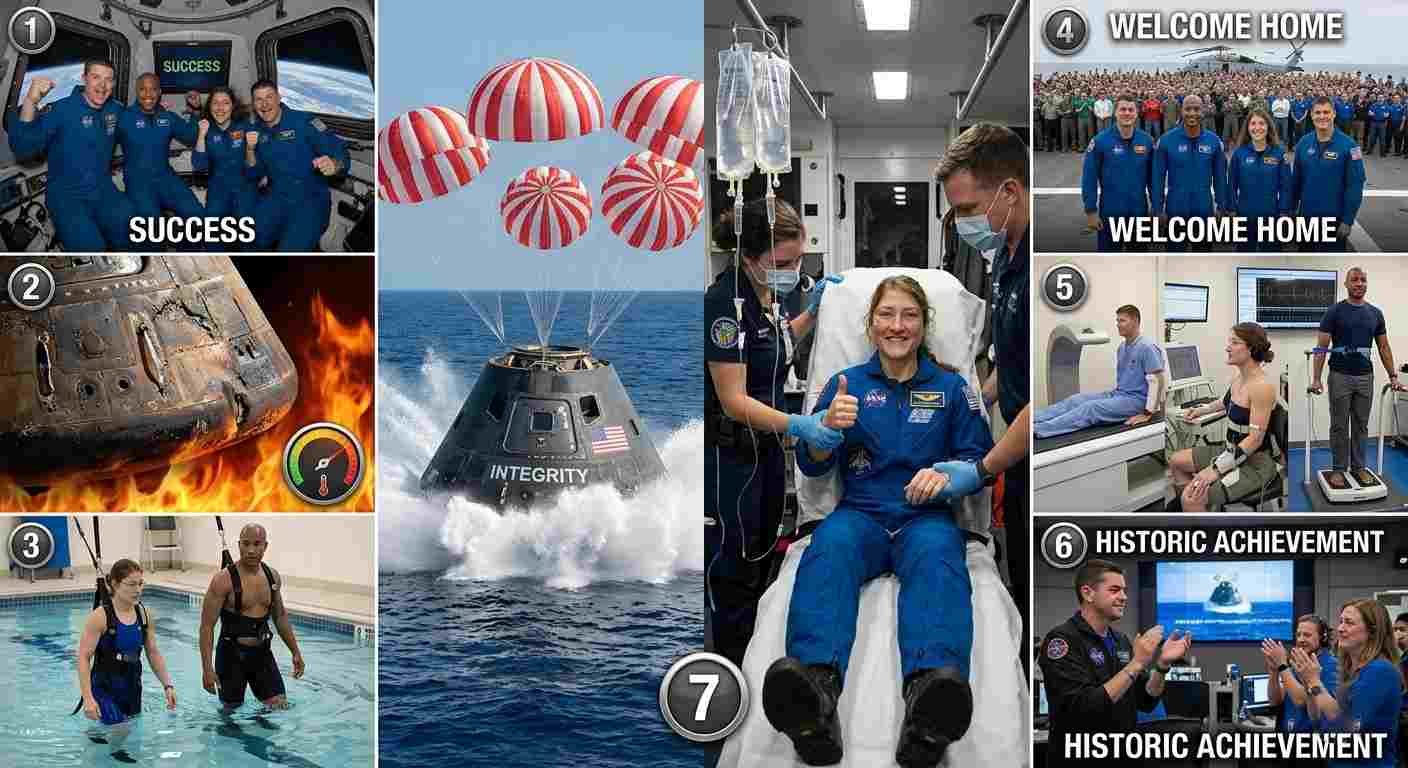
Friday, April 10, 2026,Artemis II Mission Success Landing: the world watched in collective awe as the Orion spacecraft, aptly named “Integrity,” streaked across the evening sky like a fallen star, successfully concluding the Artemis II mission.
After traveling further into the void than any human being in history—surpassing the 1970 record of Apollo 13 by over 4,000 miles—the crew of four has finally splashed down off the coast of San Diego. But while the fire of re-entry is over, a new, quieter battle begins for the crew. For NASA astronauts Reid Wiseman, Victor Glover, Christina Koch, and Jeremy Hansen, the journey doesn’t end at the water’s edge. Now begins the intense, month-long physical and psychological recovery process essential for transitioning from the weightless vacuum of space back to the unforgiving pull of Earth’s gravity.
Artemis II Mission Success Landing The Riskiest 16 Minutes: A Trial by Fire
Before we dive into the medical recovery, we must acknowledge the sheer violence of the return. Re-entering Earth’s atmosphere from a lunar trajectory is fundamentally different from returning from the International Space Station (ISS).
The Orion capsule hit the atmosphere at a staggering 25,000 mph (40,000 km/h). At these speeds, the air in front of the capsule compresses so violently it turns into plasma, reaching temperatures of 5,000 degrees Fahrenheit (2,800 degrees Celsius).
The Heat Shield Factor
There was significant anxiety leading up to this moment. Following the uncrewed Artemis I mission in late 2022, NASA engineers discovered unexpected “charring” and minor cracks in the 16.5-foot heat shield. To protect the Artemis II crew, flight director Rick Henfling utilized a steeper re-entry angle, minimizing the time the shield was exposed to peak thermal loads.
The strategy worked. Despite a tense six-minute radio blackout caused by plasma interference, the drogues and main parachutes deployed flawlessly, slowing the “Integrity” to a gentle 19 mph (31 km/h) before it kissed the Pacific at 8:07 pm EST.
Why Recovery is Necessary: The Biological Toll of the Moon
The Artemis II crew spent ten days in a high-radiation, microgravity environment. While ten days may seem short compared to a six-month stint on the ISS, the physiological changes are rapid and profound.
1. The “G-Loc” and Vestibular Reset
After days of floating, the sudden impact of Earth’s gravity feels like a lead blanket being dropped on the chest. The inner ear (the vestibular system), which governs balance, has spent the last week confused. Upon landing, astronauts often experience:
Severe Vertigo: The sensation that the world is spinning even when lying still.
Orthostatic Intolerance: A condition where blood pools in the legs because the heart has “forgotten” how to pump forcefully against gravity, often leading to fainting when standing.
2. Muscle and Bone Density Loss
Even in a short mission, the body begins to shed “unnecessary” weight. Without the need to support the skeleton, bone density begins to leach into the bloodstream, and postural muscles start to atrophy. The recovery period involves intensive physical therapy to ensure the astronauts don’t suffer long-term skeletal fragility.
3. The Fluid Shift
In space, fluids move toward the head (the “puffy face” syndrome). Upon return, that fluid rushes back down. This rapid shifting can cause vision issues and intense pressure headaches, requiring doctors on the USS John P. Murtha to monitor intracranial pressure closely.
The “Firsts” That Define a Generation
The recovery is not just physical; it is symbolic. This crew represents the modern face of humanity.
Victor Glover: As the first person of color to leave Earth’s orbit, his safe return is a milestone for inclusive exploration.
Christina Koch: The first woman to reach the Moon’s vicinity, proving once again that the lunar surface is no longer a “boys’ club.”
Jeremy Hansen: Representing the Canadian Space Agency, he is the first non-American to venture into deep space, cementing the Artemis program as a global alliance.
NASA Administrator Jared Isaacman, watching from the recovery ship, noted the emotional weight of the moment: “The childhood Jared can’t believe what I just saw. We sent four amazing people to the moon and brought them back for the first time in over 50 years.”
The Recovery Protocol: What Happens Now?
The astronauts won’t be heading home to their families immediately. Following the splashdown, they were hoisted from the water and moved to the medical bay of the USS John P. Murtha.
Phase 1: Immediate Stabilization (Hours 1–24)
Doctors perform blood draws, neurological exams, and hydration therapy. The goal is to ensure the cardiovascular system is stabilizing.
Phase 2: The “Earth-Legs” Training (Days 2–7)
Once back at the Johnson Space Center in Houston, the crew will undergo “re-adaptation” exercises. This includes walking on anti-gravity treadmills and performing balance drills to retrain the brain to interpret Earth’s signals.
Phase 3: The Science Debrief
Because Artemis II is a test flight for the Space Launch System (SLS) and the Orion capsule, the astronauts’ own bodies are part of the data. Their physical reactions to deep-space radiation—which is much higher beyond the Van Allen belts—will be studied to prepare for the much longer Artemis III and IV missions.
Statistical Comparison: Apollo vs. Artemis
To understand the magnitude of this mission, we look at the numbers.
The Artemis II mission didn’t just break a distance record; it proved that the Orion capsule is a superior lifeboat, capable of sustaining life in the most hostile environments known to man.
Looking Ahead: The Path to the Lunar South Pole
The success of Artemis II is the green light NASA needed for the “main event.”
Artemis III (Mid-2027): This mission will aim to land the first woman and person of color on the lunar surface near the South Pole. They will use SpaceX’s Starship HLS to touch down in a region believed to be rich in water ice.
Artemis IV (Late 2028): Will focus on the Lunar Gateway, a space station orbiting the Moon that will serve as a staging point for Mars.
As NASA Associate Administrator Amit Kshatriya stated during the post-splashdown briefing: “Fifty-three years ago, humanity left the moon. This time, we return to stay.”
Final Thoughts: The Cost of Exploration
Why put these four individuals through such physical trauma? Why risk the heat shield cracks and the 25,000 mph re-entry?
The answer lies in the future of our species. The water ice at the Moon’s South Pole can be processed into rocket fuel, turning the Moon into a “gas station” for missions to Mars. By enduring the recovery process today, Wiseman, Glover, Koch, and Hansen are providing the physiological blueprint for the first humans who will eventually walk on the Red Planet in the 2030s.
The recovery of the Artemis II astronauts is the final chapter of a historic mission, but it is also the preface to a new era of human existence. For the first time in half a century, we are no longer a planet-bound species. We are lunar travelers, and soon, we will be Martians.
Welcome home, Integrity. The Moon is closer than it has ever been.