
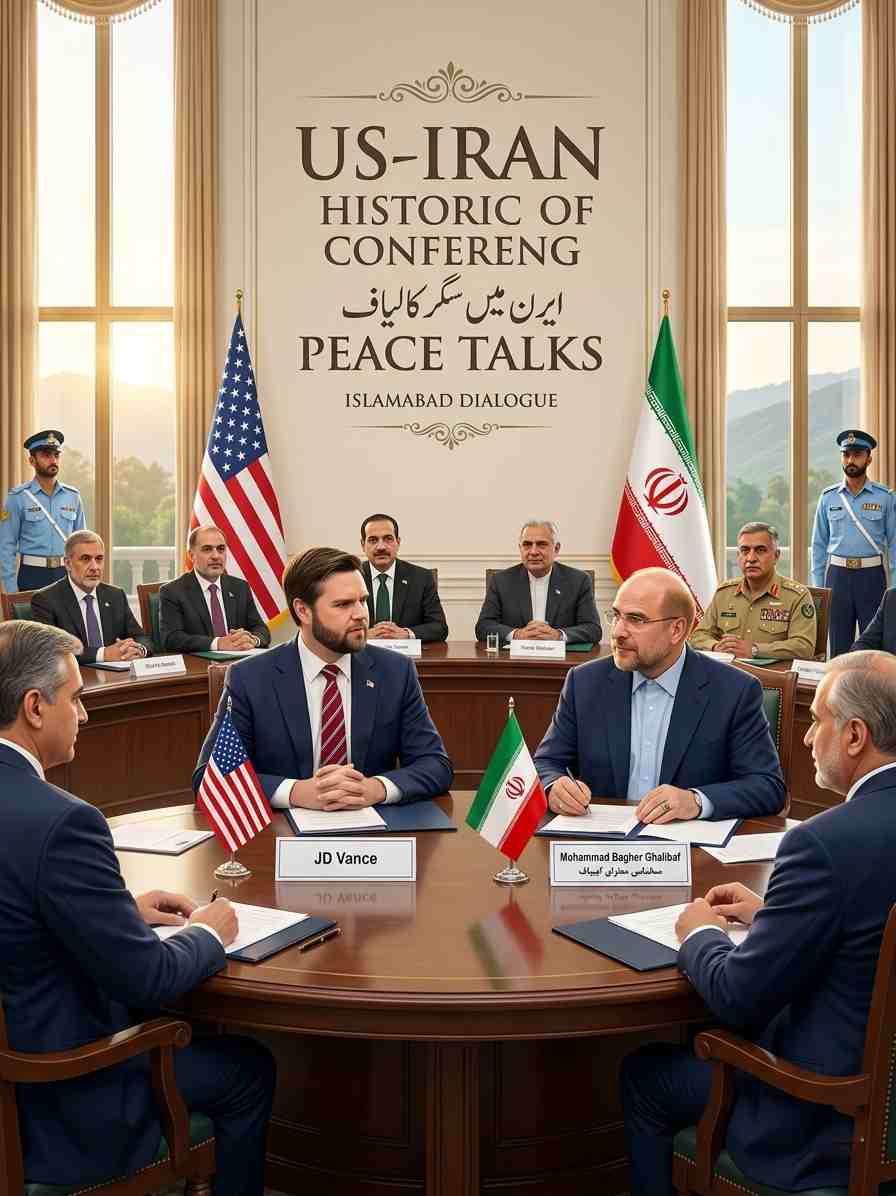
US-Iran Peace Talks : The world holds its breath today as the specter of a global conflict begins to recede. In a move that few political analysts predicted, the “Islamabad Dialogue” has officially commenced. US Vice President JD Vance has touched down in Pakistan’s capital, marking a seismic shift in Middle Eastern geopolitics and a potential end to the escalating US-Israel-Iran hostilities.
US-Iran Peace Talks : JD Vance’s Welcome and a Crucial Security Perimeter
The atmosphere at Nur Khan Airbase was electric this morning. In a display of military cooperation and diplomatic respect, five Pakistan Air Force (PAF) F-16 fighter jets escorted the US Air Force’s Boeing C-32A into Pakistani airspace. The sight of American wings flanked by Pakistani steel served as a powerful visual metaphor for the mediation role Islamabad has assumed.
Vice President JD Vance was received by Field Marshal Asim Munir, a key figure in the back-channel negotiations that prevented a catastrophic escalation earlier this week. This visit is not merely a diplomatic formality; it is the highest-level face-to-face meeting between Washington and Tehran since the 1979 Islamic Revolution.
The “Minab 168” Delegation
Hours before Vance’s arrival, the Iranian delegation, codenamed “Minab 168,” landed under heavy security. Led by Iranian Parliament Speaker Mohammad Bagher Ghalibaf, the delegation represents a strategic choice by Tehran. Ghalibaf, a pragmatic yet hardline figure, brings the weight of the Iranian legislature to the table, ensuring that any deal struck in Islamabad has a path toward domestic ratification.
Inside the Ceasefire: How the “Trump Deadline” Was Averted
The path to Islamabad was paved with high-tension drama. Just 48 hours ago, the Middle East was on the brink of total war. President Donald Trump had issued a stern deadline to Tehran: agree to a framework or face targeted strikes on Iran’s power plants and critical infrastructure, including major bridges.
The Role of Pakistan as the Bridge
The breakthrough came late Tuesday when a ceasefire deal was reached, thanks to the relentless mediation of Prime Minister Shehbaz Sharif and Field Marshal Asim Munir. Both President Trump and Iranian Foreign Minister Seyed Abbas Araghchi have publicly expressed their gratitude to the Pakistani leadership for providing the neutral ground necessary for these talks.
The Negotiation Table: Who Is Who?
The American delegation isn’t just composed of career diplomats. President Trump has sent a “closer” team designed to handle high-stakes real estate and geopolitical deals.
JD Vance: The Vice President, chosen specifically to fulfill a request from Tehran for a direct line to the Oval Office.
Steve Witkoff: The Special Envoy, known for his deep ties to the Trump administration’s inner circle.
Jared Kushner: The architect of the Abraham Accords, returning to the diplomatic fold to bridge the gap between Israeli security needs and Iranian sovereignty.
On the Iranian side, Ghalibaf is supported by senior military and diplomatic advisors. His flight to Pakistan was notable for his “Minab strike reminder”—a subtle but firm nod to Iran’s military capabilities, ensuring the US understands that Tehran is negotiating from a position of perceived strength, not surrender.
The 15 vs. 10 Conflict: Comparing the Frameworks
The core of the Islamabad talks revolves around two competing documents that outline the future of the Middle East.
The US 15-Point Framework
The Trump administration’s plan is aggressive and focused on “Total Denuclearization.” Key points include:
Surrender of Highly Enriched Uranium: Iran must hand over its stockpiles to a neutral third party.
Military Limits: Strict caps on ballistic missile ranges and drone production.
Regional Non-Interference: Ceasing support for proxy groups in Lebanon, Yemen, and Iraq.
The Iranian 10-Point Plan
Tehran’s counter-proposal focuses on “Sovereignty and Restitution”:
Financial Reparations: Compensation for economic damage caused by decades of sanctions.
Strait of Hormuz Recognition: The US must formally acknowledge Tehran’s primary sovereignty over the vital oil artery.
Security Guarantees: A permanent end to “regime change” rhetoric from Washington.
| Key Issue | US Position | Iranian Position |
| Nuclear Assets | Full Surrender | Peaceful Usage Rights |
| Sanctions | Conditional Lift | Immediate Removal + Reparations |
| Maritime Access | International Waters | Iranian Sovereignty (Hormuz) |
The Lebanon-Israel Factor: A Parallel Peace
The ripples of the Islamabad talks are already being felt across the border in Lebanon. After a day of intense strikes that nearly derailed the entire process, Lebanon and Israel have agreed to their own set of talks next week. This “momentary pause” is vital; if the Hezbollah-Israel front remains hot, the US-Iran deal could collapse before the ink is dry.
Why This Matters for the Global Economy
The geopolitical tension had pushed Brent Crude prices toward $120 per barrel. With the announcement of the ceasefire and the commencement of the Islamabad Dialogue, markets have begun to stabilize. A successful peace deal could see:
A drop in energy prices as the “war premium” evaporates.
Stabilization of global shipping routes, particularly through the Red Sea and the Strait of Hormuz.
Increased investor confidence in emerging markets within the Middle East and South Asia.
The Road Ahead: Can a Lasting Peace be Achieved?
Pakistan’s Foreign Minister Ishaq Dar has called on both parties to “engage constructively.” However, the road to a lasting solution is fraught with obstacles. Hardliners in both Washington and Tehran are skeptical of any concessions.
The presence of Jared Kushner suggests that the “Economic Peace” model—used previously in the Abraham Accords—might be the secret sauce here. If the US can offer Iran a path to economic prosperity that outweighs the strategic value of its nuclear program, a deal might just be possible.
Conclusion: A Historic Turning Point
As JD Vance and Mohammad Bagher Ghalibaf sit down in the secure halls of Islamabad, the world watches with bated breath. This is more than just a meeting; it is a test of whether 21st-century diplomacy can still prevail over the primitive impulse of war. For the first time in nearly 50 years, the “Great Satan” and the “Axis of Resistance” are talking. That, in itself, is a victory.