
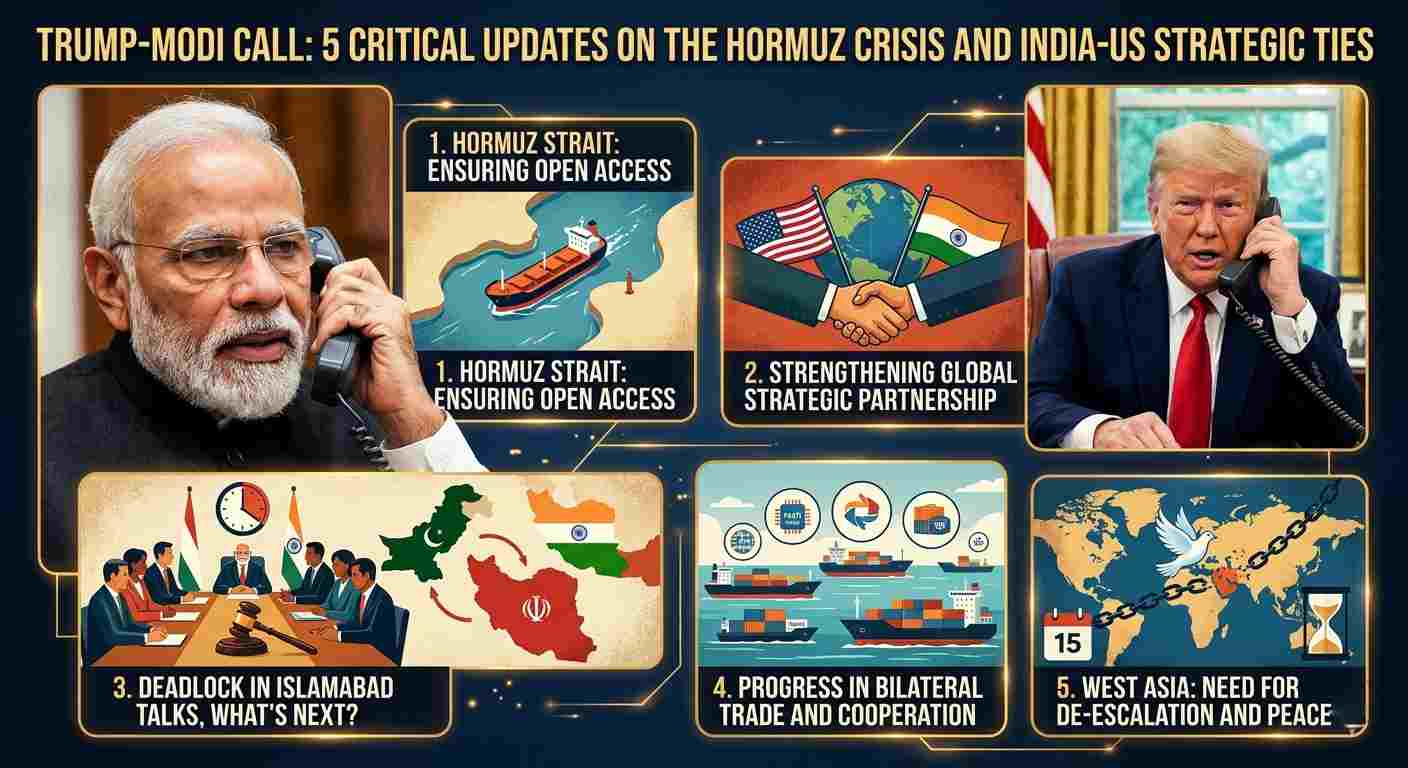
Trump-Modi Call: The geopolitical landscape of West Asia is shifting like desert sands, and at the center of this whirlwind are two of the world’s most influential leaders. On Tuesday, April 14, 2026, Prime Minister Narendra Modi and US President Donald Trump engaged in a high-stakes, 40-minute phone conversation that could dictate the flow of global energy and the stability of the Indo-Pacific region.
This marks the third time the duo has spoken this year, signaling a “hotline” level of urgency as the world watches the precarious truce between Washington and Tehran. With the Strait of Hormuz hanging in the balance, here is a deep dive into what this conversation means for India, the US, and the global economy.
1. The Hormuz Factor: Why the Strait is a Red Line
The most striking takeaway from the Modi-Trump dialogue was the mutual emphasis on the Strait of Hormuz. For the uninitiated, this narrow strip of water is the world’s most important oil chokepoint.
During the call, both leaders stressed that keeping the Strait “open, secure, and accessible” is not just a regional preference but a global necessity.
The Threat: Following the failure of the Islamabad talks last weekend, the US has initiated a blockade of Iranian ports.
The Counter: Tehran has retaliated with threats against ports across the Persian Gulf and the Gulf of Oman.
India’s Stake: As a massive energy importer, any disruption in the Strait would send Indian fuel prices skyrocketing, threatening domestic inflation and economic growth.
By aligning with Trump on this, Modi is sending a clear message: India supports de-escalation, but not at the cost of global energy security.
2. A”Comprehensive Global Strategic Partnership” Under Pressure
While the war in West Asia dominated the headlines, the “bread and butter” of the India-US relationship—bilateral trade and cooperation—was not ignored. PM Modi noted that the two reviewed “substantial progress” in various sectors.
Earlier this year, on February 2, the leaders laid the groundwork for a massive trade deal aimed at slashing US tariffs on Indian exports. Despite the looming shadow of the Iran-Israel conflict (which sparked following the February 28 attacks), the commitment to the Comprehensive Global Strategic Partnership remains unshaken.
3. The “Stalemate” in Islamabad and the Road to April 22
The timing of this call is no coincidence. We are currently in a “war stalemate.” The talks held in Pakistan’s capital last weekend—the first face-to-face contact between Iran and the US in 47 years—ended in a disappointing deadlock.
“Both sides are sticking to their guns as a precarious truce holds until April 22.”
With only a week left before this truce expires, Trump’s outreach to Modi suggests that the US views India as a vital diplomatic bridge. Modi’s consistent stance on “restoration of peace at the earliest” provides a neutral ground that neither Washington nor Tehran can ignore.
4. The Personal Equation: “People of India Love You”
In a move that highlights the unique personal chemistry between the two leaders, PM Modi told Trump, “People of India love you.” US Ambassador to India, Sergio Gor, confirmed that Trump keeps the Prime Minister updated regularly. This level of transparency—sharing “big-ticket items” happening in Washington—suggests that India is no longer just a regional partner but a primary confidant in US foreign policy decisions.
5. What Happens Next? The “April 22” Deadline
As we approach the end of the month, the world looks toward the possibility of a second round of talks.
Optimism: Reports suggest new negotiations could happen this week.
Pessimism: The US blockade and Iranian counter-threats make the situation a powder keg.
Trump-Modi Call Conclusion: India’s Balancing Act
Prime Minister Modi is walking a tightrope. By supporting “de-escalation” while simultaneously reinforcing a “strategic partnership” with a warring US, India is positioning itself as the voice of reason in an increasingly polarized world.
Whether the “friendship” between Modi and Trump can prevent a full-scale blockade of the Persian Gulf remains to be seen. However, one thing is certain: the road to peace in West Asia now runs through New Delhi.
Quick Facts Table: The 2026 Modi-Trump Diplomatic Timeline
| Date | Key Discussion Point | Context |
| Feb 2 | Trade Deal & Tariffs | Reducing barriers for Indian exports. |
| Feb 28 | Conflict Erupts | US/Israel strikes on Iran; Middle East instability. |
| Mar 24 | De-escalation | First call after the conflict started. |
| Apr 12 | Islamabad Failure | Face-to-face US-Iran talks yield no results. |
| Apr 14 | The Hormuz Crisis | 40-minute call on securing the Strait. |