
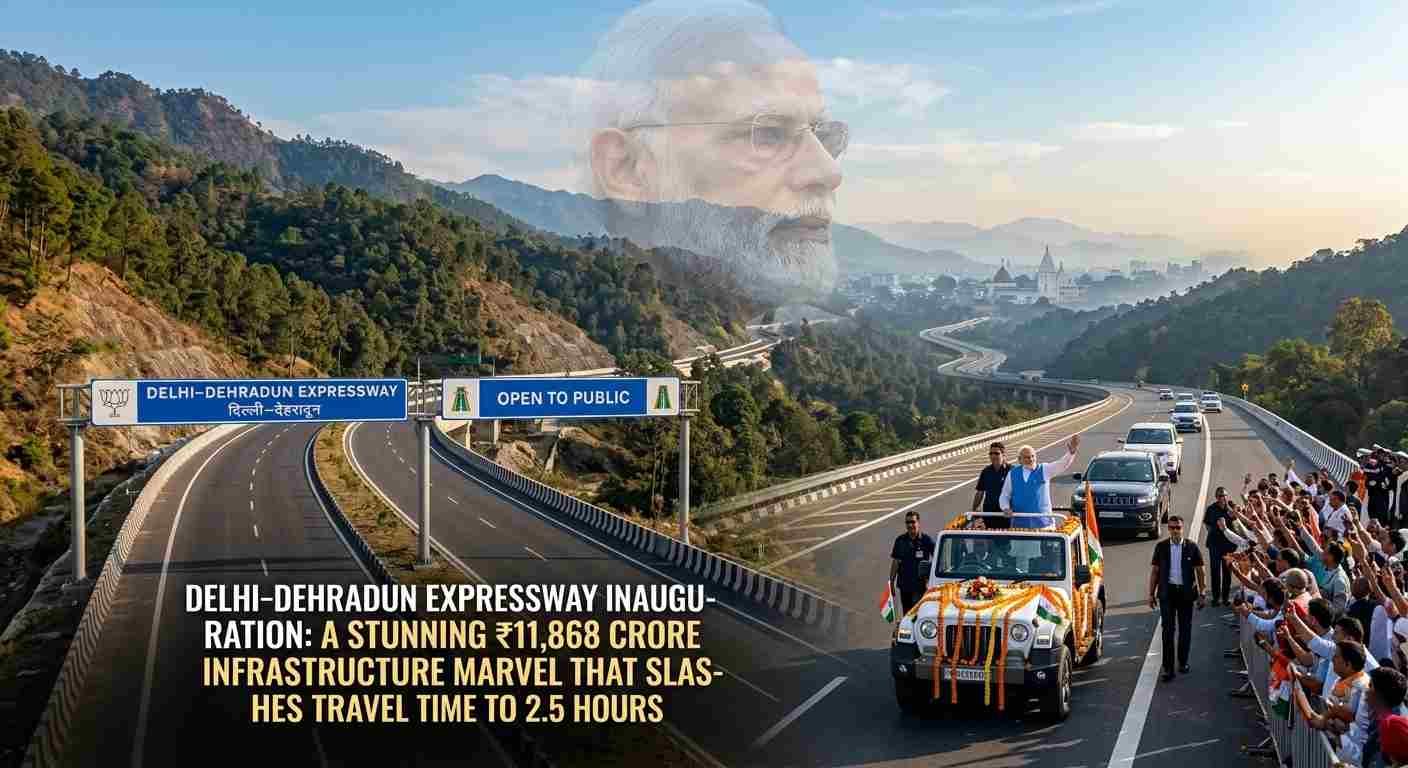
Delhi–Dehradun Expressway Inauguration: The geography of North India has been redefined today, April 14, 2026. In a historic move that promises to revolutionize regional connectivity, Prime Minister Narendra Modi has officially inaugurated the full 212-km stretch of the Delhi–Dehradun Expressway.
This ambitious project, also known as the Delhi-Dehradun Economic Corridor, is not just a road; it is a high-speed artery designed to pump economic growth into Uttar Pradesh and Uttarakhand while offering a breathtakingly swift commute for travelers.
Delhi–Dehradun Expressway Inauguration:The Speed Revolution-From 6 Hours to a 2.5-Hour Dash
For decades, the journey between the national capital and the “Abode of Drona” was a test of patience. Travelers had to navigate congested urban sprawls, narrow highways, and unpredictable traffic, often spending more than six to seven hours on the road.
With the opening of the Delhi–Dehradun Expressway, that ordeal is a thing of the past. The travel time has been decimated to a mere two and a half hours.
Why This Matters:
Tourism Boost: Dehradun, Mussoorie, and Rishikesh are now essentially weekend-commute distance from Delhi.
Economic Velocity: Faster movement of goods between the industrial hubs of UP and the markets of Delhi.
Emergency Access: Crucial for medical emergencies and rapid logistics.
Inside the ₹11,868.6 Crore Mega-Project
Infrastructure on this scale requires massive capital and even greater vision. Since its inception in early 2021, the project has been a top priority for Union Minister Nitin Gadkari and the PMO.
Built at a total cost of ₹11,868.6 crore, the expressway was a race against time. Although originally slated for a December 2024 completion, the final finishing touches and wildlife safety audits pushed the full operational date to today.
“This corridor represents the ‘Gati Shakti’ vision—integrating speed with sustainability,” remarked a senior official from the NHAI.
A Landmark for Wildlife: The 12-km Elevated Corridor
Perhaps the most stunning feature of this expressway is how it coexists with nature. A significant portion of the route passes through the ecologically sensitive Rajaji National Park.
To protect the local fauna, the government constructed a 12-km long elevated wildlife corridor—the largest of its kind in Asia.
Wildlife Safety Features:
Animal Underpasses: Six dedicated underpasses allow animals to cross the forest floor without ever encountering a vehicle.
Elephant Passes: Two massive 200-metre-long underpasses specifically designed for the movement of elephant herds.
The Daat Kali Tunnel: A 370-metre tunnel near the revered Daat Kali temple that ensures the road remains submerged or elevated in a way that minimizes noise pollution for forest inhabitants.
Before the inauguration, PM Modi visited Saharanpur to personally review these wildlife safety measures, ensuring that development does not come at the cost of the environment.
The Four Phases of Connectivity
The 212-km corridor was developed in four strategic phases, each serving a unique geographic and logistical purpose:
| Phase | Stretch | Key Features |
| Phase 1 | Akshardham (Delhi) to Baghpat | 32 km, 12 lanes (already operational since late 2025). |
| Phase 2 | Baghpat to Saharanpur Bypass | 118 km, 6 lanes, includes 7 major interchanges. |
| Phase 3 | Saharanpur to Ganeshpur | 40 km, 6 lanes, providing seamless bypasses. |
| Phase 4 | Ganeshpur to Dehradun | 20 km, includes twin tunnels and the elevated forest stretch. |
Seamless Integration with India’s Expressway Grid
The Delhi-Dehradun Expressway isn’t an isolated road; it is a vital cog in the larger Indian infrastructure machine. It features over 100 underpasses and 5 railway overbridges, ensuring that there isn’t a single red light between the two cities.
It offers seamless connectivity with:
Delhi–Mumbai Expressway: Creating a corridor from the Himalayas to the Arabian Sea.
Eastern Peripheral Expressway (EPE): Allowing commuters to bypass the heavy traffic of central Delhi.
Haridwar & Roorkee: Dedicated spurs that make the pilgrimage to Haridwar faster than ever.
Smart Safety: The Advanced Traffic Management System (ATMS)
Speed is nothing without safety. The entire corridor is equipped with an Advanced Traffic Management System (ATMS). This includes:
High-definition CCTV coverage for real-time monitoring.
Automatic Number Plate Recognition (ANPR) for tolling and speed enforcement.
Emergency Call Boxes every few kilometers.
Weather monitoring sensors to alert drivers of fog or heavy rain in the Shivalik foothills.
A New Chapter for Uttarakhand
As PM Modi performed the Pooja at Jai Maa Daat Kali Temple today, the atmosphere was one of celebration. For the people of Uttarakhand, this expressway is a lifeline. It brings the markets of the capital to their doorstep and makes the beauty of the hills accessible to millions more.
The Delhi–Dehradun Expressway is more than just asphalt and concrete; it is a testament to India’s engineering prowess and a stunning example of how modern humanity can build paths through nature without destroying it.
Expressway At A Glance
Total Length: 212 KM
Operational Date: April 14, 2026
Major Cities Linked: Delhi, Ghaziabad, Baghpat, Saharanpur, Dehradun
Top Speed: 120 kmph (designated sections)
Estimated Fuel Savings: Thousands of crores annually due to reduced idling and distance.