
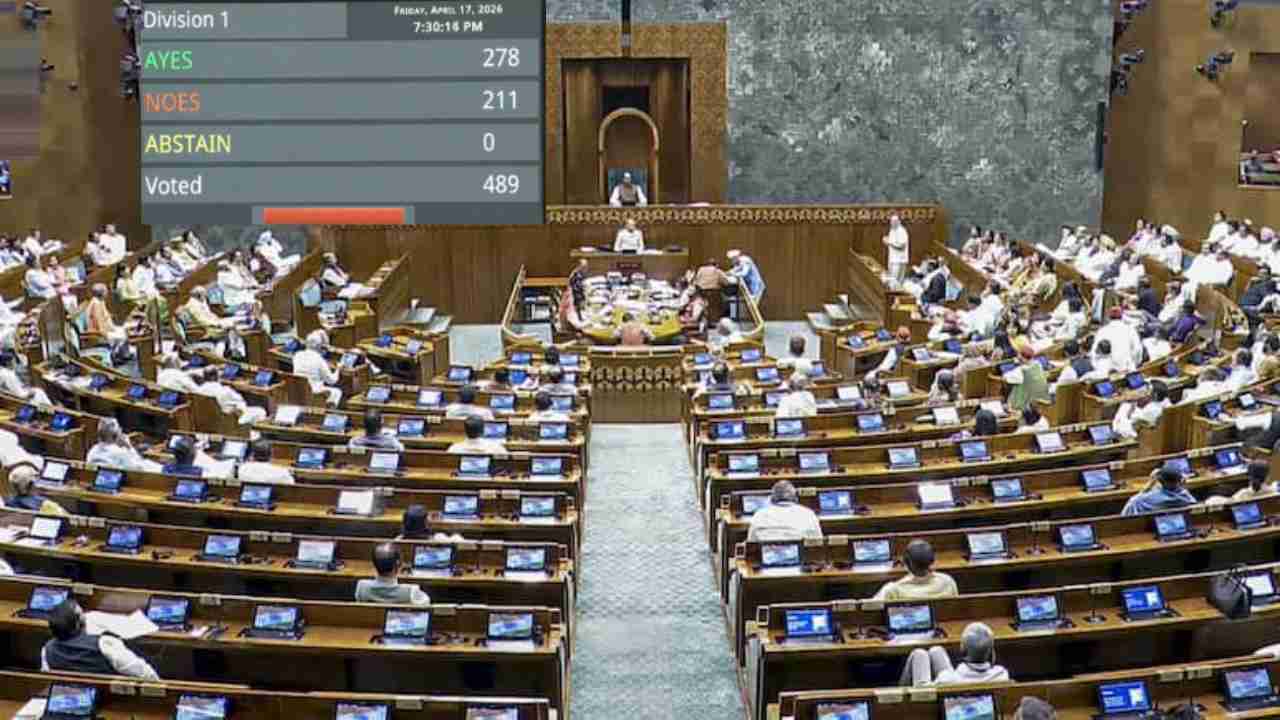
On Friday, April 17, 2026, a Constitution Amendment Bill Fails in Lok Sabha. The landscape of Indian democracy witnessed a seismic shift. During a pivotal special session of Parliament, the Central Government’s ambitious Constitution Amendment Bill—the cornerstone of a proposed delimitation package—failed to secure passage in the Lower House. Despite commanding a simple majority, the Bill succumbed to the weight of constitutional imperatives, triggering a political upheaval that has effectively cleaved the nation along a North-South divide.
Quick Facts for Readers
Date of Vote: April 17, 2026
Total Votes Cast: 528
The Rule: A 2/3rd majority is required for Constitutional changes.
The Result: Bill defeated despite having the most votes.
Constitution Amendment Bill Fails in Lok Sabha The Numbers Behind : Why 298 Ayes Weren’t Enough
In a packed House with 528 members present and voting, the atmosphere was electric. When the electronic voting board lit up, the results were:
Ayes: 298
Noes: 230
Abstentions: 0
On the surface, 298 votes represent a clear majority. However, for a Constitution Amendment Bill, the stakes are mathematically higher. Under Article 368, such a bill must be passed by a majority of the total membership of the House and by a majority of not less than two-thirds of the members present and voting.
To pass, the government needed approximately 352 votes (two-thirds of 528). By falling short by 54 votes, the Bill was officially defeated, marking one of the most significant legislative setbacks for the current administration.
The Delimitation Package: A Double-Edged Sword
The defeated Bill was not a standalone piece of legislation. It was part of a broader “Delimitation Package” designed to reshape India’s electoral geography. The primary objectives were:
Women’s Reservation: Implementing a long-awaited quota for women in legislatures by the 2029 General Elections.
Expanding the Lok Sabha: Increasing the total number of seats to reflect India’s current population density.
Correcting the Voter-to-MP Ratio: Addressing the massive disparity where some MPs represent three times as many voters as others.
Following the defeat, Parliamentary Affairs Minister Kiren Rijiju announced that the government would not move forward with two related Bills. “These reforms cannot be viewed in isolation,” Rijiju stated, expressing deep disappointment over what he termed a “missed opportunity for national consensus.”
“An Anti-National Act”: Rahul Gandhi’s Scathing Critique
The opposition, led by Rahul Gandhi, did not just vote against the Bill; they framed it as an existential threat to the Union of India. During a fiery speech in the Lok Sabha, Gandhi labeled the Bill a “panic reaction” by a government sensing a shift in political winds.
“This Bill has nothing to do with women’s reservation. It is a calculated attempt to change the country’s electoral map by snatching away the voice of Southern India, the Northeast, and smaller States. This is nothing short of an anti-national act,” Gandhi declared.
The Opposition’s primary fear is that a population-based delimitation would unfairly penalize states that have successfully implemented population control measures (mostly in the South), effectively handing permanent political hegemony to the high-population belts of the North.
Amit Shah Defends the Reform: “Correcting Historic Imbalances”
Home Minister Amit Shah, replying to the debate before the vote, mounted a robust defense of the government’s vision. He argued that the current seat distribution is outdated and undemocratic, as it relies on 1971 census data.
Key Arguments from the Home Minister:
Democracy is about People: Shah argued that an MP from a constituency with 3 million voters cannot provide the same level of representation as one with 1.5 million.
The Congress Legacy: He accused the Congress party of “depriving the people of their right to fair representation” for decades to maintain their own political comfort.
Correction, Not Punishment: Shah maintained that delimitation is a constitutional necessity to ensure “one citizen, one vote, one value.”
The Regional Divide: Why Southern States are Worried
The defeat of the Bill highlights a growing friction point in Indian federalism. Southern states like Tamil Nadu, Kerala, and Karnataka have voiced concerns that if seats are increased based purely on population, their influence in New Delhi will shrink.
By defeating the Bill, the Opposition has successfully paused a process that many believe would have altered the “federal equilibrium” of the country.
What Happens Next?
With the defeat of the Constitution Amendment Bill, the path to the 2029 elections has become clouded with uncertainty.
No Women’s Reservation for now: The 2029 deadline for women’s quotas in Parliament is now practically impossible to meet without a new, consensus-driven Bill.
The Delimitation Freeze: The freeze on the number of seats in the Lok Sabha (which was set to expire) continues to remain a thorny legal and political issue..
Political Fallout: This victory will embolden the Opposition “INDIA” bloc, signaling that the government no longer has a “blank check” for radical constitutional changes.
Final Thoughts
The events of April 17, 2026, will be remembered as a day when the procedural safeguards of the Indian Constitution functioned exactly as intended—preventing major shifts in the national fabric without a broad, super-majority consensus. While the government laments a “missed opportunity,” the Opposition celebrates what they call the “protection of the Nation State.”
One thing is certain: the debate over how India maps its democracy is far from over.
Frequently Asked Questions (FAQs)
1. Why did the Bill fail if 298 people voted for it? Under the Indian Constitution, an amendment requires a “Special Majority.” This means it needs more than 50% of the total House strength AND at least two-thirds (66.6%) of those present and voting. 298 is only 56% of 528, falling short of the required 66.6%.
2. Is women’s reservation cancelled? Technically, the specific Bill that would have implemented it by 2029 was defeated. The government will have to draft a new Bill or seek a different legislative route to bring it back.
3. What is delimitation? Delimitation is the act of redrawing boundaries of Lok Sabha and Assembly seats to represent changes in population. It ensures that each seat has roughly the same number of voters.