
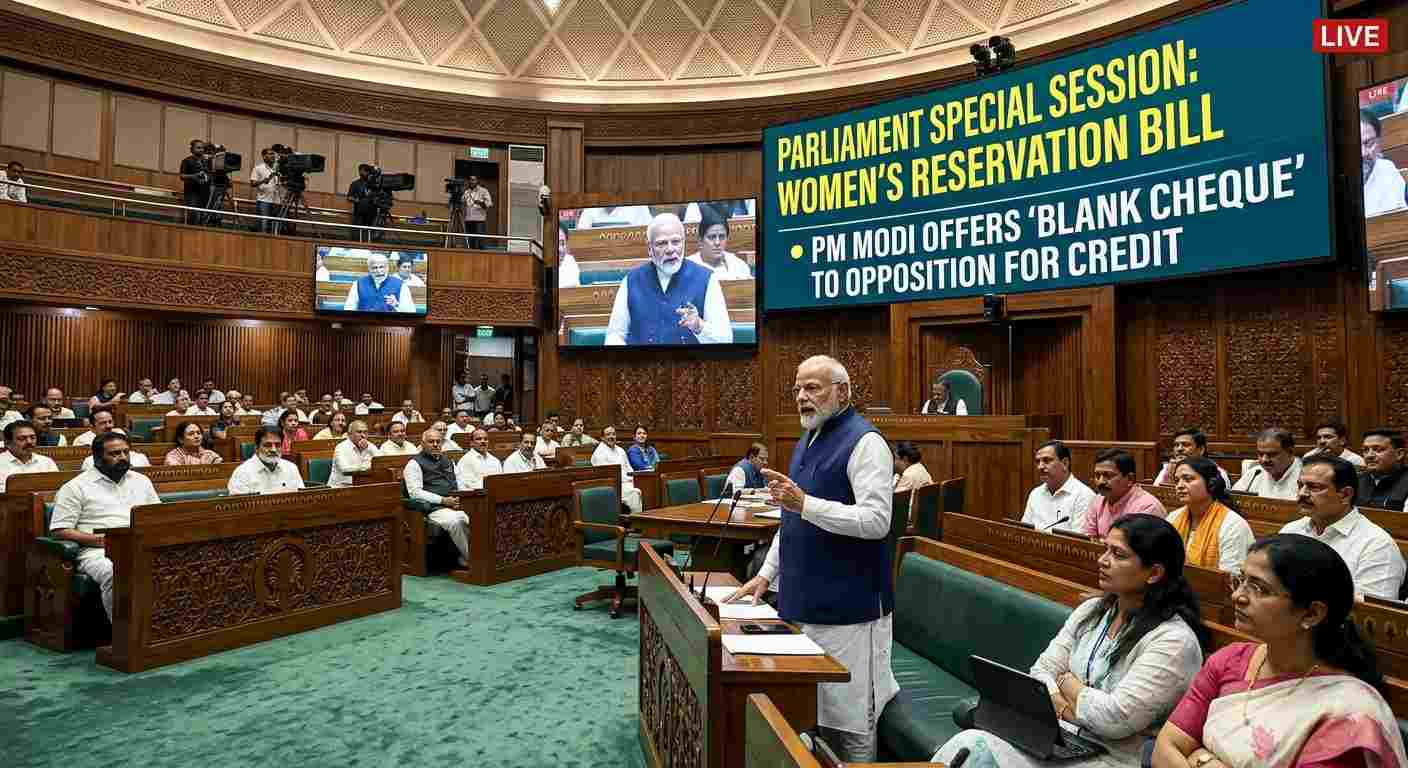
Parliament Special Session 2026 :The Indian Parliament has once again become the epicenter of a high-stakes political drama as a three-day special sitting commenced on Thursday, April 16, 2026. At the heart of this legislative storm is the Constitution (131st Amendment) Bill, a pivotal move aimed at finally unfreezing the long-delayed 33% reservation for women in the Lok Sabha and State Assemblies.
With the historic halls of the New Parliament House echoing with heated debates, Prime Minister Narendra Modi made a significant overture to the Opposition, offering what he termed a “blank cheque” for credit, provided the legislation passes without further political bickering. However, as the numbers are crunched and the implications of a massive delimitation exercise loom, the road to consensus remains fraught with challenges.
Parliament Special Session 2026 :The Reform Blueprint A Deep Dive into the Triple Legislative Push
The special session, scheduled from April 16 to April 18, saw the introduction of three major bills that could fundamentally alter India’s democratic map:
The Constitution (One Hundred and Thirty-First Amendment) Bill, 2026: Introduced by Union Law Minister Arjun Ram Meghwal, this bill seeks to decouple the 2023 Women’s Reservation Law from the previous constraints that tied its implementation to the completion of a new Census and subsequent delimitation.
The Delimitation Bill, 2026: Also tabled by Meghwal, this proposal is perhaps the most controversial. It envisions expanding the Lok Sabha’s strength from the current 543 seats to a staggering 850 seats.
The Union Territories Laws (Amendment) Bill, 2026: Tabled by Home Minister Amit Shah, this bill focuses on administrative adjustments required to align UT laws with the new structural changes in the legislature.
The introduction of these bills was not a quiet affair. After a division of votes, the House saw 251 members supporting the introduction, while 185 members stood in opposition.
PM Modi’s “Blank Cheque” and the Call for National Interest
In a speech that blended conciliation with a stern warning, Prime Minister Narendra Modi urged the House to view the Women’s Reservation Bill through the lens of national progress rather than partisan gain.
“Women’s reservation is not intended to favor any single party; it is a commitment to the mothers and daughters of this nation,” the PM stated.
Addressing the anxieties of Southern states regarding the delimitation exercise—which many fear will reduce their parliamentary weightage due to successful population control—the Prime Minister was emphatic: “No injustice will be done to any State.”
In a rare rhetorical move, he challenged the Opposition to stop “politicizing” the delay. He offered to let the Opposition take all the credit for the bill’s passage, effectively handing over a “blank cheque” to the INDIA bloc if they supported the immediate implementation of the quota. He further reminded the House that parties which had historically blocked such measures had often faced the wrath of the electorate.
The Opposition’s Counter: “Implement Now, Don’t Weaponize”
The INDIA bloc, led by senior Congress figures like KC Venugopal, was quick to pivot the narrative. While the Opposition maintains it is not against the 33% reservation, it remains vehemently opposed to the delimitation provisions bundled with the amendment.
KC Venugopal’s critique focused on the “nine years of inaction” by the current government. He pointed out that the Congress party had already set the precedent for female leadership by giving India its first woman Prime Minister and first woman Speaker.
“Don’t weaponize this quota,” Venugopal argued, alleging that the government is using the reservation as a tactical tool to force through a delimitation exercise that could harm democratic balance. The Opposition’s stance is clear: they are willing to give the government their own “blank cheque” of support if the 33% quota is implemented immediately, without waiting for the seat-count expansion.
The Math of the 131st Amendment
The legislative hurdle for a Constitutional Amendment is steep. It requires a two-thirds majority of the members present and voting.
NDA Strength: 292 seats
Opposition (INDIA bloc) Strength: 233 seats
With 425 members present during the initial vote, the government managed to introduce the bill, but the real test comes on Friday, April 17, 2026, at 4 p.m., when the final voting on the passage of the bills will take place. The gap between the NDA’s current strength and the required two-thirds mark suggests that some level of cross-party support or tactical abstentions will be necessary for the amendment to sail through.
The Delimitation Dilemma: Why 850 Seats?
The draft proposals to increase the Lok Sabha to 850 seats are based on the need to reflect India’s current population distribution. However, this has opened a Pandora’s box of regional politics.
The Argument for Expansion: Supporters argue that the current seat count is based on the 1971 Census, making each MP responsible for an unwieldy number of constituents. An expansion would allow for better representation and more manageable constituencies.
The Argument Against: Critics, including Tamil Nadu Chief Minister MK Stalin—who has led protests on the streets—argue that states that successfully implemented family planning will be “punished” with fewer seats relative to states with higher population growth. This, they claim, threatens the federal structure of the Union.
The Road Ahead: Friday’s Decisive Vote
As the three-day session moves into its second day, the focus shifts to the detailed discussion and the looming 4 p.m. deadline on Friday. The nation is watching closely to see if the “blank cheque” offered by the Prime Minister will be picked up by the Opposition, or if the 131st Amendment will become the latest casualty of the ideological divide.
Beyond the walls of Parliament, activists are already calling for the delinking of women’s reservation from the Census and delimitation entirely. They argue that women have waited decades for representation, and tying their rights to a complex, multi-year bureaucratic exercise like delimitation is a form of “procedural injustice.”
Conclusion
Whether this special session results in a historic victory for gender parity in Indian politics or a deeper stalemate over regional representation remains to be seen. One thing is certain: the decision made on April 17 will resonate for decades, defining the composition of the Indian legislature and the strength of its federal spirit.