
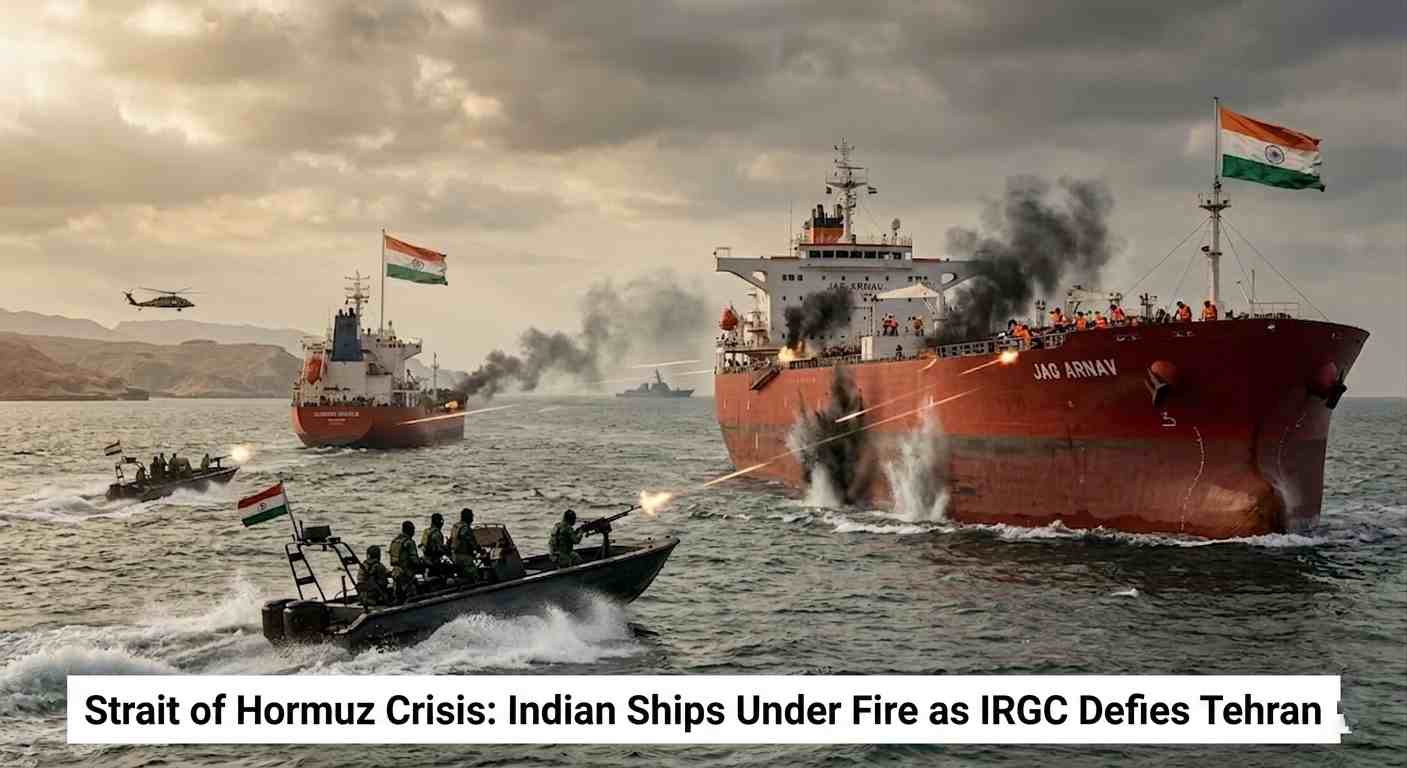
The Strait of Hormuz Crisis volatile waters of the Middle East have witnessed a harrowing escalation that threatens to destabilize global energy markets and strain long-standing diplomatic ties. In a shocking turn of events on Saturday, 2 Indian-flagged vessels—including a massive Very Large Crude Carrier (VLCC)—were targeted by Iranian gunboats in the Strait of Hormuz.
This critical security breach comes at a time when the world was hoping for a de-escalation following a ceasefire in Lebanon. Instead, the incident has exposed a massive and dangerous rift within Iran’s own power structure, proving that the “fog of war” is not just between nations, but within the halls of Tehran itself.
1. The Attack: Chaos in the Shipping Lane
The two vessels, identified as the Jag Arnav and the Sanmar Herald, were navigating the northeast waters of Oman, a vital maritime corridor for global oil trade. According to official sources, Iranian gunboats approached the ships and opened fire.
While the Ministry of External Affairs (MEA) confirmed that the crew is safe and the vessels sustained no structural damage, the psychological and geopolitical impact is enormous. The ships were forced to abandon their course and turn back, adding to the growing list of commercial vessels caught in the crossfire of the ongoing US-Iran tensions.
The involvement of a VLCC is particularly concerning. These “super-tankers” are designed for long-haul transport and can carry up to 2 million barrels of oil. An attack on such a vessel isn’t just a threat to the crew; it is a potential environmental and economic catastrophe waiting to happen.
2. India’s Swift Diplomatic Pushback
New Delhi did not mince words. Following the incident, the Foreign Secretary summoned the Iranian Ambassador, Mohammad Fathali, to lodge a formal and stern protest.
“India attaches the highest importance to the safety of merchant shipping and its mariners,” the MEA statement read.
The timing of this attack is particularly puzzling for Indian diplomats. Only days ago, Ambassador Fathali had assured NDTV that the Strait of Hormuz would remain open for Indian vessels, categorizing India as a “friendly nation.” The sudden shift from verbal assurances to active gunfire suggests a total breakdown in communication between Iran’s diplomatic corps and its paramilitary forces.
3. A Divided Iran: The Civilian vs. IRGC Rift
Why would Iran fire on ships from a country it considers a “friend”? The answer lies in the concept of Heterarchical Governance—a system where power is split between multiple centers with no single authority in charge.
The Diplomatic Side: Foreign Minister Abbas Araghchi has been the face of Iran’s attempt to seek economic relief and engage in talks. He tweeted that the Strait would remain “fully open” following the ceasefire in Lebanon.
The Military Side: The Islamic Revolutionary Guard Corps (IRGC), which maintains operational control over the Strait, clearly had other plans. Hours after Araghchi’s announcement, the IRGC enforced a blockade, claiming that any passage required “direct coordination” with their naval wing.
This vicious internal politics has led to what experts call a “mosaic” power structure. Since the death of Supreme Leader Ali Khamenei and other high-ranking officials like Ali Larijani, a power vacuum has emerged. The IRGC has moved to fill this void, often overriding the decisions of President Masoud Pezeshkian, whom they view as too moderate.
4. The Economic Fallout: 180° Shift in Global Stability
The Strait of Hormuz is the world’s most important oil transit chokepoint. Approximately 20% of the world’s oil and liquefied natural gas (LNG) passes through this narrow waterway. For India, the stakes are even higher: nearly 90% of Indian gas imports transit through this region.
The US naval blockade of Iranian ports and Iran’s subsequent threats to “choke” the Strait have sent insurance premiums for shipping through the roof. Even as Iran claims to have delivered 6 million barrels of oil to India in the past week to bypass the blockade, the firing incident suggests that no shipment is truly safe.
5. What Lies Ahead?
The situation in the Persian Gulf remains “fluid” and highly dangerous. With 20,000 seafarers currently stranded in the region, the international community is looking toward Washington and Tehran for a definitive resolution. US President Donald Trump has signaled that a deal might be “soon,” but the IRGC’s “finger on the trigger” mentality suggests that any peace treaty signed in a boardroom might be ignored on the water.
For India, the priority remains the safe return of its sailors and the security of its energy supply. However, as long as the IRGC continues to challenge Tehran’s civilian leadership, the Strait of Hormuz will remain a deadly gamble for commercial shipping.
Strait of Hormuz Crisis : Key Takeaways from the Crisis
| Feature | Details |
| Vessels Attacked | Jag Arnav (VLCC) & Sanmar Herald |
| Location | Northeast of Oman, Strait of Hormuz |
| Primary Conflict | IRGC (Military) vs. Iranian Civilian Government |
| Global Impact | Threat to 20% of world oil supply |
| India’s Status | “Friendly” but still targeted due to internal Iranian chaos |