
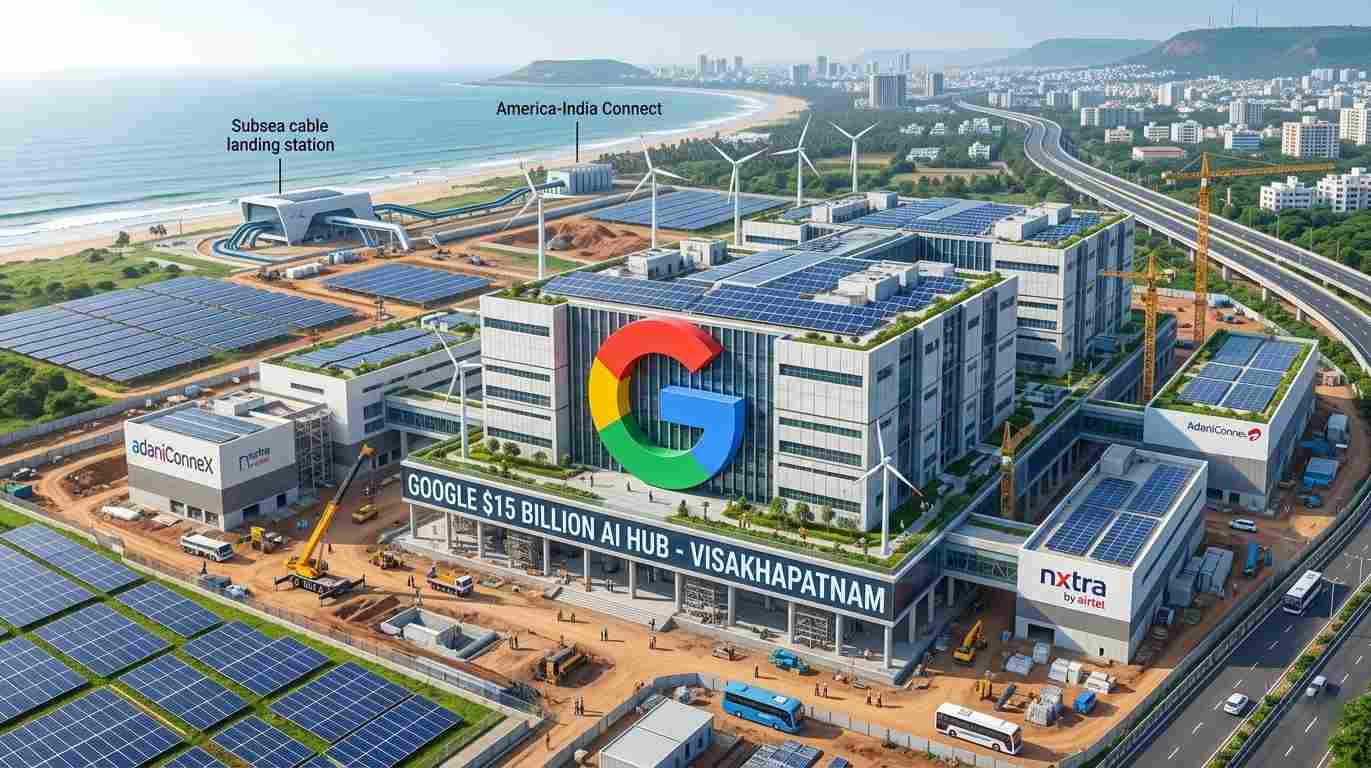
Google’s $15 Billion AI Hub in Visakhapatnam in a monumental move that solidifies India’s position as a global technology powerhouse, Google has officially broken ground on its massive $15 billion AI hub in Visakhapatnam. This ambitious project, first announced in late 2025, represents Google’s largest investment outside the United States and is set to transform the coastal city of Andhra Pradesh into a critical node in the global artificial intelligence landscape.
The groundbreaking ceremony, held on April 28, 2026, saw a gathering of high-profile leaders including Union IT Minister Ashwini Vaishnaw, Andhra Pradesh Chief Minister N. Chandrababu Naidu, and IT Minister Nara Lokesh. Industry titans from the Adani Group and Bharti Enterprises also joined Google executives to mark the start of a project that aligns directly with the government’s Viksit Bharat 2047 vision.
1. A Gigawatt-Scale Marvel: The Infrastructure
The Google’s $15 Billion AI Hub in Visakhapatnam is not just a data center; it is a “gigawatt-scale” ecosystem. Developed in partnership with AdaniConneX and Nxtra by Airtel, the hub will consist of three sprawling data center campuses.
Unlike Google’s existing facilities in Mumbai and Delhi—which primarily serve enterprise applications—this new Vizag hub is designed to handle the massive compute loads required for Google’s entire consumer stack. This includes:
Google Search (Powered by next-gen AI)
Gemini (Google’s flagship AI model)
Google Maps
Global Enterprise Cloud Services
By building at this scale, Google is ensuring that it can serve not only the burgeoning domestic demand in India but also export AI compute capabilities to the rest of the world.
2. The “Greenest” Data Centers on the Planet
Sustainability is at the heart of this $15 billion investment. Bikash Koley, Vice President of Global Infrastructure at Google, emphasized that these will be among the company’s “greenest” facilities.
Google’s strategy involves:
Grid Assets: Rather than just drawing power, these data centers are designed to be “grid assets” that add energy back into the local infrastructure.
Renewable Energy Mix: The project will leverage a sophisticated combination of solar, wind, hydro, and pumped hydro energy.
Local Collaboration: Google is working with Indian renewable energy developers to build new transmission lines and energy storage systems specifically for the Visakhapatnam region.
3. Global Connectivity: The America-India Connect
Visakhapatnam is set to become a focal point of the “global mesh” of connectivity. The AI hub includes the America-India Connect initiative, a new international subsea gateway.
This subsea cable route will provide a direct, high-capacity link between the United States, India, and various locations across the Southern Hemisphere. This infrastructure ensures that India remains connected even during issues at traditional maritime chokepoints, providing “robust connectivity” that is vital for real-time AI applications.
4. Economic Impact and the “STAR” Program
While data centers are often criticized for low direct employment relative to investment, Google is focusing on the broader economic ecosystem. Koley noted that such hubs typically generate over $500 million in regional economic activity.
To ensure the local population benefits directly, Google has launched the Skills Trade and Readiness (STAR) program.
Training: Over 1,000 locals will be trained in specialized fields like welding, facility operations, and construction.
Academic Partnerships: In collaboration with the ICT Academy, 1,200 students and educators will receive training in Generative AI and cloud computing.
NARI Shakti: A dedicated program to help women from low-income backgrounds build sustainable livelihoods through technology.
5. Timeline: When Will Vizag Go Live?
The construction will be “front-loaded,” meaning a significant portion of the $15 billion will be spent in these early stages on physical infrastructure and power systems. Google expects a “good fraction” of the gigawatt capacity to be operational by late 2028 or early 2029.
The capacity will then scale up incrementally every two to three years to match the growth of AI usage globally.
Beyond Technology: Community Welfare
Google’s $15 Billion AI Hub in Visakhapatnam entry into Vizag comes with a commitment to environmental and social welfare. The company has announced several initiatives:
Watershed Management: Partnering with Sponge Collaborative to protect local natural resources.
Fishing Community Support: Providing GPS and advanced weather tools to over 1,000 local fishers through the Sambhav Foundation.
Udaan India Fund: Grants for local schools and social enterprises to improve education and social mobility.
Conclusion: A Strategic Blueprint for the Future
The Google $15 billion AI hub in Visakhapatnam is more than an infrastructure project; it is a strategic blueprint for the future of the digital economy. By combining high-end AI infrastructure with sustainable energy and deep community roots, Google is betting big on India’s ability to lead the next wave of global innovation.
As the first bricks are laid at Tarluvada, the message is clear: the future of AI is being built in Visakhapatnam.
Quick Facts: The Vizag AI Hub at a Glance
| Feature | Details |
| Total Investment | $15 Billion (approx. ₹1.25 Lakh Crore) |
| Location | Tarluvada, Visakhapatnam, Andhra Pradesh |
| Partners | AdaniConneX, Nxtra by Airtel |
| Operational Goal | Late 2028 – Early 2029 |
| Power Scale | Gigawatt-level capacity |
| Key Initiatives | Subsea Cable Gateway, STAR Training Program |