
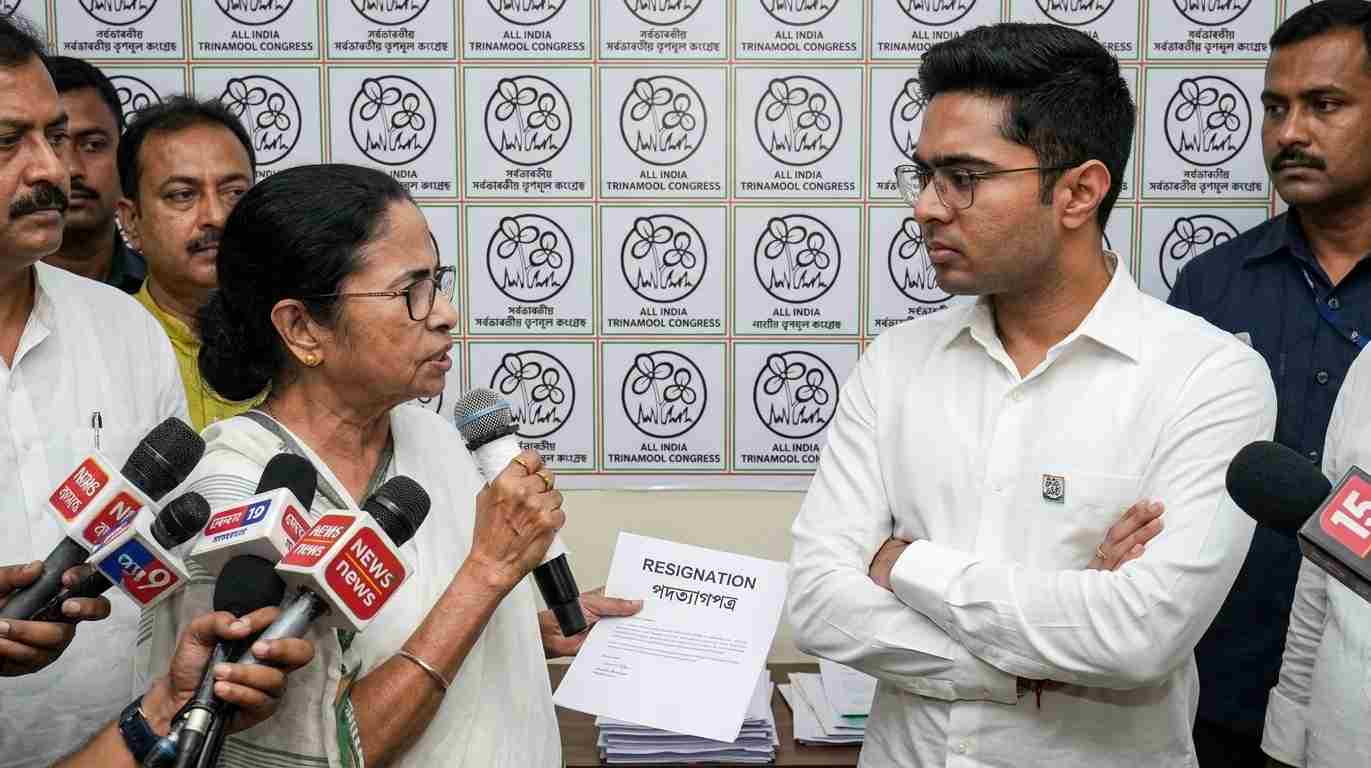
Mamata Banerjee Resignation Stand- off The political landscape of India has witnessed many storms, but the current situation in West Bengal following the 2026 Assembly Elections is perhaps the most turbulent in recent democratic history. On May 5, 2026, a day that will be etched in the annals of Indian politics, West Bengal Chief Minister Mamata Banerjee made a startling declaration : she will not resign. Despite a decisive mandate favoring the Bharatiya Janata Party (BJP), which secured 206 out of 293 seats, Banerjee remains defiant, claiming that she did not truly lose the election.
The Defiance: “I Am a Free Bird”
Following a massive setback where the Trinamool Congress (TMC) was reduced to just 80 seats—a staggering drop from the 215 seats it held in 2021—Banerjee addressed the press not with a concession, but with a challenge. She characterized her current status as that of a “free bird,” signaling her intent to pivot toward national politics and the strengthening of the INDIA bloc, even as her hold on the state administration hangs by a thread.
The core of the Mamata Banerjee Resignation Stand-off lies in her refusal to visit Raj Bhavan. Traditionally, an outgoing Chief Minister submits their resignation to the Governor immediately after the results are declared. Banerjee, however, has broken this convention.
“I have not lost, so I will not go to Raj Bhavan. I will not tender resignation,” she stated. This
move has created a constitutional vacuum that has never been seen in a state as large and
politically significant as West Bengal.
The Counter-Attack: Himanta Biswa Sarma’s Ultimatum
The BJP’s response was swift and uncompromising. Assam Chief Minister Himanta Biswa Sarma, acting as a prominent voice for the party’s central leadership, has called for her immediate dismissal if she does not step down voluntarily. Sarma’s rhetoric highlights the growing friction between the state’s popular mandate and the incumbent’s refusal to acknowledge it.
“The Governor will wait for a certain period, and after that, she
will be dismissed – it is as simple as that. The country doesn’t
run according to her whims.” — Himanta Biswa Sarma
Sarma’s argument is grounded in the logic of parliamentary democracy. He pointed out that the election outcome is a declared fact. Banerjee’s claim that “100 seats were snatched” was dismissed by Sarma as a dangerous precedent. He argued that if every losing party claimed their seats were stolen, the electoral fabric of the country would dissolve into chaos.
The Election Commission and the “SIR” Controversy
Central to the Mamata Banerjee Resignation Stand-off is the allegation of “vote theft” through the Special Intensive Revision (SIR) of voter lists. The TMC has accused the Election Commission of India (ECI) and the central government of colluding to manipulate the electoral rolls. Banerjee has gone as far as to say that her real contest was not with the BJP, but with the ECI itself.
However, the legal standing of these claims is weak. The SIR was mandated by the Supreme Court of India to ensure the integrity of the voter lists in a state plagued by allegations of illegal immigration and “ghost voters.” As Sarma pointed out, the TMC had already challenged this in the Supreme Court and lost. The judicial stamp of approval on the ECI’s methods leaves Banerjee with little room for legal recourse, yet she continues to use this as a political shield to justify her refusal to exit.
Constitutional Implications: Can a Governor Dismiss a CM?
The current Mamata Banerjee Resignation Stand-off brings to the forefront the powers of the Governor under the Indian Constitution. Technically, the Governor has the authority to dismiss a Chief Minister if they lose the confidence of the house. However, several Supreme Court rulings, most notably the S.R. Bommai case, have placed significant checks on this power. Typically, the floor of the Assembly is where “confidence” must be tested. But the Bengal situation is unique. The term of the current assembly ends on May 7. If the winning party (BJP) stakes a claim and Banerjee refuses to leave, the Governor is legally obligated to invite the party with the majority to form the government. The refusal to resign is seen by many legal experts not just as a political protest, but as a direct challenge to the constitutional transition of power.
The Role of the INDIA Bloc
Banerjee’s mention of the INDIA bloc suggests a strategic shift. By refusing to resign, she is
attempting to frame her defeat as a “state-sponsored coup” rather than a democratic loss.This narrative is designed to galvanize the national opposition. By labeling herself a “free bird,” she signals that she is no longer bound by the administrative duties of Bengal and is ready to take the fight to the national stage.
Yet, this strategy is a double-edged sword. While it might win her sympathy among certain sections of the opposition, it risks alienating the moderate voter who values the sanctity of the democratic process. The Mamata Banerjee Resignation Stand-off could potentially paint her as an anti-democratic figure, a narrative the BJP is already aggressively pushing.
Public Sentiment and the Future of Bengal
Bengal has tolerated Banerjee for three terms, but the 2026 results indicate a massive shift in public sentiment. The BJP’s jump to 206 seats is not a narrow margin; it is a landslide.The issues of border fencing, internal security, and corruption allegations seem to have finally reached a tipping point for the electorate.
Sarma’s critique of Banerjee’s governance—notably her opposition to border fencing—resonated with a large section of the voters who feel that the state’s security has been compromised for “vote bank politics.” The refusal to accept this mandate is being viewed by critics as an insult to the “Amra Bangali” (We Bengalis) identity that Banerjee has so often invoked.
Conclusion: A Deadline for Democracy
As the May 7 deadline approaches, the Mamata Banerjee Resignation Stand-off remains the most watched political drama in the country. Will she relently and follow the democratic norm, or will the Governor be forced to take the unprecedented step of dismissal?
The outcome of this standoff will set a precedent for how electoral defeats are handled in the age of extreme polarization. For now, West Bengal remains in a state of suspended animation, caught between a leader who refuses to let go and a mandate that demands change. The next 48 hours will decide if Bengal moves toward a smooth transition or a deep constitutional crisis.