
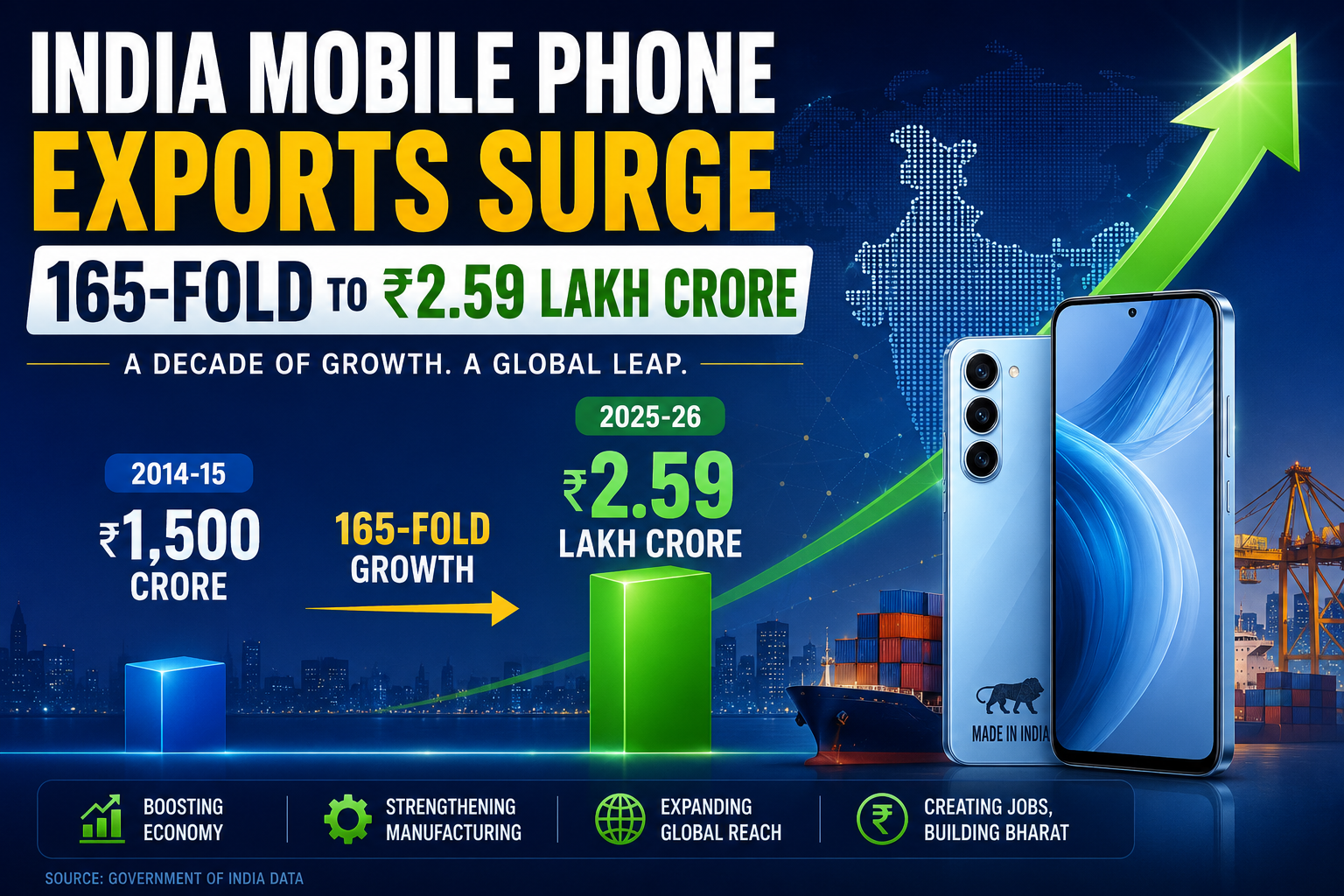
India Mobile Phone Exports have taken a huge leap over the last decade. India used to buy almost all its phones from abroad, but now it has turned into a major global maker. The government recently told the Lok Sabha how new local policies, cash incentives for parts, and foreign money helped build this huge electronics market from the ground up.
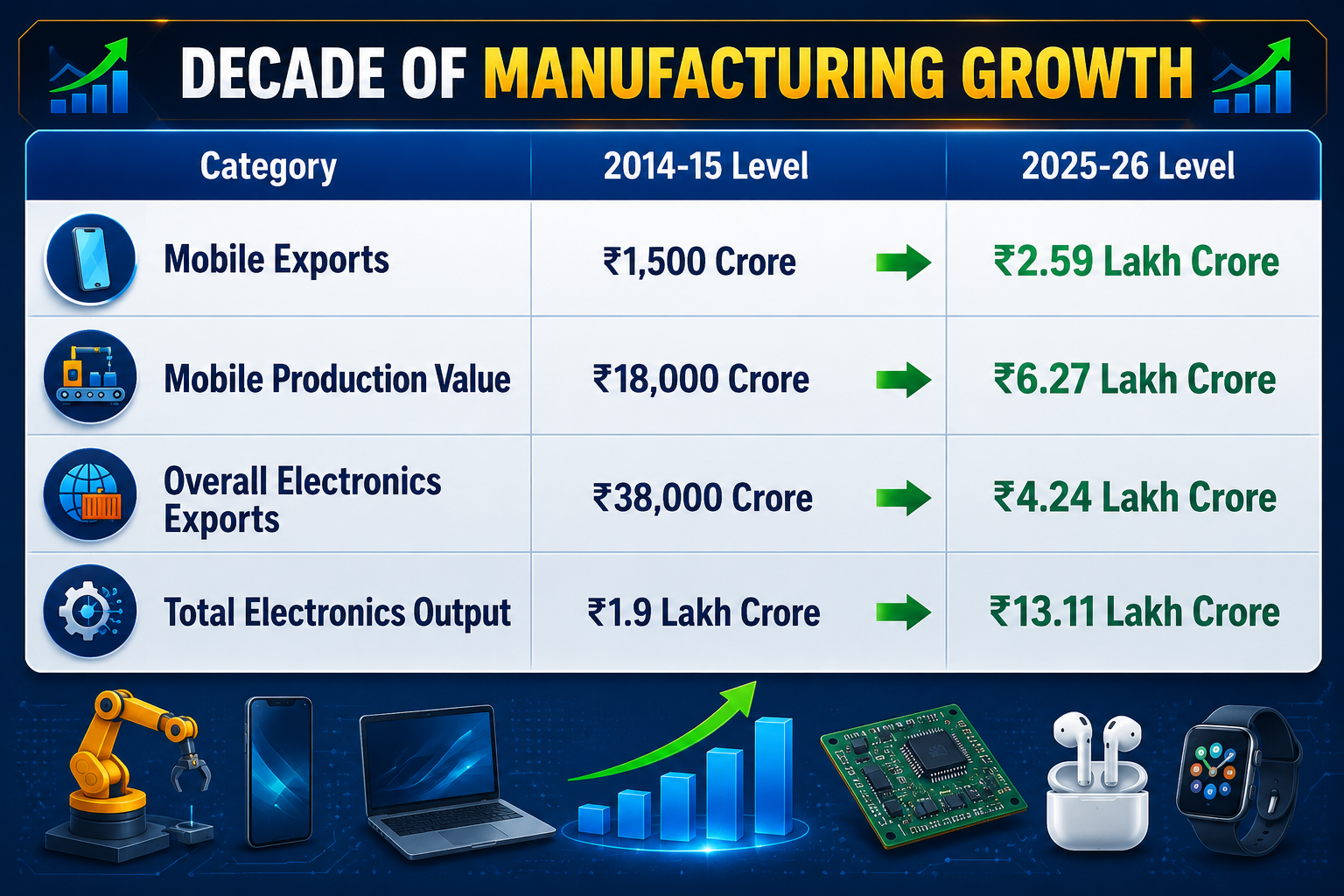
Union Minister for Electronics and Information Technology Ashwini Vaishnaw highlighted that mobile phone exports soared from roughly ₹1,500 crore in FY15 to an impressive ₹2.59 lakh crore in FY26—marking a 165-fold rise. Overall mobile production expanded 33 times in the same timeline, escalating from ₹18,000 crore to ₹6.27 lakh crore.
1. Broader Electronics and Semiconductor Progress
The expansion of mobile assembling is part of a larger push across the broader electronics and component landscape. Overall electronics output expanded nearly sevenfold, climbing from ₹1.9 lakh crore in FY15 to ₹13.11 lakh crore in FY26. Concurrently, broader electronics exports rose 11-fold, advancing from nearly ₹38,000 crore to ₹4.24 lakh crore.
Total Electronics Output Trend
2014-15: [₹1.9 Lakh Cr  ]
2025-26: [========================= ₹13.11 Lakh Cr =========================]
Domestic Memory Chip Production
Addressing domestic semiconductor supply chains under the Semicon India Programme (launched in January 2022), the government confirmed active memory chip assembly:
Micron: Currently producing DRAM, NAND Flash Memory, and Solid State Drives (SSDs).
Sahasra: Actively manufacturing NAND Flash Memory units.
These operations provide a crucial buffer as global memory chip supplies tighten under surging demand from artificial intelligence servers, enterprise data centers, and high-performance computing applications. To sustain momentum, the Union Cabinet approved Semicon 2.0, designed to deepen indigenous chip design, fabrication, display fabs, and advanced packaging infrastructure.
2. The Next Phase: The ₹62,500-Crore Mobile Scheme
Following the sunset of the initial Production-Linked Incentive (PLI) scheme for mobile phones in FY26, the government introduced the enhanced Mobile Manufacturing Scheme (MPMS) with an outlay of ₹62,500 crore over five years.
| PLI Scheme (FY21-FY26) | MPMS Scheme (Next 5 Years) |
| Outlay: ~₹30,000 Crore | Outlay: ₹62,500 Crore |
| Base Incentive: 4% to 6% | Base Incentive: 2.5% to 5.0% |
| Primary Focus: Volume / Investment | Primary Focus: Export Target & DVA |
| Additional Bonus: None | Domestic Sourcing Bonus: +1.5% |
Strategic Policy Shifts
Export-Linked Incentives: Base incentive tiers will range between 2.5% and 5% (down from 4–6% under PLI), but financial payouts are now explicitly conditioned on export volume milestones rather than total volume.
Deepening Value Addition: Companies earn an additional 1.5% incentive bonus by sourcing key sub-assemblies and components locally. While India’s Domestic Value Addition (DVA) stands at 24%, policy updates target higher integration.
Domestic Champion Support: Dedicated provisions aim to help home-grown vendors scale, shift away from sole reliance on contract work for foreign players, and build globally recognized Indian device brands.
3. Apple’s Rising India Footprint
Apple Inc. serves as a primary example of this policy shift. Initially expecting India to handle around 10% of its global iPhone production by FY26, the company now manufactures one out of every four iPhones globally within the country.
Global iPhone Manufacturing Share (Current)

        [ China: ~75% ]
        [ India:  25% ] ========> (1 in 4 iPhones worldwide)
In FY26 alone, smartphone exports to key markets like the United States jumped 86% to reach $19.6 billion, up from $10.5 billion in FY25. This single fiscal year accounted for nearly 40% of Apple’s total cumulative exports from India during the entire initial PLI operational period.
Local Component Supplier Ecosystem
To solidify domestic manufacturing, Apple has partnered with key anchor vendors under electronic component initiatives:
Tata Electronics: Structural enclosures and precision assembly.
Motherson Electronic Components: Wiring and component assemblies.
Hindalco: High-grade industrial aluminum supplies.
Yuzhan Technology (Foxconn subsidiary): Component tooling and specialized parts.
ATL: Lithium-ion battery cell packaging and assembly.
4. Addressing the Cost Disability Gap with China
Despite rapid growth, Indian manufacturing continues to deal with structural cost disadvantages relative to China, though the margin has shrunk significantly over the last seven years.
Cost Disability Gap to China (iPhone Production)

  2019 baseline:  [19.2% ============= 21.7%]
  FY26 closeout:  [12.0% ===== 14.0%]
  Long-term goal: [Sub-10% Target   ]
Key Drivers of Disability Costs
High import tariffs on initial raw inputs and non-localized micro-components.
Elevated industrial logistics, power, and utility costs compared to regional hubs.
Higher borrowing rates and financing fees for capital investments.
Industry targets framed by MeitY and the India Cellular and Electronics Association (ICEA) project cumulative mobile exports under MPMS to reach ₹15 trillion ($155 billion) over the next five-year cycle, with total mobile production value hitting ₹39 trillion ($405 billion).
Key Strategic Takeaways
Massive Export Scaling: India Mobile Phone Exports surged from ₹1,500 crore to ₹2.59 lakh crore in a single decade.
Targeted Incentives: The ₹62,500-crore MPMS replaces the initial PLI, emphasizing direct exports and a 1.5% bonus for local component sourcing.
Global Footprint: India now accounts for 25% of global iPhone production, supported by a growing network of component suppliers.
Semiconductor Progress: Micron and Sahasra are manufacturing DRAM and NAND flash locally, backed by the new Semicon 2.0 framework.
Narrowing the Cost Gap: Cost disabilities relative to China have dropped from over 19% to between 12% and 14%, with long-term competitiveness depending on broader logistics and infrastructure reforms.