
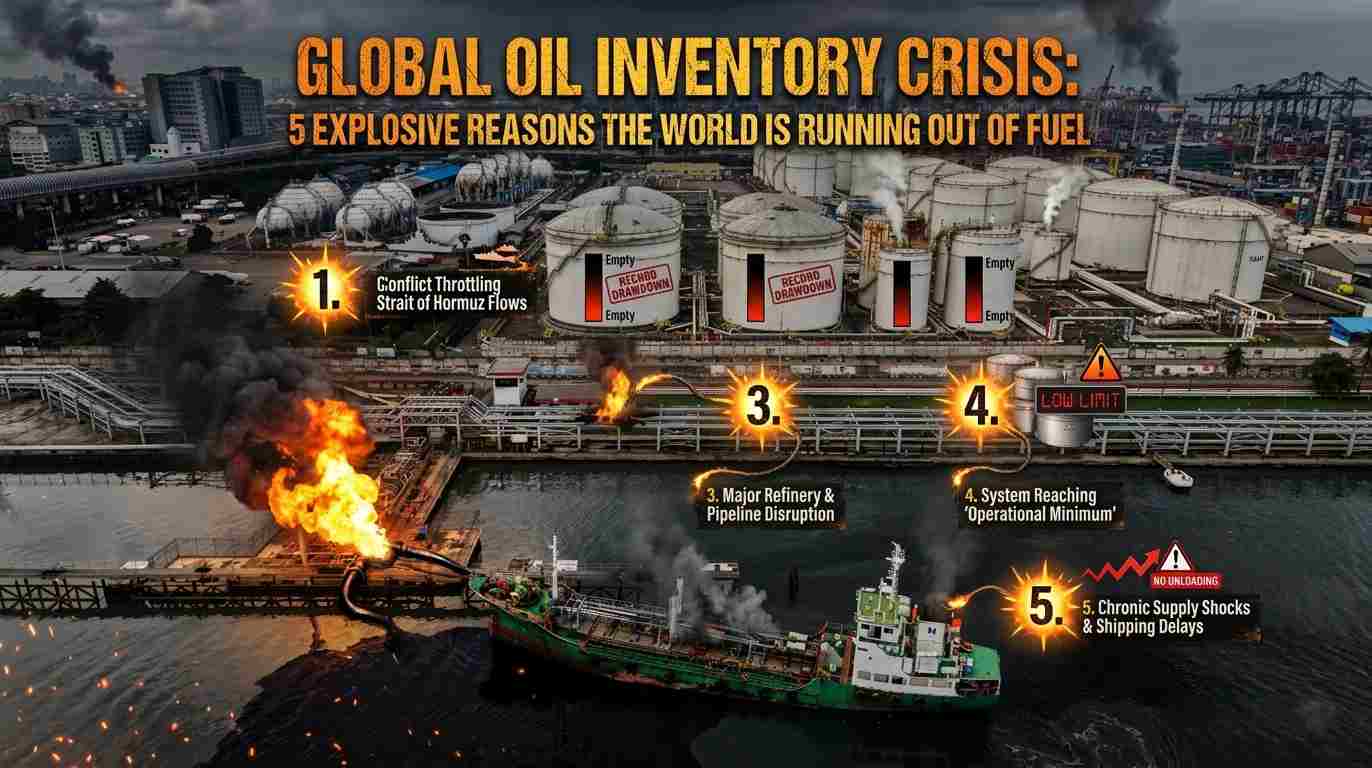
The Global Oil Inventory Crisis has officially entered uncharted territory. As the conflict in the Middle East throttles the world’s most vital energy artery—the Strait of Hormuz—the “shock absorbers” of the global economy are being compressed to their breaking point. This isn’t just another fluctuation in the volatile energy market; it is a fundamental shift in how the world fuels its existence.
For decades, global oil stockpiles served as a silent guardian, a massive buffer designed to protect nations from the whims of geopolitics. But today, that buffer is evaporating. Recent data from Morgan Stanley paints a harrowing picture: between March 1 and April 25, global oil stockpiles plummeted by approximately 4.8 million barrels a day. To put that in perspective, this drawdown far exceeds any previous peak in the history of the International Energy Agency’s (IEA) data tracking.
We are no longer just looking at high prices at the pump; we are looking at the terrifying prospect of empty tanks and stalled industries.
The Math of Exhaustion: 4.8 Million Barrels a Day
When Morgan Stanley released its estimates, the shockwaves were felt from Wall Street to Tokyo. A daily drop of 4.8 million barrels is more than a statistic; it represents the literal burning through of our safety net.
The primary driver is the near-closure of the Strait of Hormuz. With the Iran war effectively blockading one of the world’s most critical transit points, the flow of crude has turned from a torrent into a trickle. Consequently, the world has been forced to dip into its savings account—its strategic and commercial reserves—to keep the lights on.
The “Operational Minimum” Trap
One of the most dangerous misconceptions about the Global Oil Inventory Crisis is the idea that we can use every last drop of oil in storage. Natasha Kaneva, head of global commodities research at JPMorgan Chase & Co., recently issued a sobering reminder: the system has an “operational minimum.”
Think of it like the fuel tank in your car. When the light comes on, you aren’t out of gas, but the pump may struggle to pull the remaining sediment-heavy fuel from the bottom. On a global scale, the “tank” includes the oil sitting in pipelines, the sludge at the bottom of massive storage vats, and the “on-water” inventory that is weeks away from reaching a refinery.
We reach a crisis point—the operational minimum—long before the physical inventory hits zero. If we hit that floor, the global supply chain doesn’t just slow down; it seizes.
Regional Disparities: A Tale of Two Troughs
While the Global Oil Inventory Crisis is a worldwide phenomenon, the pain is not being felt equally. This regional imbalance is perhaps the most volatile element of the current crisis.
1. The US Strategic Reserve at 1980s Levels
In the United States, the situation is particularly acute. U.S. oil reserves have hit their lowest levels since 1982. While exports have climbed to meet global demand, the domestic “emergency fund” is looking increasingly thin. This leaves the world’s largest economy uniquely vulnerable to any further supply shocks.
2. Europe and Asia on the Brink
Goldman Sachs Commodities Research has pointed out that while aggregate global levels seem “safe” on paper, the localized reality in Europe and Asia is much grimmer.
Europe: Facing critical shortages of jet fuel and diesel.
Emerging Asia: Struggling with a lack of naphtha and LPG, the lifeblood of the petrochemical industry.
Goldman estimates that while the world currently has about 101 Days of Demand (DoD) in stock, that number is expected to slide to 98 DoD by the end of May. This is dangerously close to the 8-year low.
3. The China Conundrum
Interestingly, China remains an outlier. While the rest of the world drains its tanks, China has maintained crude stocks near record highs. However, this offers little comfort to the global market. Export restrictions and the logistical nightmare of moving oil from one side of the planet to the other mean that China’s surplus cannot easily solve Europe’s deficit.
Is the World Truly Running Out of Oil?
The question isn’t whether there is oil left in the ground—there is plenty. The question is whether we can get it to the people who need it before the “landed” storage runs dry.
Goldman Sachs analysts have warned that the “depletion speed” is now a more significant threat than the absolute level of stocks. If the current pace continues, the global system’s minimum operational landed storage level—estimated at 30 to 40 days of demand—could be breached in specific regions.
The Threat of “Fuel Runs”
When inventories drop below critical levels, a psychological shift occurs. Much like a bank run, a “fuel run” happens when industries and governments begin hoarding what little is left, terrified of being the one left without. We are already seeing the early signs of this:
Industrial Outages: Factories in Asia slowing production due to LPG shortages.
Aviation Crisis: European airlines scrambling to secure jet fuel contracts at any price.
Logistical Gridlock: A lack of refined products means trucks can’t move goods, further exacerbating the economic slowdown.
The Long-Term Fallout of the Iran War
Even if a peace treaty were signed tomorrow, the Global Oil Inventory Crisis would cast a long shadow. Refilling a billion barrels of lost inventory is not an overnight task. It requires years of overproduction and massive capital investment—something the oil industry has been hesitant to do in the face of the global transition to green energy.
The current conflict has effectively “eaten” the buffer that was supposed to protect us against the next crisis. We are now walking a tightrope without a net.
Conclusion: A Fragile Future
The Global Oil Inventory Crisis is a wake-up call. The era of “cheap and easy” energy security is over. As the Iran war continues to throttle supply and the world burns through its final reserves, the margin for error has disappeared.
Governments must now decide: do they implement drastic demand-side rations, or do they risk a total systemic collapse when the “operational minimum” is finally reached? For the average consumer, the message is clear: the volatility is just beginning.