
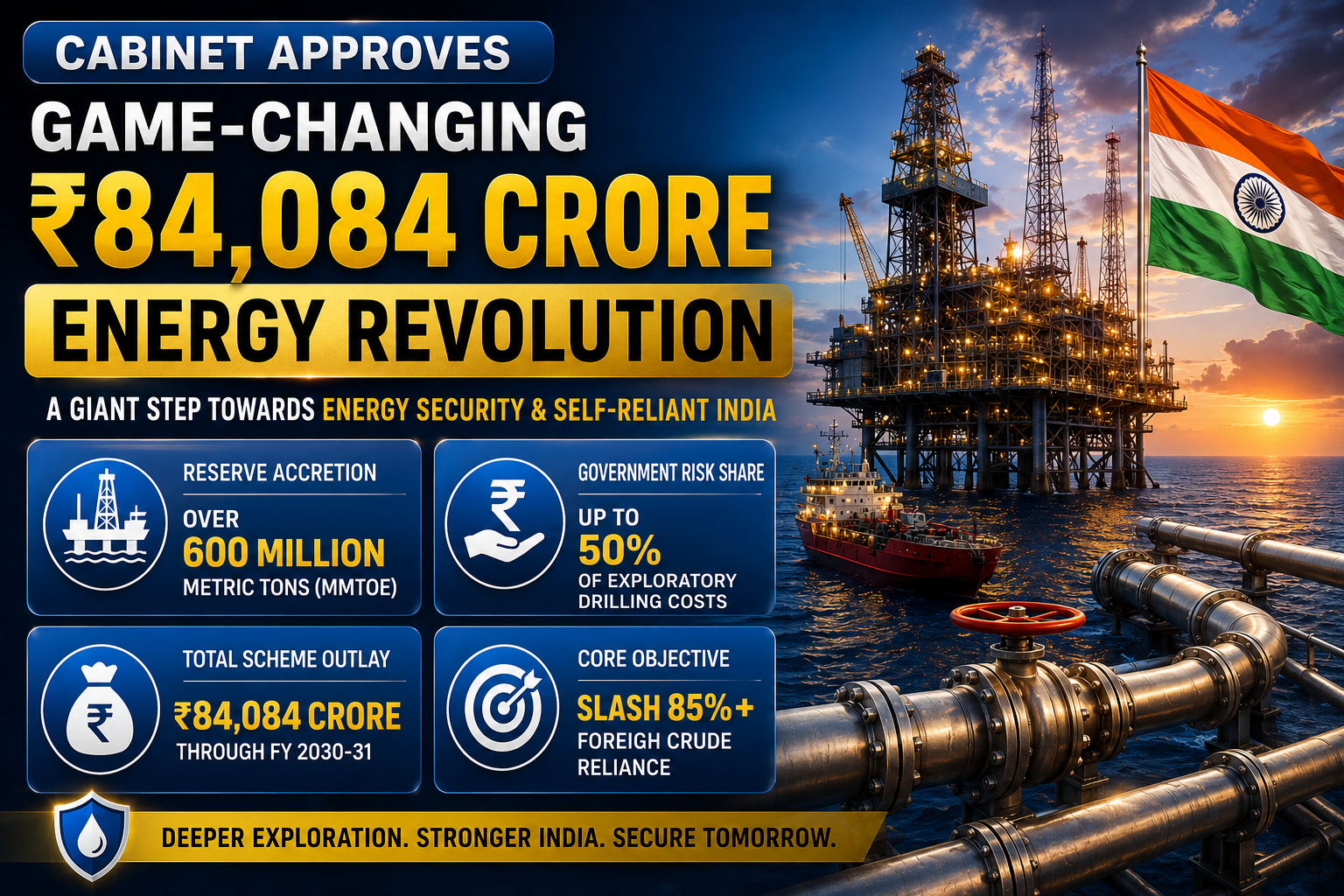
The Samudra Manthan Scheme has been given the go by the Union Cabinet. This is a moment for India as it tries to be independent when it comes to energy. The Union Cabinet, which is led by Prime Minister Narendra Modi said yes to the Samudra Manthan Scheme. This scheme is run by the Ministry of Petroleum & Natural Gas. The government will spend a lot of money on this scheme, ₹84,084 crore. The plan is to make the Samudra Manthan Scheme work by the time the financial year 2030-31 is over.
The Samudra Manthan Scheme is a plan that wants to use the oil and natural gas that is under the ocean. India gets most of its oil from other countries. This has been a problem for India for a long time. When there are problems in parts of the world or when the price of oil goes up it affects India. The Samudra Manthan Scheme is a way to deal with this problem. The idea for the Samudra Manthan Scheme came from Prime Minister Narendra Modi. He talked about it on Independence Day in 2025 from the Red Fort. The Samudra Manthan Scheme is like a way of finding energy in the ocean. It wants to make India less dependent on countries for oil and gas. The Samudra Manthan Scheme will help India use its energy sources. The Samudra Manthan Scheme is a step, for India and it will help the country grow.
Why India Urgently Needs the Samudra Manthan Scheme
To understand why this scheme is getting so much attention, one only needs to look at India’s current energy consumption dynamics. India is one of the fastest-growing major economies in the world, and its demand for energy is hitting record highs every single year. Yet, a massive chunk of the oil powering Indian factories, vehicles, and homes comes from abroad.
Importing over 85% of crude oil leaves the nation constantly exposed to external shocks. War, supply chain blockades, and sudden price hikes by global cartels pose continuous risks to national stability. While ground-based policy reforms over the past decade opened up vast offshore acres for exploration, international energy giants remained hesitant to dive in.
Why? Because deepwater and ultra-deepwater drilling are extraordinarily risky and brutally expensive.
Drilling miles beneath the ocean surface requires specialized ships, advanced sensor technology, and billions of dollars in upfront capital. If a test well turns out empty, energy companies swallow massive financial losses. The Samudra Manthan Scheme fixes this precise problem by introducing public sector support, financial incentives, and shared infrastructure to make India’s deep offshore waters highly attractive to global investors.
Breaking Down the ₹84,084 Crore Plan: Key Interventions
This isn’t just a basic policy announcement on paper; it is a fully integrated, multi-tier industrial strategy designed to build a complete domestic offshore ecosystem from the ground up. Here is how the government plans to deploy the ₹84,084 crore outlay across the entire offshore value chain:
1. Massive Seismic Data Acquisition and Mapping
Before any drilling rig sets sail, geologists need ultra-clear images of what lies beneath the seabed. A huge portion of the budget will fund large-scale acquisition, advanced processing, and deep interpretation of high-resolution 2D and 3D seismic data. By upgrading the National Data Repository with top-tier geological maps, India removes much of the guesswork for prospective drillers.
2. Direct Financial Support for High-Risk Drilling
In what industry experts call a game-changing policy shift, the Centre is stepping in to share the financial risk. The government plans to cover up to 50% of exploratory drilling costs for deepwater and ultra-deepwater projects. By absorbing half the financial risk of probing frontier basins, India turns high-risk deep-sea projects into commercially viable ventures for both Indian players like ONGC and global energy titans.
3. Shared Offshore Infrastructure Development
Setting up individual pipelines and processing platforms for every single offshore block is extremely inefficient and costly. Under the new scheme, the government will fund the development of shared offshore production hubs and evacuation infrastructure. This central network allows multiple companies operating in nearby ocean blocks to transport oil and gas to the mainland seamlessly, cutting down operational costs significantly.
4. Integrated Manufacturing and Services Zones
To end dependence on imported deep-sea equipment, the policy mandates the establishment of an integrated Oil & Gas Manufacturing and Services Zone. Built closely aligned with the ‘Make in India’ and ‘Atmanirbhar Bharat’ initiatives, this zone will manufacture specialized marine drilling hardware, underwater pipelines, and high-tech sensors locally.
5. Cutting-Edge Tech, Capacity Building, and Digital Oversight
Deep-sea operations require specialized human talent and rock-solid digital management systems. The scheme includes dedicated funds for digital program monitoring, AI-driven seismic interpretation tools, specialized technical training programs for Indian marine engineers, and global collaboration channels to bring world-class expertise to Indian shores.
Major Expected Outcomes and Economic Benefits
The economic and strategic dividends expected from this initiative are staggering. Government estimates show that the program will trigger a massive chain reaction across multiple sectors of the Indian economy.
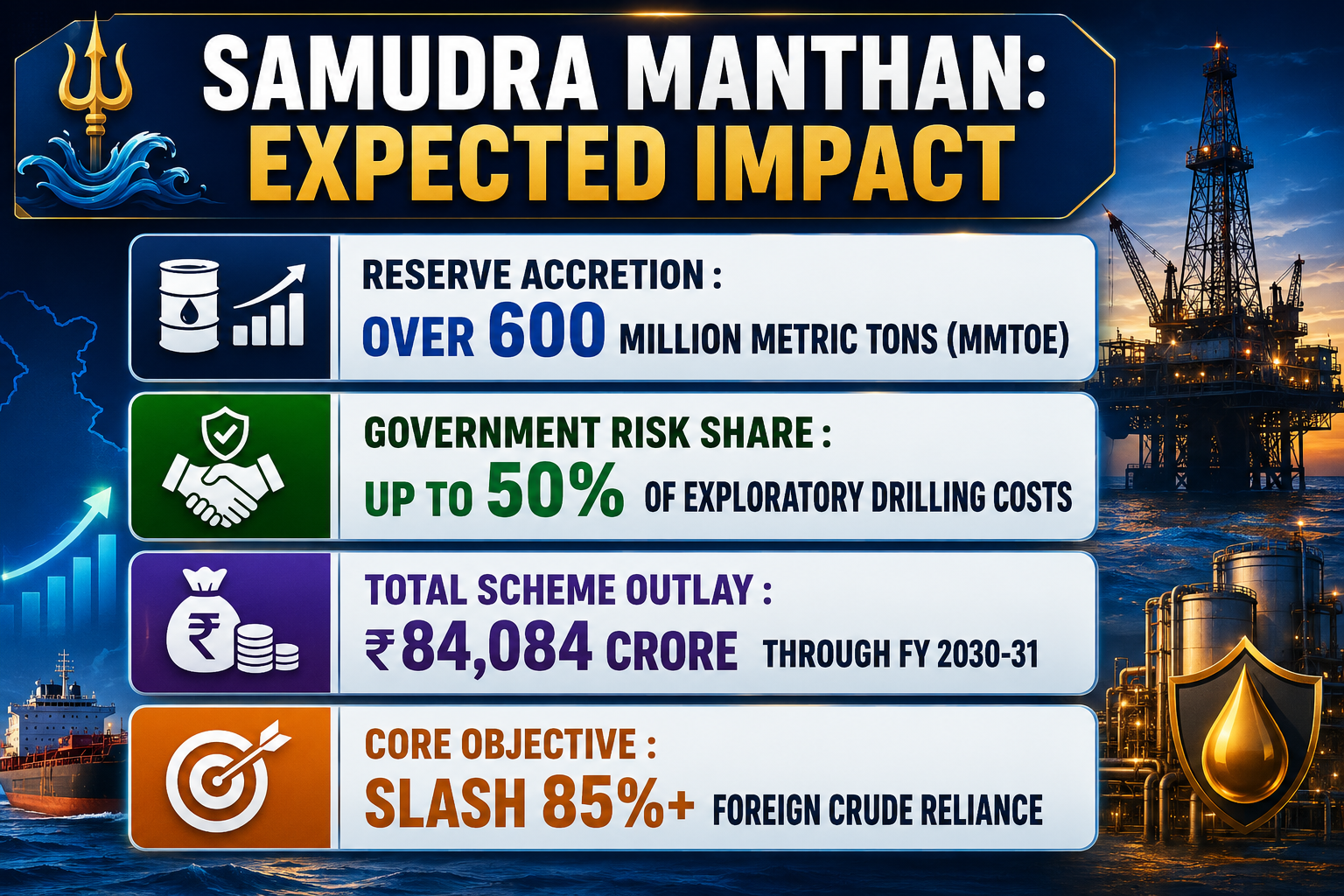
1. 600+ MMTOE Reserve Accretion
The scheme is projected to catalyze the discovery and accretion of over 600 Million Metric Tons of Oil Equivalent (MMTOE) in fresh reserves. Unlocking these vast deposits will ensure that India has a steady, reliable internal energy buffer for decades to come.
2. Massive Inflow of Foreign Direct Investment (FDI)
By offering to fund 50% of high-risk exploratory drilling costs right before rolling out fresh licensing rounds, India becomes one of the most attractive deepwater exploration destinations globally. Major global energy corporations that previously stayed away due to high entry risks are now expected to bid aggressively for offshore blocks.
3. Large-Scale Job Creation
Deep-sea exploration, shipbuilding, underwater pipeline fabrication, and onshore refining require hundreds of thousands of skilled and semi-skilled workers. From marine geologists and specialized deep-sea divers to factory workers in manufacturing hubs, the scheme will generate vast direct and indirect employment opportunities across coastal states.
4. Boosting Domestic Manufacturing
Instead of spending billions importing foreign marine technology, the creation of dedicated service zones will encourage local industrial houses to design and manufacture heavy machinery domestically, drastically enhancing India’s industrial capabilities.
Strategic Timing: Aligning Policy with Licensing Rounds
Timing is everything in global energy markets. Government sources indicate that this scheme was fast-tracked to roll out alongside India’s ongoing deepwater block auctions.
In past licensing rounds, global players often cited high deepwater drilling expenses as the primary barrier preventing them from placing aggressive bids. By finalizing this ₹84,084 crore policy support right now, the Ministry of Petroleum & Natural Gas gives clear, concrete financial clarity to global energy executives evaluating Indian blocks.
With clear government backing, reduced financial exposure, ready access to seismic data, and shared pipeline networks, international operators have every reason to enter the Indian energy market.
A Decisive Step Toward Viksit Bharat 2047
As India accelerates toward its goal of becoming a fully developed nation (Viksit Bharat), long-term energy security remains non-negotiable. No country can sustain rapid industrial growth, urban expansion, and rising living standards while relying entirely on foreign oil imports.
The Samudra Manthan Scheme bridges this gap. It turns policy intent into concrete action by backing bold strategic vision with substantial financial capital. By combining state-led financial risk-sharing with private sector innovation and cutting-edge marine technology, India is finally ready to claim its true offshore potential.
Over the coming decade through FY 2030–31, as deepwater rigs settle into frontier ocean basins and seismic survey vessels map out uncharted seas, India takes a major, confident stride toward securing an energy-independent future for generations to come.