
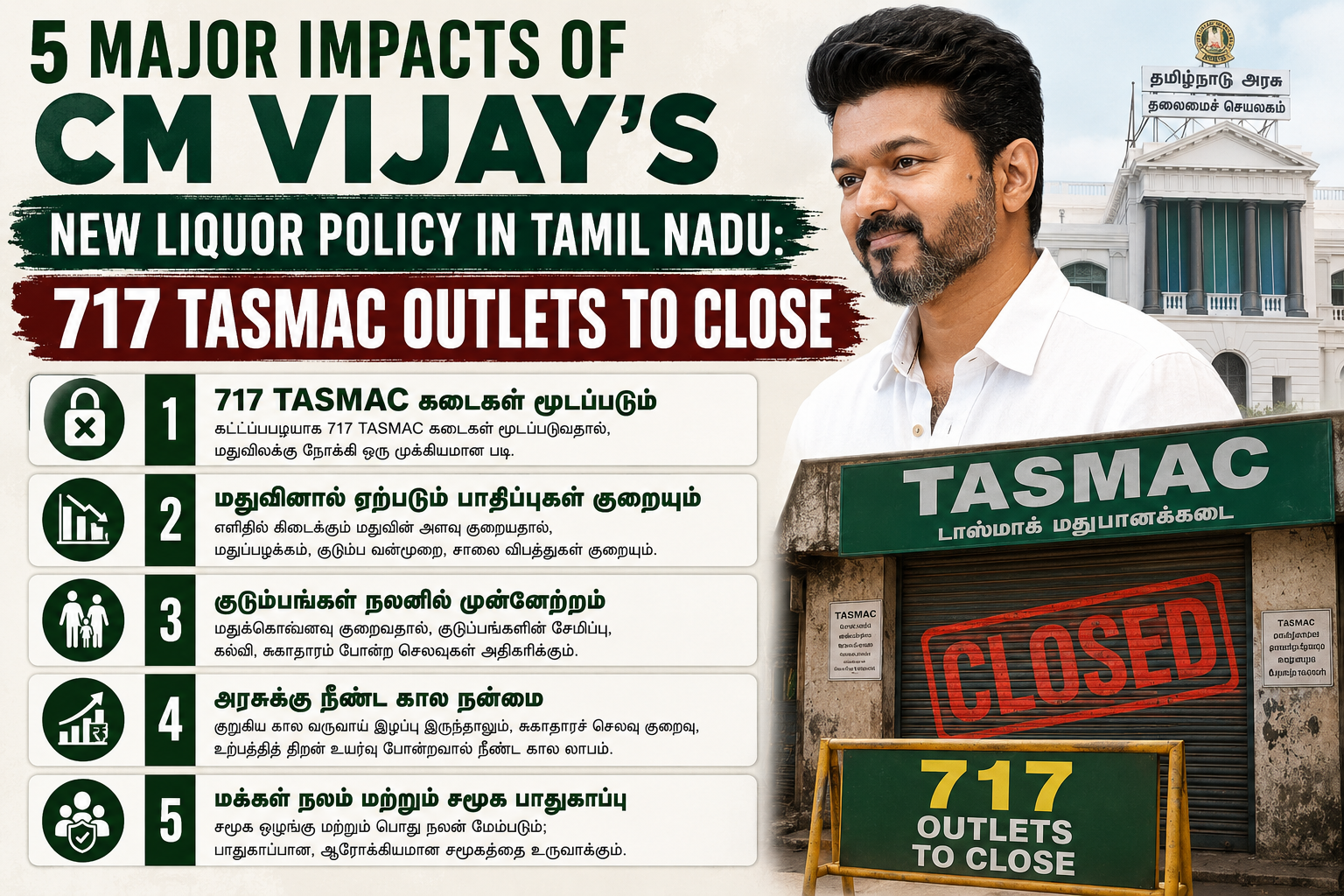
CM Vijay’s New Liquor Policy in Tamil Nadu-In a move that has sent ripples through the political and social landscape of South India, the newly sworn-in Tamil Nadu CM has made his first major executive decision. Fulfilling a core campaign promise faster than many anticipated, the actor-turned-politician has officially ordered the closure of 717 TASMAC shops located in sensitive zones across the state.
This isn’t just a routine administrative tweak; it is a calculated strike aimed at the proximity of liquor outlets to educational institutions and places of worship. For a state where TASMAC (Tamil Nadu State Marketing Corporation) has long been a titan of revenue, this decision marks the beginning of a potentially transformative era under the Tamilaga Vettri Kazhagam (TVK) leadership.
The Immediate Order: Clearing the 500-Meter Radius
The official release from the Chief Minister’s office was clear and uncompromising. A total of 717 state-run retail liquor outlets are to be shuttered within a strict two-week deadline. The breakdown of these closures highlights exactly where the government feels the presence of alcohol was most detrimental:
276 shops located within 500 meters of places of worship (temples, churches, and mosques).
186 shops situated near educational institutions, including schools and colleges.
255 shops located near busy bus terminuses, which often serve as high-traffic public hubs.
Currently, TASMAC operates a massive network of 4,765 retail shops. While 717 represents roughly 15% of the total fleet, the message is symbolic. CM Vijay is signaling that “public welfare” will now take precedence over “liquor profits.”
From Superstar to Politician: TVK’s First Strategy
The road to this decision was anything but simple. Last month’s Assembly elections saw C. Joseph Vijay’s TVK secure a dominant 108 seats. However, falling short of the 118-seat majority mark meant a week of intense political maneuvering. With the eventual support of the Congress, Left parties, and the VCK, Vijay took the helm of a coalition government.
Critics wondered if the pressure of coalition politics or the lure of state revenue would dilute his “addiction-free Tamil Nadu” manifesto. This order serves as his emphatic answer. By targeting shops near schools and temples, Vijay is tapping into a long-standing grievance of the Tamil electorate—particularly women voters who have historically been the loudest voices against the proliferation of TASMAC outlets.
The Economy’s ‘Big Issue’: The Rs 48,000 Crore Dilemma
One cannot discuss liquor in Tamil Nadu without discussing the “TASMAC economy.” In 2025 alone, the total revenue generated from liquor sales exceeded a staggering Rs 48,000 crore. This money funds a significant portion of the state’s welfare schemes, infrastructure projects, and public salaries.
The closure of 717 shops will undoubtedly lead to a dip in immediate revenue. However, the TVK administration seems to be betting on a different kind of “profit”—social stability and public health. The challenge for the new Chief Minister will be finding alternative revenue streams to plug the hole left by these closures without imposing new taxes on the middle class.
The Shadow of the ED: Corruption and Money Laundering Allegations
The timing of this “cleaning up” of TASMAC also coincides with a dark cloud hanging over the corporation. Before the April elections, the Enforcement Directorate (ED) conducted extensive raids across the state. The allegations were severe:
Unaccounted Cash: The ED claimed to have found irregularities amounting to nearly Rs 1,000 crore.
The “Bottle Surcharge” Scam: Evidence suggested a fraudulent surcharge of Rs 10 to Rs 30 per bottle was being collected by officials at the retail level.
Tender Manipulation: Investigations pointed toward “manipulated data” and favoritism in awarding bar licenses and transport tenders.
By shutting down a significant number of shops and enforcing stricter regulations, CM Vijay may also be attempting to sanitize an institution that has become synonymous with “political vendetta” and systemic corruption under previous administrations.
CM Vijay’s New Liquor Policy in Tamil Nadu Truly Become “Addiction-Free”?
While the closure of 717 shops is a victory for activists, the path to a completely addiction-free state is fraught with obstacles. Total prohibition has been tried in various Indian states (like Bihar and Gujarat) with mixed results, often leading to the rise of “hooch” (illicit liquor) and cross-border smuggling.
The TVK’s strategy appears more surgical. Rather than an overnight ban that could shock the state’s economy and lead to a black market, Vijay is focusing on “zoning”—removing liquor from the daily sightlines of students and devotees.
Public Reaction and Political Fallout
The response on the ground in Chennai, Madurai, and Coimbatore has been largely positive. Parents, in particular, have welcomed the removal of shops near schools, citing concerns over the safety of children and the normalization of drinking culture among youth.
However, the opposition is watching closely. Will the government be able to sustain its welfare programs without the TASMAC cash cow? And how will the coalition partners react if the “revenue loss” starts affecting their local constituencies?
Conclusion: A New Direction for Tamil Nadu
The order to close 717 TASMAC shops is more than just a policy shift; it is a statement of intent from CM Vijay. It represents a break from the status quo where revenue was king. As the two-week deadline approaches, all eyes will be on the TASMAC officials to see how effectively this order is implemented.
For the people of Tamil Nadu, this is a moment of cautious optimism. If Vijay can balance the state’s books while continuing his crusade against addiction, he may well redefine what “superstar leadership” looks like in Indian politics.
What do you think about the closure of TASMAC shops? Is it a bold social move or a risky economic gamble? Let us know in the comments below.
Frequently Asked Questions (FAQs)
1. Which shops are being closed by CM Vijay? A total of 717 TASMAC shops located within 500 meters of schools, temples, and bus stands are being closed.
2. Why is the revenue of TASMAC important for Tamil Nadu? TASMAC generated over Rs 48,000 crore in 2025, which is a major source of funding for the state’s social welfare schemes.
3. What was the ED investigation into TASMAC about? The ED investigated alleged money laundering, fraudulent surcharges on bottles, and irregularities in tender processes worth over Rs 1,000 crore.
4. How many TASMAC shops will remain in Tamil Nadu? After the closure of 717 shops, approximately 4,048 shops will remain operational across the state.