
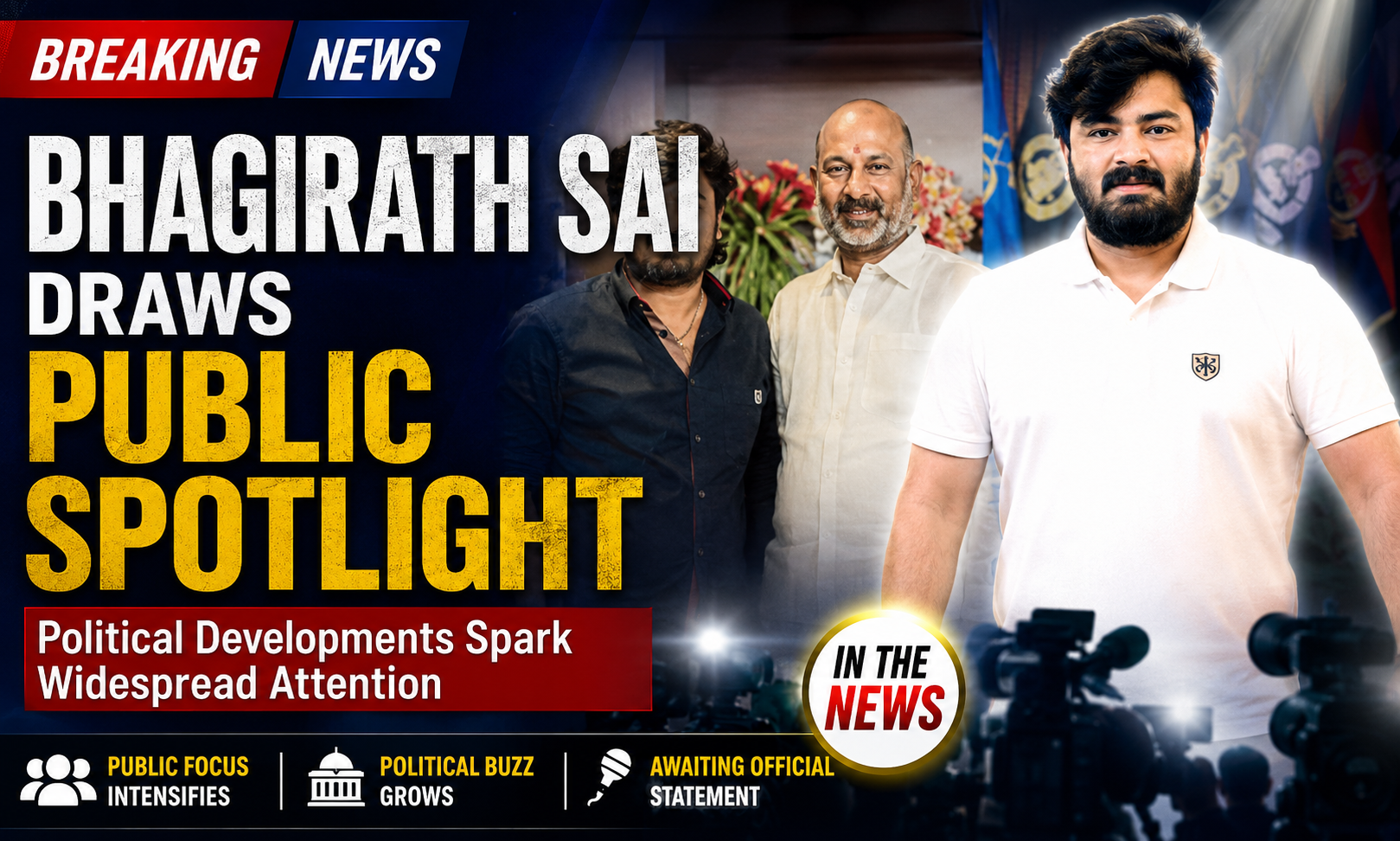
Bandi Bhageerath Sai Arrested on Saturday evening, sending shockwaves through the political landscape of Telangana and New Delhi. The dramatic development unfolded just hours after the Telangana High Court refused to grant him interim protection from arrest during a high-stakes, late-night courtroom battle that lasted until the midnight mark.
Bandi Bhageerath Sai, the 25-year-old son of the Union Minister of State for Home Affairs and prominent BJP leader Bandi Sanjay Kumar, is facing serious allegations involving the sexual assault of a 17-year-old minor girl. The case, filed under the stringent Protection of Children from Sexual Offences (POCSO) Act alongside relevant sections of the Bharatiya Nyaya Sanhita (BNS), has rapidly escalated into a major legal and political flashpoint.
Following the High Court’s refusal to shield him from immediate custodial interrogation, his father, Union Minister Bandi Sanjay Kumar, announced that his son had voluntarily surrendered through legal representatives to cooperate fully with the Telangana Police. Asserting his long-standing public stance on accountability, the senior BJP leader stated that no one, including his own blood, is above the legal framework of the nation.
The Late-Night Courtroom Drama: Why the High Court Refused Interim Relief
The legal battle reached a boiling point on Friday, May 15, 2026, when Justice T. Madhavi Devi of the Telangana High Court presided over a marathon hearing spanning more than two and a half hours. The defense counsel representing the petitioner pushed aggressively for emergency interim protection, arguing that the police action was politically motivated and structurally flawed.
A Midnight Judgment
As the clock ticked toward midnight, the courtroom remained packed. The petitioner’s legal team implored the bench to issue an interim directive preventing the state police from executing an arrest warrant until a final, detailed order could be formally drafted and published. They offered to accept exceptionally stringent bail conditions to ensure compliance.
However, the bench remained unpersuaded. After reviewing the initial statements provided by the survivor, Justice T. Madhavi Devi delivered a decisive oral observation:
“I have gone through the statement of the victim, though not in detail but cursorily, and at this stage, I am not inclined to grant any interim order.”
The judge further noted that given the massive volume of precedent case laws cited and the extensive documentation presented by both sides, a rushed interim order could not be justified. The court confirmed that the final, detailed order would be released the following week, leaving the doors wide open for the Telangana Police to take the 25-year-old into custody immediately.
Outrage Over Social Media Smear CampaignsAt the very outset of the proceedings, the High Court expressed deep distress over the external pressures surrounding the high-profile case. Justice Madhavi Devi openly condemned targeted social media campaigns that attempted to cast aspersions on the integrity of the judicial process.
“Before hearing you… There has been a smear campaign on social media… I am really pained by it,” the judge remarked, addressing the legal teams. “There has been an imputation that something has been offered or something like that… I am not shying away from hearing the matter; I will pass orders. But this is not done.”
Responding to the court’s vulnerability to online misinformation, Senior Advocate S. Niranjan Reddy, appearing for the petitioner, strongly agreed that such malicious actors must be brought to book. He emphasized that the legal fraternity and the bar association must stand firmly against digital intimidation tactics that seek to influence judicial independence.
Shifting Allegations: The Defense Arguments on “Improvements”
A central pillar of the defense strategy focused on the evolution of the official police complaints. Senior Advocate Niranjan Reddy argued that the case against the minister’s son suffered from systematic, calculated “improvements” designed to artificially amplify the severity of the charges.
EVOLUTION OF LEGAL ARGUMENTS
INITIAL COMPLAINT
- Filed on May 8 at Petbasheerabad Police Station.
- Focused on relationship complexities and allegations of harassment.
- Defense claims: No initial mention of penetrative sexual assault.
SUBSEQUENT STATEMENTS & ALTERATION MEMO
- Section 164 statement recorded; case escalated under POCSO Act.
- Serious allegations of physical and sexual assault introduced.
- Prosecution claims: Complete details of minor’s trauma revealed.
- Defense claims: Deliberate legal “improvements” after consultation.
The Core Defense Arguments:Lack of Initial Physical Penetration Claims: The defense asserted that the primary First Information Report (FIR), registered on May 8 at the Petbasheerabad Police Station, did not contain explicit allegations of penetrative sexual assault. They claimed these grave elements were introduced later after the complainant received strategic legal advice.
The Request for Anticipatory Bail: The petitioner argued that he was not seeking to quash the investigation entirely but was merely requesting anticipatory bail. The defense maintained that the young man was fully prepared to join the investigation and would not flee from justice.
Political Targeting: The legal team argued that because the petitioner’s father is a highly influential Union Minister, political adversaries within the state were actively weaponizing local law enforcement mechanisms to maximize political damage ahead of upcoming electoral assessments.
“If the original offense is not alleging penetrative sexual assault, then can it be thought that a subsequent improvement evokes any suspicion in your ladyship’s mind?” Senior Advocate Reddy submitted to the bench. “My lord may grant me that benefit of doubt… please see the jump in terms of gravity by this improvement. Even if the improvement was part of the original complaint, if surrounding material at that particular time leads to doubt in the mind of the court, even then… the court may have to discard it.”
The Prosecution and Complainant’s Counter-Stance
The legal narrative presented by the State of Telangana and the counsel representing the minor survivor’s mother told an entirely different story. They vehemently opposed any form of interim protection, highlighting the immense power imbalance inherent in the case.
Protecting a Minor Under POCSO
The State’s counsel argued fiercely that because the victim is a certified minor under the eyes of the law, the provisions of the POCSO Act must be applied with total rigidity. The prosecution emphasized that granting anticipatory bail to individuals accused of heinous crimes against minors defeats the foundational objective of child protection laws in India.
The complainant’s legal counsel rejected the defense’s narrative regarding “belated improvements.” They explained that the initial complaint naturally reflected what a deeply traumatized minor girl could initially communicate to her mother. The full depth of the physical and psychological violation emerged clearly as the investigation progressed and formal statements were recorded under structured environment protocols.
| Case Parameter | Details of the Legal Dispute |
| Primary Charges Filed | POCSO Act & Relevant Sections of Bharatiya Nyaya Sanhita (BNS) |
| Jurisdiction | Petbasheerabad Police Station, Telangana |
| Date of Original FIR | May 8, 2026 |
| High Court Hearing Date | May 15, 2026 |
| Key Judicial Stance | Court prioritizes written law over social perceptions; rejects interim relief |
The Power and Influence Factor
A major point of contention during the two-and-a-half-hour hearing was the immense societal and political clout held by the accused’s family. The complainant’s lawyer warned that if the accused were granted freedom, it would instill deep fear in the victim’s family and potentially compromise witnesses.
The counsel highlighted that the accused is not a first-time offender, pointing to the existence of two separate, pre-existing FIRs registered against him in unrelated matters. This pattern of behavior, the prosecution argued, made custodial interrogation absolutely essential.
When the complainant’s counsel explicitly pointed out that the father’s cabinet position created an uneven playing field, the High Court intervened to clarify its focus:
“Your imputation now is because of the position of the father, there is every likelihood… that they are in such a position, an influential position… What will be the fear in the mind of the victim… there is fear instilled… what will society think?” the counsel argued.
The court firmly countered, stating that the judiciary operates strictly within the confines of statutory frameworks: “The court is not going to think about what society thinks, and it will only look at the law.”
"Honey-Trap and Extortion": The Counter-Claim of a 5-Crore DemandPrior to the news that Bandi Bhageerath Sai Arrested on Saturday, the accused and his family had launched a fierce public defense, claiming the entire legal saga was a pre-planned criminal conspiracy rooted in financial extortion.
According to statements released by the accused’s legal representatives, the relationship between the two individuals had indeed been cordial and consensual over the past year. However, they alleged that the situation soured when the minor girl’s parents began deploying coercive tactics to force a marriage alliance.
       [ Accused's Defense Claims ]
                     │
                     ├─► Relationship was initially cordial & mutual
                     ├─► Escalated into a "Honey-Trap" conspiracy
                     ├─► Family allegedly demanded ₹5 Crore in cash
                     └─► Coercion applied to force a marriage alliance
The accused claimed that he had formally approached senior police officials well before the POCSO FIR was lodged, alleging that the girl’s family was aggressively demanding a massive financial settlement of ₹5 Crore. The defense argued that when the extortion attempt failed to yield the desired cash payout, the family weaponized the POCSO Act—knowing its severe, non-bailable nature—to destroy his reputation and force a settlement.
Union Minister Bandi Sanjay Kumar echoed these claims early on, categorizing the allegations as “false propaganda” orchestrated and amplified by opposition parties to damage his political standing. However, as the legal machinery tightened, the strategy shifted from public denials to total surrender to the judicial process.
Union Minister Bandi Sanjay Kumar Responds: “Everyone is Equal Before the Law”
Following the rejection of interim relief by the High Court, Union Minister Bandi Sanjay Kumar took to the social media platform X (formerly Twitter) to clarify his position. His statement sought to strike a delicate balance between a father defending his son’s innocence and a high-ranking state official upholding the rule of law.
   "With utmost respect for the law and judiciary, today my son Bandi Bhageerath went
   before the Telangana Police through our advocates for investigation. I have said
   this before too: whether it is my own son or a common citizen, everyone is equal
   before the law. My son has consistently maintained that he has committed no mistake.
   After consulting legal experts and placing before them the evidence available with us,
   we were advised that the matter would be addressed appropriately through the legal process."
                                             — Union Minister Bandi Sanjay Kumar
The junior Home Minister emphasized that despite his legal team advising him that final court orders were slated for the upcoming week, he felt that any delay in cooperating with law enforcement would send the wrong signal to the public.
“At the same time, I believe in fully cooperating with the investigation and respecting the judicial system,” Kumar added in his public address. “Even though court proceedings are underway and orders are expected next week, and despite advice from our legal team, I felt there should be no hesitation from our side in cooperating with the inquiry. I have complete faith in the justice system. Justice may be delayed, but not denied.”
State Machinery Reacts: Special Investigation Teams FormedRecognizing the immense political sensitivity of an investigation involving the son of the Union MoS for Home Affairs, the Telangana state government intervened directly to guarantee an uncompromised probe.
The state administration directed the Director General of Police (DGP) to bypass standard local police protocols and immediately constitute dedicated Special Investigation Teams (SIT). These specialized units, comprising senior investigative officers and forensic experts, have been tasked with conducting a highly comprehensive, time-bound investigation into the allegations.
Key Mandates of the Special Investigation Team:
Independent Evidence Gathering: Securing all digital footprints, mobile communication records, and location data relevant to the timelines detailed in the FIR.
Protection of the Survivor: Ensuring the minor victim and her family receive comprehensive security detailing to prevent any external intimidation or influence.
Unbiased Documentation: Filing objective status reports directly to the High Court, ensuring that neither local political rivalries nor central ministerial influence dilutes the integrity of the findings.
The establishment of the SIT underscores the high stakes involved for the ruling dispensation in Telangana, which faces intense pressure to demonstrate absolute impartiality when investigating members of the central ruling party.
Legal Definitions & Implications Under the POCSO Act
To understand why the news of Bandi Bhageerath Sai Arrested has caused such a massive political storm, it is essential to examine the severe legal architecture of the Protection of Children from Sexual Offences (POCSO) Act, 2012.
The POCSO Act was enacted to offer robust legal protection to individuals under the age of 18 against sexual exploitation, assault, and harassment. The law features several distinct mechanisms that alter standard criminal procedures:
1. Presumption of Guilt
Unlike traditional criminal law under the BNS, where an accused is presumed innocent until proven guilty, certain sections of the POCSO Act shift the burden of proof. Under Sections 29 and 30 of the Act, the Special Court presumes that the accused committed or abetted the offense unless the contrary is proven beyond doubt. This makes securing bail exceptionally difficult.
2. Strict Restrictions on Anticipatory Bail
Indian jurisprudence has consistently maintained a very high threshold for granting anticipatory bail in child sexual abuse cases. While higher courts retain the constitutional power to grant interim relief, they rarely do so if the preliminary statement of the minor survivor demonstrates a prima facie case of abuse or severe harassment.
3. Non-Bailable and Cognizable Framework
Offenses registered under this Act are entirely cognizable and non-bailable. Police officers are legally mandated to register an FIR immediately upon receiving a complaint involving a minor, leaving no room for informal mediations or preliminary domestic verifications.
Political Repercussions and Public Reaction
The arrest of a Union Minister’s son on such severe charges has ignited a fierce political debate across India, transforming a localized criminal investigation into a nationwide talking point on accountability and governance.
+-------------------------------------------------------------------------+
                         POLITICAL FLASHPOINTS
+-------------------------------------------------------------------------+
   [OPPOSITION DISPENSATION]
   • Demanding the immediate resignation of Union Minister Bandi Sanjay
   • Asserting that Home Ministry oversight could compromise local SITs
   • Organizing state-wide protests for fast-tracked judicial trials
                                    │
                                    ▼
   [RULING PARTY DEFENSE]
   • Highlighting the voluntary surrender as proof of systemic respect
   • Warning against the political weaponization of sensitive legal cases
   • Reaffirming commitment to the judicial outcome without interference
The Position of Opposition Coalitions
Opposition parties in Telangana and New Delhi have seized upon the development to launch a coordinated attack on the ruling central government. Critics argue that because Bandi Sanjay Kumar serves specifically as the Minister of State for Home Affairs—the very ministry that oversees central law enforcement and coordinates national security frameworks—his continuation in office could cast a shadow over the independence of local investigators.
Spokespersons from rival political groups have demanded his immediate resignation on moral grounds, arguing that a fair trial can only be guaranteed if the family wields no official state authority while the case is active.
The Defense of Government Integrity
Conversely, supporters of the Union Minister argue that his handling of the crisis has been exemplary compared to past political scandals. They point to his public declarations and his active choice to hand his son over to state police authorities as definitive proof that the administration is not using its immense power to suppress the investigation.
Commentators aligned with the party emphasize that the legal strategy avoids seeking an outright quashing of the case, focusing instead on navigating the established judicial pathway to prove the claims of an extortion plot in an open court of law.
What Lies Ahead for the Legal Proceedings?
With Bandi Bhageerath Sai Arrested, the case now enters a critical procedural phase within the Indian criminal justice system. Over the coming days, several key milestones will dictate the trajectory of this high-profile legal battle.
[ PHASE 1: ARREST & SURRENDER ] ──► [ PHASE 2: MAGISTRATE REMAND ] ──► [ PHASE 3: SIT CUSTODIAL INTERROGATION ]

│

▼
[ PHASE 6: TRIAL & VERDICT ] ◄── [ PHASE 5: CHARGESHEET FILING ] ◄── [ PHASE 4: FORENSIC & DIGITAL ANALYSIS ]
The Upcoming Milestones:
Production Before the Magistrate: Following his arrest, the accused must be presented before a local judicial magistrate within 24 hours. The police will seek formal physical custody to conduct intensive interrogations regarding the timelines and locations cited by the survivor.
Medical and Forensic Evaluations: The Special Investigation Team will execute standard medical examinations and digital forensic tracing of all mobile devices to verify or disprove the extortion counter-claims raised by the defense team.
High Court Order Release: Legal analysts are eagerly awaiting the detailed written order from Justice T. Madhavi Devi next week. The specific observations recorded in that document will fundamentally shape the defense’s strategy when they inevitably file a regular bail application before the Special POCSO Court.
Filing of the Comprehensive Chargesheet: Law enforcement teams will work under tight statutory timelines to compile all witness testimonies, Section 164 judicial statements, and physical evidence into a definitive chargesheet to initiate the formal trial phase.
The evolving situation continues to command massive public interest across the country. As the Special Investigation Team begins its work and the High Court prepares to publish its comprehensive legal findings, the case stands as a crucial test of institutional integrity, balancing complex familial loyalties against the unyielding demands of statutory law.
Disclaimer: This information is based on various inputs from news agency.