
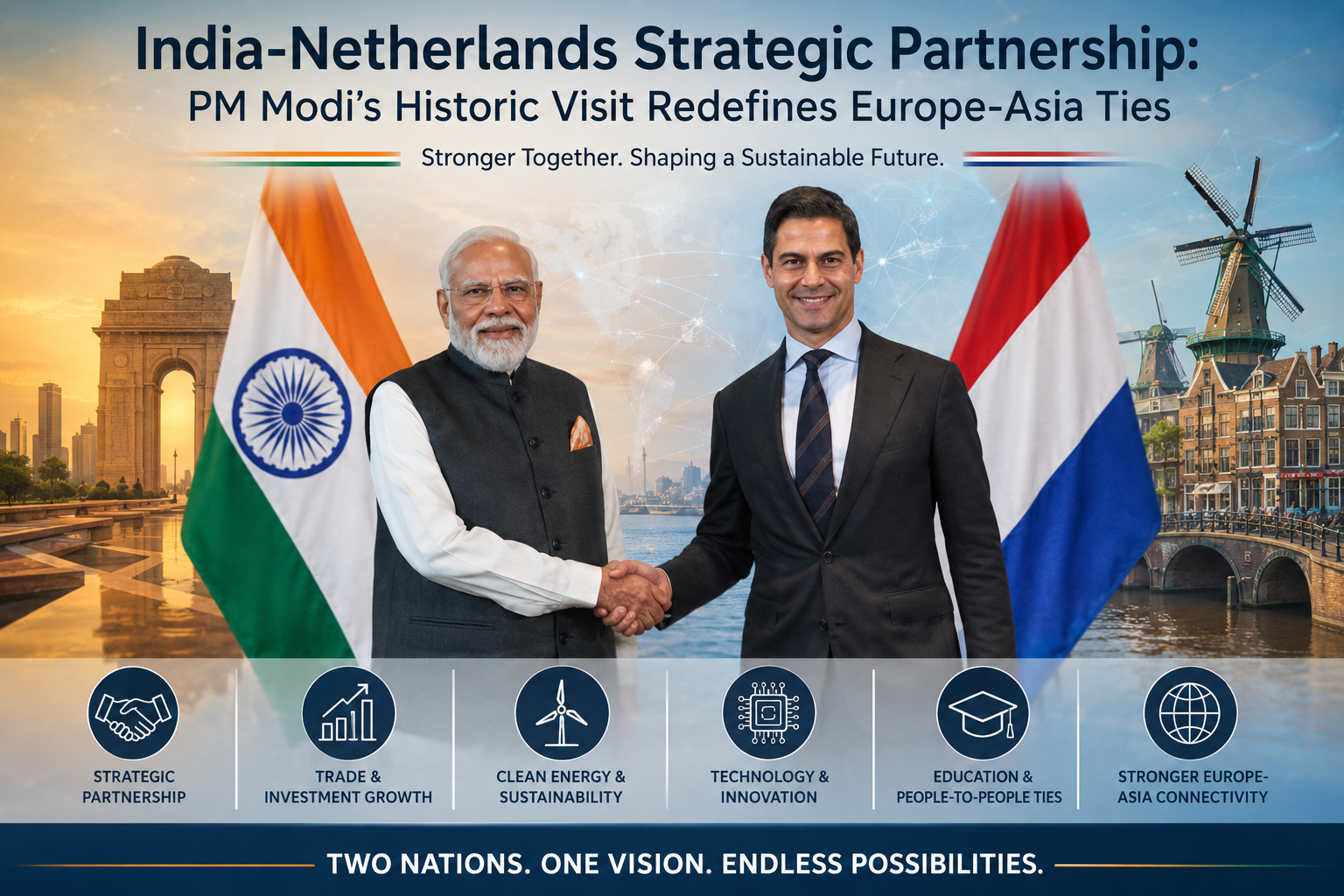
The India-Netherlands strategic partnership has officially entered a transformative era. During Prime Minister Narendra Modi’s high-profile two-day visit to The Hague, India and the Netherlands made the historic decision to elevate their bilateral relations to a comprehensive strategic partnership. This landmark upgrade comes at a crucial juncture of shifting global geopolitics, signaling a deeper alignment between Asia’s fastest-growing major economy and one of Europe’s most influential economic and technological hubs.
The two-day visit was part of Prime Minister Modi’s broader multi-nation European tour, designed to ramp up India’s strategic, technological, and economic alliances with key European partners. Through intensive bilateral talks with his Dutch counterpart, Prime Minister Rob Jetten, high-level interactions with industry titans, and the signing of groundbreaking commercial agreements, the visit successfully mapped out a robust blueprint for the future of the India-Netherlands strategic partnership.
The Strategic Shift: Why This Partnership Matters Now
The decision to establish an official India-Netherlands strategic partnership reflects a mutual recognition that the challenges and opportunities of the 21st century require deep, institutionalized collaboration. In their televised opening remarks, both leaders highlighted that the relationship has graduated from standard diplomatic cooperation to a vital geopolitical alliance.
                      India-Netherlands Strategic Partnership │
                    └────────────────────┬────────────────────┘
         ┌───────────────────────────────┼───────────────────────────────┐
         ▼                               ▼                               ▼
┌─────────────────┐             ┌─────────────────┐             ┌─────────────────┐
│ Geopolitical    │             │ Technological   │             │ Economic        │
│ Alignment       │             │ Collaboration   │             │ Integration     │
│ • Shared Values │             │ • Semiconductors│             │ • Trade Growth  │
│ • Stability     │             │ • Clean Energy  │             │ • FDI Inflows   │
└─────────────────┘             └─────────────────┘             └─────────────────┘
Prime Minister Modi noted the exceptional trajectory of bilateral ties, stating that there has been significant progress in India-Netherlands relations over the last decade. He emphasized that the bond is anchored in deeply rooted historical ties, robust people-to-people connections, and a shared global outlook.
“Democratic values, a market economy, and responsible behavior are part of our common approach,” PM Modi stated, underlining the foundational principles that unite the two democracies.
Dutch Prime Minister Rob Jetten mirrored these sentiments, acknowledging India’s indispensable role in global stability and economic growth. Jetten emphasized that backing stronger cooperation in strategic, technological, and economic sectors is a natural step forward for the Netherlands as it seeks to diversify its partnerships in Asia.
Combining Dutch Expertise with Indian Speed and SkillA central theme of the bilateral discussions was the synergy between the unique strengths of both nations. PM Modi proposed a simple yet powerful formula for the India-Netherlands strategic partnership: converging the Netherlands’ world-renowned technological expertise with India’s unprecedented “speed and skill.”
By combining these complementary strengths, both nations aim to drive innovation and sustainable development across several core pillars:
Innovation and Technology: Joint research and development initiatives focusing on digital public infrastructure, artificial intelligence, and deep-tech solutions.
Sustainability and Clean Energy: Leveraging Dutch advancements in green hydrogen, circular economy models, and maritime sustainability to fuel India’s green transition.
Defence and Security: Enhancing defense industrial cooperation, co-production, and sharing of maritime security intelligence.
Water Management: Expanding long-standing cooperation in flood control, river rejuvenation, and water purification technologies where the Netherlands is a global pioneer.
Economic Groundwork: Trade, FDI, and Market Integration
The economic foundation supporting the India-Netherlands strategic partnership is already incredibly formidable. The Netherlands has quietly emerged as one of India’s premier economic gateways to Europe, serving as a critical trading hub and a massive source of investment capital.
| Economic Indicator | Financial Metrics | Strategic Significance |
| Bilateral Trade (2024-25) | USD 27.8 Billion | Positions the Netherlands as one of India’s largest trading destinations in Europe. |
| Cumulative Foreign Direct Investment (FDI) | USD 55.6 Billion | Establishes the European nation as India’s fourth-largest investor globally. |
| Growth Vector | Fast-Growing Services & Manufacturing | Acts as a dual engine of economic efficiency and industrial innovation. |
During the high-level talks, both prime ministers strongly underlined the importance of securing an early implementation of the India-EU Free Trade Agreement (FTA). A formalized India-EU FTA is seen as a major catalyst that would dismantle trade barriers, streamline regulatory frameworks, and unleash the full potential of the India-Netherlands strategic partnership, providing businesses in both nations with unprecedented market access.
The CEO Roundtable: Unleashing Private Sector SynergiesRecognizing that the private sector is the true engine of bilateral ties, PM Modi and PM Jetten jointly hosted a high-powered CEO Roundtable in The Hague. The event brought together top business leaders from leading Dutch companies spanning vital sectors such as renewable energy, ports, agriculture, healthcare, trade, and digital technology.
       ┌───────────────────────────────────────────────────────────────┐
       │                 PM Modi's Pitch to Dutch CEOs                 │
       └───────────────────────────────┬───────────────────────────────┘
                                       │
         ┌─────────────────────────────┼─────────────────────────────┐
         ▼                             ▼                             ▼
┌──────────────────┐          ┌──────────────────┐          ┌──────────────────┐
│  Scale & Growth  │          │ Policy Stability │          │ Next-Gen Reforms │
│ Fastest-growing  │          │ 12 years of core │          │ Simplified tax & │
│ major economy &  │          │ predictability   │          │ labor codes for  │
│ massive talent.  │          │ for businesses.  │          │ ease of doing.   │
└──────────────────┘          └──────────────────┘          └──────────────────┘
PM Modi made an assertive pitch to the Dutch business community, inviting them to aggressively explore and expand investments within India’s rapidly modernizing industrial landscape. He highlighted several key sectors ripe for immediate collaboration:
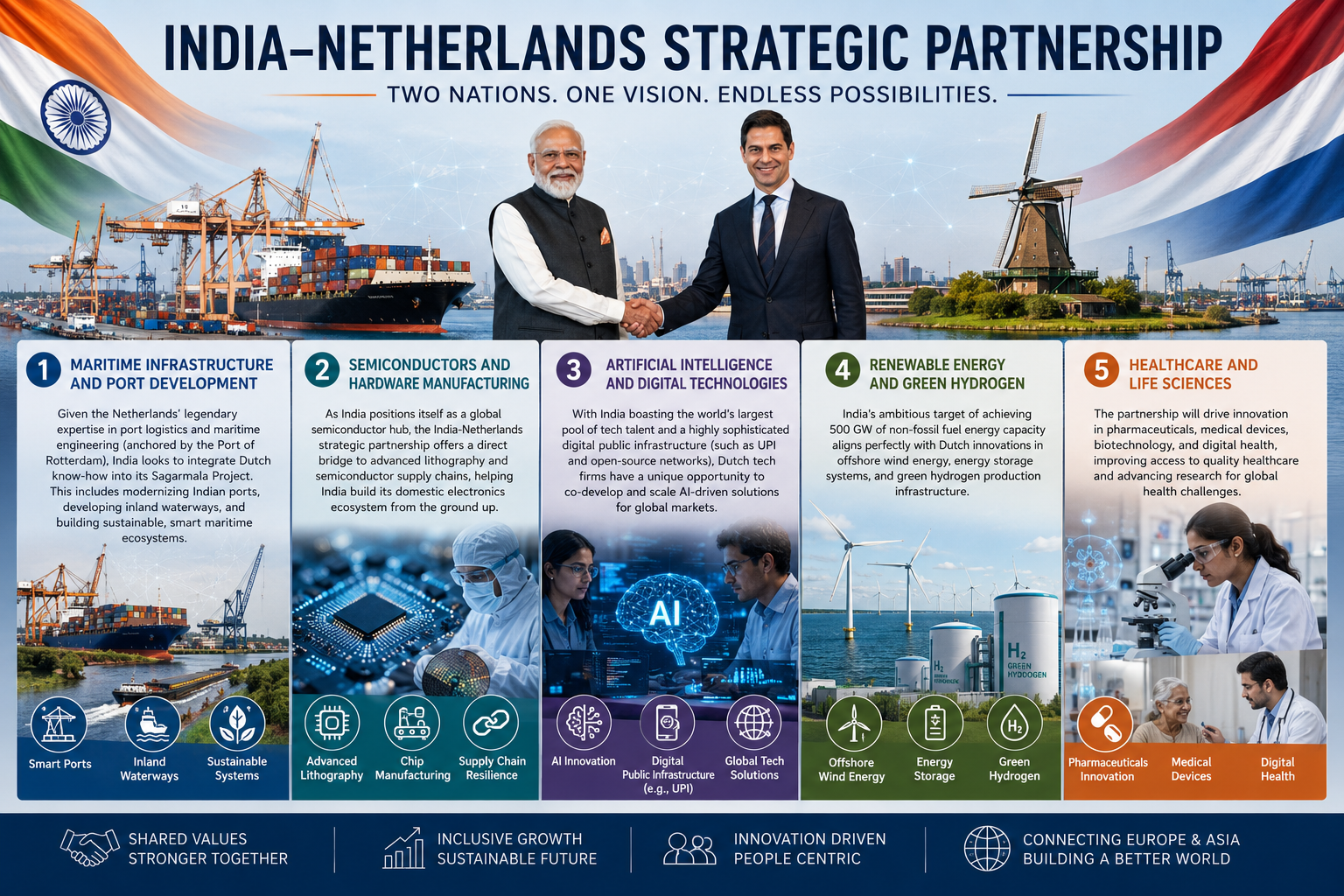
1. Maritime Infrastructure and Port Development
Given the Netherlands’ legendary expertise in port logistics and maritime engineering (anchored by the Port of Rotterdam), India looks to integrate Dutch know-how into its Sagarmala Project. This includes modernizing Indian ports, developing inland waterways, and building sustainable, smart maritime ecosystems.
2. Semiconductors and Hardware Manufacturing
As India positions itself as a global semiconductor hub, the India-Netherlands strategic partnership offers a direct bridge to advanced lithography and semiconductor supply chains, helping India build its domestic electronics ecosystem from the ground up.
3. Artificial Intelligence and Digital Technologies
With India boasting the world’s largest pool of tech talent and a highly sophisticated digital public infrastructure (such as UPI and open-source networks), Dutch tech firms have a unique opportunity to co-develop and scale AI-driven solutions for global markets.
4. Renewable Energy and Green Hydrogen
India’s ambitious target of achieving 500 GW of non-fossil fuel energy capacity aligns perfectly with Dutch innovations in offshore wind energy, energy storage systems, and green hydrogen production infrastructure.
5. Healthcare and Life Sciences
Collaborative efforts will focus on pharmaceutical supply chain resilience, digital health solutions, and joint research into affordable biomedical devices and advanced healthcare delivery systems.
Economic Groundwork: Trade, FDI, and Market Integration
Addressing the corporate leaders at the roundtable, Prime Minister Modi explained how India transformed its “economic DNA” over the last decade. He framed modern India as a global symbol of both scale and stability—a rare combination in today’s volatile macroeconomic environment.
“Today’s India is a symbol of scale and stability. In terms of scale, we are the fastest-growing major economy in the world and hold the world’s largest talent pool. When it comes to infrastructure, clean energy, or digital connectivity, no one in the world can match India’s current speed,” PM Modi told the business leaders.
12 Years of Governance ──► Continuous Policy Reforms ──► Predictable Business Climate
The Prime Minister explicitly detailed how his administration has prioritized policy predictability and opened previously restricted sectors to private enterprise:
Next-Generation Structural Reforms: Streamlining the corporate landscape by implementing comprehensive overhauls of the taxation system, modernizing labor codes, and simplifying bureaucratic governance frameworks.
Reduction of Compliance Burdens: Systematically cutting down redundant regulatory compliance requirements to significantly improve the country’s Ease of Doing Business index rankings.
Unprecedented Sectoral Openness: Dismantling state monopolies to fully open critical, high-tech sectors such as space exploration, commercial mining, and civil nuclear energy to private investments and global partnerships.
Cost-Effective Manufacturing Base: Building out a robust domestic manufacturing ecosystem (backed by initiatives like the Production Linked Incentive scheme) that offers global corporations a highly competitive, reliable, and cost-effective alternative for global supply chains.
Semiconductor Breakthrough: The Tata Electronics and ASML Deal
The most significant, tangible outcome of the India-Netherlands strategic partnership during this visit was the landmark agreement signed between Indian industrial giant Tata Electronics and the Dutch semiconductor heavyweight ASML.
┌──────────────────┐         Strategic Alliance          ┌──────────────────┐
│ Tata Electronics │ <─────────────────────────────────> │    ASML (Dutch)  │
└────────┬─────────┘                                     └────────┬─────────┘
         │                                                        │
         │             ┌────────────────────────┐                 │
         └────────────►│ Dholera Fab Facility   │◄────────────────┘
                       │ (Gujarat, India)       │
                       └────────────────────────┘
Witnessed directly by both Prime Minister Modi and Prime Minister Jetten, this high-stakes agreement is designed to directly support and accelerate the development of India’s very first front-end semiconductor fabrication facility, located in Dholera, Gujarat.
ASML occupies an absolute monopoly-like status in the global semiconductor ecosystem as the world’s premier supplier of cutting-edge photolithography equipment, which is essential for printing microchips. The collaboration with Tata Electronics represents a massive leap forward for India’s technological sovereignty.
Under this strategic agreement, ASML will provide specialized technological architecture, advanced machine supply lines, and workforce training modules to support the Dholera Fab. This partnership ensures that India’s entry into front-end semiconductor manufacturing is backed by world-class Dutch technology, laying a solid foundation for India to become a major node in the global microchip supply chain.
Deepening Social and Cultural TiesBeyond the high-level economic numbers, semiconductor deals, and defense frameworks, both leaders spent considerable time reviewing the human element of the India-Netherlands strategic partnership. The historical ties between the two nations are reinforced by a vibrant, highly skilled Indian diaspora residing in the Netherlands.
The Indian community in the Netherlands—consisting of tech professionals, researchers, students, and entrepreneurs—acts as a living bridge between the two democracies. During the talks, both governments agreed to streamline migration and mobility partnerships, making it easier for students, academics, and skilled professionals to move seamlessly between the two nations. This exchange of human capital ensures that the “talent pool” PM Modi referenced remains deeply integrated with the Dutch knowledge economy.
Furthermore, bilateral cooperation in healthcare and education is already yielding direct, positive impacts on local communities. From joint research on infectious diseases to academic exchange programs between premier Indian institutes (like the IITs) and top-tier Dutch universities (like TU Delft), the collaboration is actively fostering a joint ecosystem of learning and problem-solving.
Geopolitical Alignment in a Shifting World Order
The elevation of ties to an official India-Netherlands strategic partnership cannot be viewed in isolation from the broader shifts in global geopolitics. As the Indo-Pacific region becomes the primary engine of global economic gravity and maritime trade, European nations are increasingly looking to rebalance their foreign policies and secure reliable alliances in Asia.
┌───────────────────────────────────────────────────────────────────────────┐
│                     Global Geopolitical Convergence                      │
└─────────────────────────────────────┬─────────────────────────────────────┘
                                      │
         ┌────────────────────────────┴────────────────────────────┐
         ▼                                                         ▼
┌────────────────────────────────────────┐┌────────────────────────────────────────┐
│        India's Geopolitical Role       ││      Netherlands & EU Strategy         │
│ • Key anchor of Indo-Pacific stability ││ • De-risking critical supply chains    │
│ • Reliable provider of net security    ││ • Diversifying economic partnerships   │
│ • Commitment to rules-based order      ││ • Strategic autonomy in technology     │
└────────────────────────────────────────┘└────────────────────────────────────────┘
The Netherlands, as a core member of the European Union, has been an active proponent of the EU’s Strategy for Cooperation in the Indo-Pacific. By locking in a strategic partnership with India, the Dutch government secures a deeply stable, democratic, and powerful ally in the region. For India, a deep partnership with the Netherlands provides a sophisticated technological partner and an influential voice within the European Union to advocate for shared economic and security interests.
Both nations share a profound commitment to maintaining a rules-based international order, ensuring freedom of navigation in critical global maritime lanes, and promoting responsible behavior in digital and space domains. This shared geopolitical alignment ensures that the partnership will extend far beyond bilateral trade, positioning both nations to jointly navigate the complex challenges of modern global governance.
Conclusion: A New Blueprint for Euro-Asian Collaboration
Prime Minister Narendra Modi’s two-day visit to The Hague has successfully institutionalized a modern, future-ready alliance. The official establishment of the India-Netherlands strategic partnership moves the relationship far beyond traditional diplomacy, grounding it in high-stakes technological collaboration, robust maritime trade, shared democratic values, and critical industrial joint ventures like the landmark Tata Electronics-ASML semiconductor deal.
By effectively combining the structural “scale and stability” of a rising India with the refined “technological expertise” of the Netherlands, this upgraded partnership sets a powerful template for how European and Asian democracies can work together. As both nations begin implementing the wide-ranging agreements signed during this historic visit, the India-Netherlands strategic partnership is poised to drive sustainable economic growth, foster cutting-edge technological innovation, and act as a vital anchor of stability in an increasingly unpredictable world.