
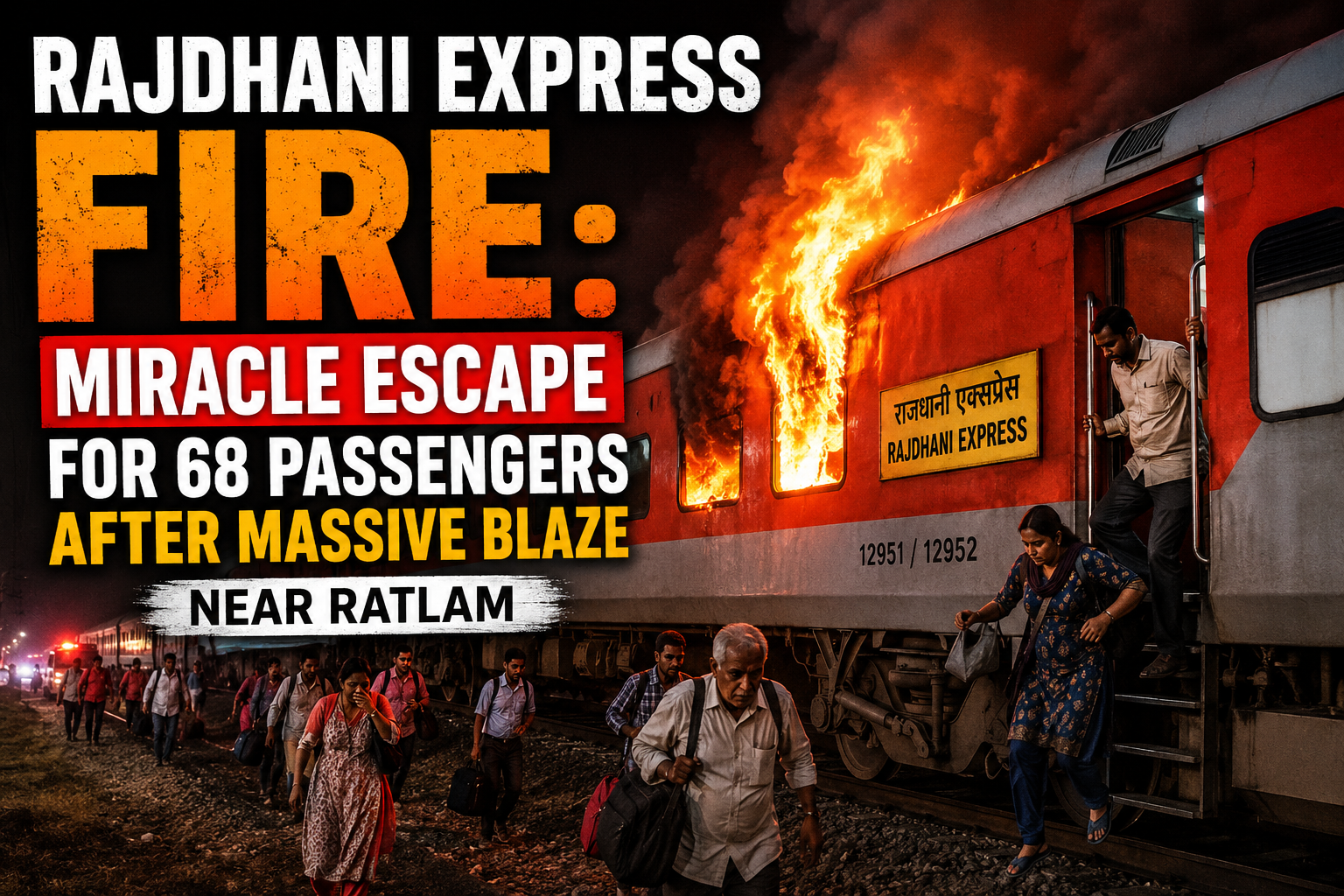
A catastrophic Rajdhani Express fire broke out early Sunday morning in Madhya Pradesh’s Ratlam district, turning a routine premium train journey into a race against time. The incident occurred on Train No. 12431, the Thiruvananthapuram Central to Hazrat Nizamuddin Rajdhani Express, which was charting its regular course toward the national capital. At around 5:15 AM on Sunday, May 17, 2026, thick, dark plumes of smoke began billowing from the undercarriage of an air-conditioned coach, triggering widespread panic among sleeping passengers.
Despite the intensity of the blaze, which completely gutted a third-class AC compartment (B-1) and an adjoining luggage-cum-guard van (SLR), a massive tragedy was averted. Thanks to the alertness of the train guard and an incredibly swift 15-minute emergency evacuation protocol executed by the Railway Protection Force (RPF) and onboard railway staff, all 68 passengers inside the affected coach were rescued safely. No injuries or casualties were reported among the passengers or the railway crew, making it one of the most successful emergency turnarounds in recent rail history.
How the Rajdhani Express Fire Unfolded Near Ratlam
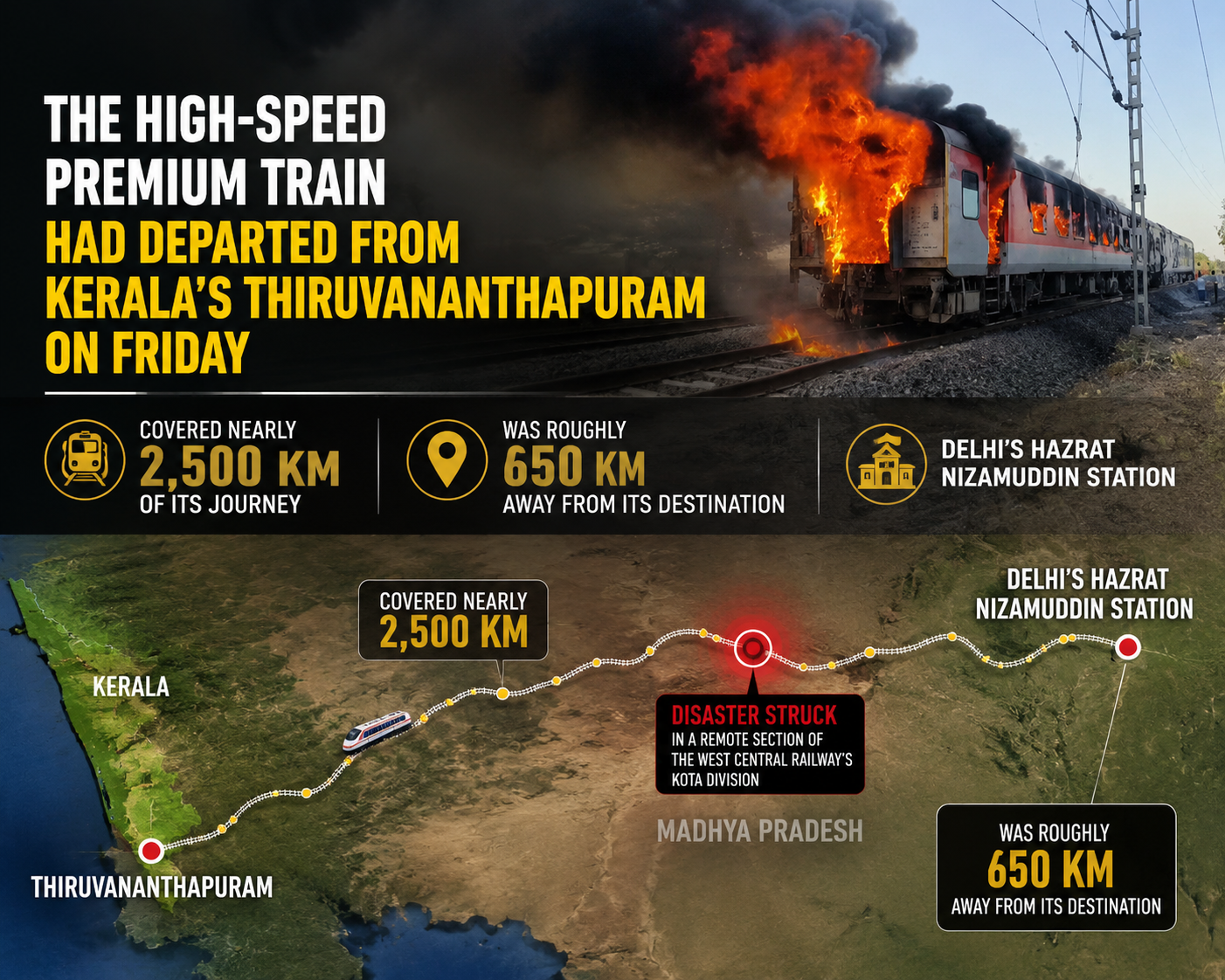
The high-speed premium train had departed from Kerala’s Thiruvananthapuram on Friday and had already covered nearly 2,500 kilometers of its journey. It was roughly 650 kilometers away from its destination, Delhi’s Hazrat Nizamuddin station, when disaster struck in a remote section of the West Central Railway’s Kota Division.
The First Signs of Danger
The train was cruising between the Luni Richha and Vikramgarh Alot stations, located approximately 110 kilometers from Ratlam in Madhya Pradesh, when the train guard noticed unusual sparks and thick smoke emerging from the front section of the passenger rake. The flames were originating near the undercarriage of the B-1 coach, which was positioned right next to the Seating-cum-Luggage Rake (SLR) brake van towards the front of the train.
Realizing the imminent danger, the train guard acted instantly. He used the emergency communication system to alert the loco pilot, who immediately applied the brakes, bringing the high-speed train to a dead stop in an open, rural stretch. This split-second decision prevented the fire from becoming an uncontrollable inferno while the train was at full speed, which would have fanned the flames significantly.
Chronology of the Incident
05:15 AM: Smoke first detected arising from beneath the B-1 AC coach.
05:20 AM: Train safely brought to an emergency halt between Luni Richha and Vikramgarh Alot.
05:25 AM: RPF personnel and coach attendants initiate the emergency evacuation protocol.
05:40 AM: All 68 passengers successfully cleared from the B-1 coach and moved to a safe distance.
06:00 AM: Overhead Electric (OHE) power supply disconnected; local fire tenders arrive at the rural site.
09:45 AM: Damaged coaches fully detached, tracks cleared, and the remaining train allowed to resume its journey toward Kota.
The 15-Minute Rescue Operation: Inside the Evacuation
When the train screeched to an unexpected halt at 5:15 AM, most passengers inside the B-1 coach were fast asleep. Within moments, the smell of burning plastic and rubber filled the air-conditioned cabin, followed by dense, toxic smoke pouring through the ventilation vents. Panic ensued as travelers woke up to a dark, smoke-filled corridor.
             EMERGENCY EVACUATION SNAPSHOT
 Coach Impacted:      | B-1 (Third AC Class)
 Total Passengers:    | 68 Men, Women, and Children
 Evacuation Time:     | ~15 Minutes
 Rescuers Involved:   | RPF Personnel, Train Guard, Staff
 Primary Outcome:     | 100% Safe Rescue, Zero Casualties
The onboard Railway Protection Force (RPF) personnel, alongside coach attendants, reacted with commendable professionalism. They immediately opened all emergency exit windows and doors, guiding panicked passengers out into the morning air.
Because the train had stopped in a rural section alongside fields, passengers had to jump onto the track ballast. RPF officers formed human chains to help elderly passengers and young children climb down safely. Neighboring coaches were also temporarily evacuated as a strict precautionary measure to prevent smoke inhalation and protect against potential secondary explosions from gas cylinders or electrical components. The entire coach was confirmed completely empty within a stunning 15-minute window, just as the fire broke through the windows and entirely engulfed the structure.
Extinguishing the Inferno and Mitigating Damage
As passengers watched from a safe distance in the nearby fields, the fire grew increasingly aggressive, fueled by the wind. Towering flames consumed the B-1 coach and rapidly spread to the rear luggage-cum-guard van (SLR). Video footage captured by local villagers showed thick, massive columns of black smoke rising into the sky, with flames even reaching the branches of trees growing close to the railway tracks.
Technical Containment Strategy
To prevent a wider disaster, railway engineers and technicians implemented a multi-step containment plan on-site:
Isolating the Power: The Overhead Electric (OHE) power cables carrying high-voltage current were immediately switched off and isolated by the regional power grid control room to eliminate any risk of electrocution during the firefighting process.
Detaching the Burning Rakes: Once the OHE lines were dead, mechanical staff carefully uncoupled the blazing B-1 and SLR coaches from the rest of the train. By isolating the fire to these two rakes, they saved the remaining passenger coaches from catching fire.
Deploying Fire Tenders: Local fire brigades from Ratlam and nearby towns arrived quickly at the remote location. Firefighters worked under the direct supervision of senior railway administrative officers, including Ratlam Divisional Railway Manager (DRM) Anil Kalra, to douse the flames.
Impact on Rail Operations on the Delhi-Mumbai Main Line
Because the incident took place on one of India’s busiest transit arteries—the New Delhi-Mumbai trunk route—the Rajdhani Express fire caused widespread operational disruptions. Rail traffic on this vital corridor remained completely halted for nearly two hours while rescue teams cleared the tracks and inspected the overhead electrical infrastructure for thermal damage.
At least 18 major trains experienced significant delays and were detained at various stations across the division. Some of the most notable trains affected by the bottleneck included:
The Avadh Express: Connecting Mumbai (Bandra Terminus) to Barauni Junction in Bihar, halted at a neighboring station.
The Mumbai Central–Duronto Express: Operating on a premium schedule between Hazrat Nizamuddin and Mumbai.
The Mumbai–Jaipur Superfast Express: Detained at an intermediate station while safety checks were underway.
The Hazrat Nizamuddin–Pune Special Train
The Haridwar–Bandra Terminus Express
The New Delhi–Indore Express
Normal operations were gradually restored after senior West Central Railway engineers thoroughly checked the fitness of the tracks and repaired minor structural damage caused by the intense heat.
Alternative Arrangements for the Stranded PassengersFollowing the successful evacuation, the immediate priority for the Indian Railways administration was ensuring the comfort and continued travel of the stranded passengers. Travelers from the B-1 coach were temporarily adjusted and accommodated inside other coaches of the same train, where fellow passengers shared available seating space.
                 RESTORATION AND RECOVERY RUN
 Train Number:        | 12431 Thiruvananthapuram - Delhi
 Incident Departure:  | Resumed from site at 9:45 AM
 Restoration Point:   | Kota Junction (Rajasthan)
 Strategy:            | Attaching brand-new replacement coach
 Ultimate Goal:       | Restore full carrying capacity
According to Harshit Shrivastava, the Chief Public Relations Officer (CPRO) of West Central Railway, the remaining portion of the train rake was cleared to move once the burnt shells were safely pushed onto a loop line. The train resumed its journey toward Rajasthan’s Kota at approximately 9:45 AM.
Saurabh Jain, the Senior Divisional Commercial Manager of the Kota Division, confirmed that emergency refreshment packets, water bottles, and medical teams were waiting for the train when it arrived at Kota station. A brand-new replacement air-conditioned coach was kept ready on a separate platform at Kota. As soon as the train arrived, the new coach was attached to restore the train’s full capacity, allowing the 68 rescued passengers to complete the remainder of their journey to Delhi’s Hazrat Nizamuddin station in comfort.
Investigation Launched: What Caused the Fire?
While a major loss of life was successfully avoided, the incident has raised critical security and technical questions regarding passenger safety on premium trains. Senior railway officials from the West Central Railway zone have ordered a comprehensive, high-level statutory inquiry into the exact origin of the blaze.
| Investigation Parameter | Details & Status |
| Suspected Initial Cause | Electrical short circuit in the coach undercarriage |
| Areas Under Inspection | Air conditioning wiring, battery boxes, alternator systems |
| Evidence Collected | Burnt remnants of the B-1 coach, electrical maintenance logs |
| Inquiry Supervised By | DRM Anil Kalra and specialized safety commissioners |
Preliminary inspections by forensic teams suspect that a severe electrical short circuit inside the undercarriage battery boxes or the heavy-duty air conditioning wiring harnesses may have triggered the fire. The inquiry committee will thoroughly scrutinize the train’s complete maintenance history, routine mechanical fitness certificates issued at Thiruvananthapuram, and the quality of electrical insulation inside the premium coaches.
A Worrying Trend: Growing Safety Concerns in Rail Travel
This critical incident marks the second time in just two weeks that a premium long-distance Indian train has experienced a dangerous electrical fire, raising serious concerns among frequent travelers and transport experts alike.
Just two days prior, on Friday, May 15, a similar fire broke out inside two air-conditioned coaches (B1 and B2) of the Hyderabad-Jaipur Special Express while it was stationary at the Nampally Railway Station in Hyderabad. That fire manifested shortly before its scheduled 7:00 PM departure, and fortunately, no casualties were reported because passengers managed to exit the coaches onto the platform immediately.
The back-to-back occurrences of the Hyderabad incident and this recent Rajdhani Express fire highlights an urgent need for an exhaustive safety audit of air conditioning units, onboard circuit breakers, and power car distribution lines across all long-distance express trains in India. Experts emphasize that regular maintenance, thermal imaging of electrical panels, and the installation of advanced automated fire suppression systems inside all AC compartments are vital to ensuring such close calls do not turn into major tragedies in the future.