
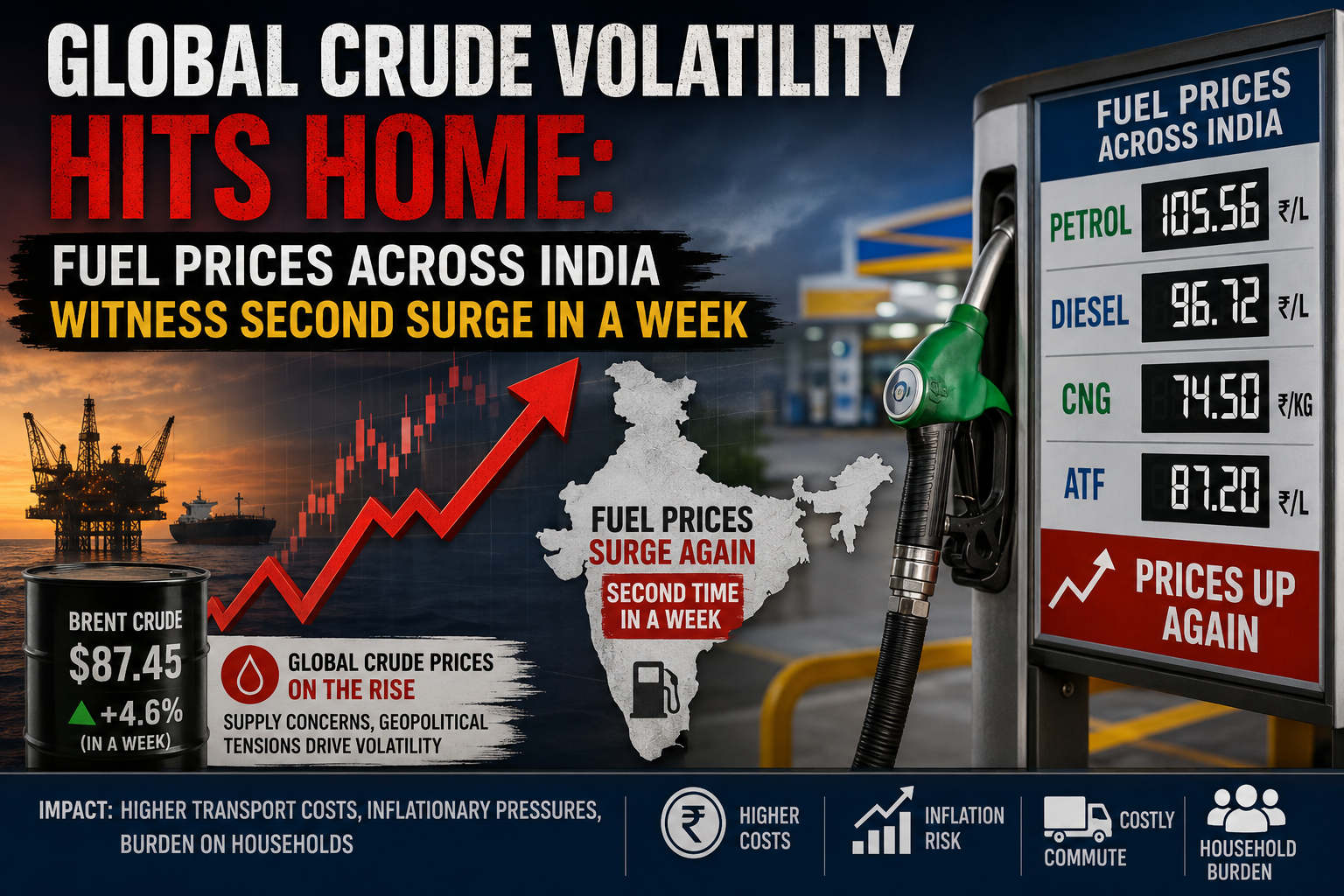
Fuel Price Hike Impact: Indian families and daily commuters are facing a tough month ahead as fuel prices go up again. On Tuesday morning, oil companies raised petrol and diesel prices by nearly 90 paise per litre. This is the second major price hike in just one week, sparking worries that the cost of daily groceries, transport, and shipping will also rise.
While fuel prices had been stable for the past two months, the ongoing war in the Middle East has disrupted global oil supply routes. With international oil prices climbing every day, Indian oil companies can no longer absorb the heavy losses and are passing the extra cost down to regular consumers.
The Immediate Financial Blow: City-Wise Retail Breakdown
The latest pricing tier came into effect at 6:00 AM on Tuesday, introducing variable rate hikes depending on local state value-added taxes (VAT) and freight octroi charges. This round follows a massive ₹3 per litre hike implemented just days earlier on Friday, May 15. Within a week, the cumulative jump has pushed fuel costs to levels not seen in recent quarters.
In the national capital, Delhi, petrol prices jumped by 87 paise, pushing the retail rate to ₹98.64 per litre. Similarly, diesel consumers in Delhi are feeling the pinch with a 91 paise hike, bringing the current rate to ₹91.58 per litre.
The situation remains even more critical in other metropolitan centers where state-level levies are traditionally higher. The table below outlines exactly how much more consumers are shelling out at the pumps today:
Petrol Retail Prices Across Major Metros
| City | Single-Day Hike (Paise) | New Retail Price (Per Litre) |
| Kolkata | 96 Paise | ₹109.70 |
| Mumbai | 91 Paise | ₹107.59 |
| Chennai | 82 Paise | ₹104.49 |
| Delhi | 87 Paise | ₹98.64 |
Diesel Retail Prices Across Major Metros
| City | Single-Day Hike (Paise) | New Retail Price (Per Litre) |
| Chennai | 86 Paise | ₹96.11 |
| Kolkata | 94 Paise | ₹96.07 |
| Mumbai | 94 Paise | ₹94.08 |
| Delhi | 91 Paise | ₹91.58 |
Kolkata recorded the steepest single-day climb for petrol at 96 paise per litre, pushing it dangerously close to the ₹110 mark. Meanwhile, Mumbai continues to bear the highest overall financial burden among the four major hubs, with petrol comfortably crossing ₹107 and diesel hovering beyond ₹94 per litre.
Why Oil Companies Stopped Absorbing the LossesFor over two months, major Indian oil companies like IOCL, BPCL, and HPCL kept petrol and diesel prices frozen. They did this to protect regular people and the economy from sudden price jumps in the global market. However, keeping prices steady came at a massive financial cost to these companies.
Eventually, the gap between the high cost of importing crude oil and the lower price at the petrol pump became too large. The companies were losing huge amounts of money every day, which began to hurt their business ratings and financial health. With no other choice left, they had to start raising retail prices. Experts warn that if global oil prices do not drop soon, small price hikes of 50 to 90 paise could become a regular feature over the next few weeks.
The Macro Factor: Geopolitical Standoff in West Asia
The underlying engine driving this domestic economic headache sits thousands of miles away in the Middle East. The escalating war involving Iran has fundamentally altered the risk premium associated with global oil infrastructure. Shipping lanes that once handled millions of barrels of crude daily are now treated as active conflict zones.
Data released by the Petroleum Planning and Analysis Cell (PPAC) highlights a stark reality. The average price of the Indian crude basket stood at a highly manageable $69.01 per barrel in February 2026. Fast forward to mid-May, following nearly three months of intense regional hostilities, and that same Indian basket has skyrocketed to $110.73 per barrel.
This represents a devastating 60.45% surge in raw material costs for Indian refiners in less than a quarter.
Crude Oil Price Trajectory (Indian Basket 2026)
Feb 2026:  ||||||||||||||| $69.01
May 2026:  |||||||||||||||||||||||||||| $110.73 (+60.45%)
India occupies a highly vulnerable position in this crisis, importing more than 85% of its total crude oil needs and roughly 60% of its Liquefied Petroleum Gas (LPG). The logistics of keeping the country running are heavily dependent on specific maritime choke points.
Historically, about 40% of India’s imported crude and an overwhelming 90% of its LPG crossed through the narrow Strait of Hormuz. Because of the ongoing military standoffs and maritime security threats involving Iranian forces and Western allies, cargo liners and massive oil tankers are facing lengthy reroutes, exorbitant insurance premiums, and severe transit delays. The resulting spike in freight costs has bloated India’s national import bill by over 60%, a structural shock that is impossible to keep hidden from retail consumers.
Currency Depreciation Compounds the ProblemMaking matters worse for the Indian economy is a weakening domestic currency against a surging US Dollar. Because international oil trade is transacted almost exclusively in greenbacks, the exchange rate dictates the final price of every single barrel arriving at ports like Jamnagar or Paradip.
Driven by global risk aversion and capital outflows to safer assets, the Indian Rupee has slipped toward the 96 per USD threshold.
The Double Whammy: India is not just paying significantly more dollars per barrel due to the West Asian conflict; it also must expend more rupees to buy each of those dollars.
The Result: This currency depreciation acts as a multiplier on top of the already inflated crude baseline. Every paisa the rupee drops adds crores of rupees to the national oil import bill, forcing OMCs to pass the buck down to retail outlets.
The Alternative Fuel Pinch: CNG Prices Climb in Tandem
For a long time, budget-conscious commuters, auto-rickshaw fleets, and urban cab aggregators viewed Compressed Natural Gas (CNG) as a reliable safe haven from volatile petroleum markets. However, that insulation has eroded over the past week.
Mirroring the liquid fuel trajectory, city gas distribution networks have revised their tariff structures. In the Delhi-National Capital Region (NCR), CNG prices climbed by an additional ₹1 per kilogram on Sunday, May 17. This followed an even larger ₹2 per kg price hike implemented the preceding Friday.
| Region / City | Current CNG Price (₹ per kg) |
| Noida | ₹88.70 |
| Ghaziabad | ₹88.70 |
| Muzaffarnagar | ₹88.58 |
| Meerut | ₹88.58 |
| Gurugram | ₹85.12 |
| Delhi | ₹80.09 |
With Delhi’s retail CNG cost now crossing the ₹80 per kg threshold and satellite cities like Noida and Ghaziabad touching nearly ₹89, the operational economics for commercial passenger vehicles are changing rapidly. Drivers are finding it harder to maintain profits without revising fares, a move that will hit daily office-goers directly.
Fuel Price Hike Impact The Trickle-Down Effect on Inflation and Daily Logistics
The impact of these consecutive fuel hikes extends far beyond the immediate shock felt at the petrol pump. Petroleum products act as the foundational fuel for the entire supply chain network. When diesel prices go up, the cost of operating long-haul interstate trucks, regional delivery vans, and agricultural tractors rises in lockstep.
1. Essential Commodity Price Pressures
India’s agricultural supply chain relies heavily on diesel-powered transport to move perishable goods like vegetables, fruits, dairy, and grains from rural farmlands to major urban wholesale markets. Logistics companies regularly implement a fuel surcharge to protect their margins. If diesel costs stay elevated or continue to climb, wholesale vendors will pass these distribution expenses onto retail shopkeepers, leading to more expensive groceries for average families.
2. Rising Public Transport and Logistics Costs
State road transport corporations, private bus operators, and app-based ride-hailing platforms are already evaluating fare hikes to cope with higher overheads. E-commerce platforms and hyper-local delivery services that promise fast shipping are also vulnerable to rising costs. If delivery fleets cost more to fuel, companies may raise minimum order thresholds or add explicit delivery fees.
3. Broad-Based Retail Inflation Risks
Macroeconomic experts warn that back-to-back fuel price hikes threaten to undo months of careful monetary policy aimed at curbing inflation. High energy costs quickly bleed into manufacturing sectors, increasing production expenses for everything from plastic packaging to heavy machinery. If international crude trends do not reverse course soon, the Reserve Bank of India (RBI) might have to keep interest rates elevated for longer to manage these supply-side inflationary pressures.
What Lies Ahead for the Indian Consumer?
The short-to-medium-term outlook for fuel prices across India remains tied to international diplomatic efforts. While recent updates suggest that some global powers are holding off on immediate military escalations in the Gulf region, the maritime logjam near the Strait of Hormuz shows no signs of an immediate fix. India is exploring alternative sourcing strategies—such as increasing shipments from Russian ports and exploring African energy corridors—but diversifying shipping routes takes time.
For now, citizens will need to adjust their monthly household budgets to account for higher transit costs. Whether you drive a personal vehicle, rely on public transit, or manage a business dependent on a supply chain, this latest 90-paise fuel hike is a sharp reminder of how deeply connected local expenses are to geopolitical shifts abroad.