
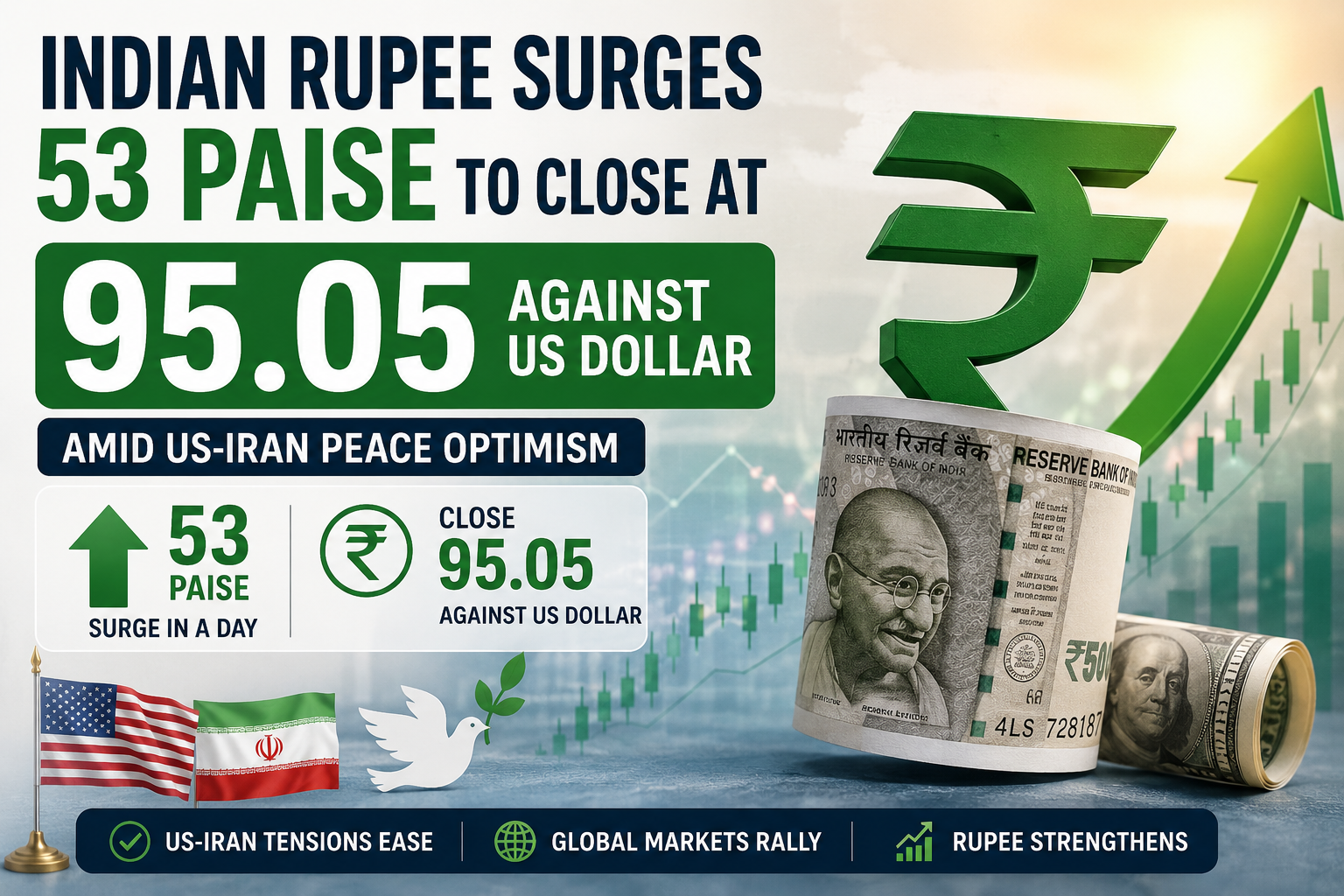
The Indian financial markets witnessed an extraordinary trading session on Friday, ending a holiday-extended week with a mix of dramatic high-stakes geopolitical relief and sharp domestic equity corrections. Headlines across major trading desks confirmed that the Indian Rupee surges 53 paise to close at 95.05 against US dollar, putting an end to a period of intense volatility.
The primary catalyst driving this sudden wave of optimism was a breakthrough in the Middle East. Geopolitical tensions eased significantly after negotiators from the United States and Iran reached a tentative agreement to extend their ceasefire by another 60 days. This diplomatic breakthrough directly cooled off global crude oil prices, offering a massive breathing room to net energy-importing economies like India. However, while the currency market celebrated this temporary relief, the domestic stock market painted a completely different picture, with the benchmark Sensex crashing by over 1,000 points.
Inside the Forex Session: How the Rupee Gained Ground
The interbank foreign exchange market re-opened on Friday morning after a mid-week break, carrying a lot of pent-up momentum. The trading dynamics throughout the day showed sharp movements as institutional investors adjusted their positions according to fresh global cues.
The Opening Bell: The local currency opened the day on a weaker note at 95.77 against the greenback, reflecting the lingering anxieties from earlier in the week.
Intraday Volatility: Driven by rapid corporate dollar inflows and speculative short-covering, the currency touched a stellar intraday high of 94.97. Conversely, minor resistance pushed it to an intraday low of 95.78 before it stabilized.
The Final Close: At the final bell, the local unit settled officially at 95.05 (provisional), marking a solid gain of 53 paise against its previous close.
To put this movement into context, the local currency had closed at 95.58 on Wednesday, gaining a modest 12 paise. With both the equity and forex markets closed on Thursday on account of Eid-ul-Azha, Friday’s action absorbed two full days of international geopolitical developments, resulting in this aggressive 53-paise rally.
The Global Catalysts: US-Iran Ceasefire Expansion and Crude Oil Relief
The primary reason behind the Indian Rupee surges 53 paise to close at 95.05 against US dollar is directly linked to the changing dynamics of global commodity markets. On Thursday, international negotiators broke a diplomatic deadlock, establishing a 60-day extension to the existing ceasefire between Washington and Tehran. Crucially, the agreement also includes a framework to restart formal talks regarding Iran’s nuclear program.
This diplomatic progress had an immediate impact on global energy markets:
Brent Crude Slide: Brent crude, the international benchmark for oil pricing, dropped by 1.81% to trade at USD 92.01 per barrel in futures trade. Lower oil prices mean a smaller import bill for India, reducing the structural demand for US dollars.
Cooling Greenback: The US Dollar Index (DXY), which tracks the strength of the greenback against a basket of six major global currencies, showed signs of exhaustion. Even though it managed a minor intraday gain of 0.11% to sit at 99.13, its overnight weakness set a highly favorable backdrop for emerging market currencies.
“We expect the rupee to trade with a slight positive bias on renewed optimism over the peace deal between the US and Iran, pending formal approval from Donald Trump and the Iranian supreme leader. Softening crude oil prices and the easing of the dollar may continue to support the local unit.”
— Anuj Choudhary, Research Analyst at Mirae Asset ShareKhan.
Choudhary also issued a note of caution for corporate treasuries, adding that the USD-INR spot price is expected to trade closely within a defined range of 94.70 to 95.60. Any fresh escalation or failure to get formal executive signatures on the peace draft could easily put the local currency back under pressure at higher levels.
Market Divergence: Sensex Tanks 1,092 Points Despite Currency Rally
| Market Indicator | Closing Value / Performance | Absolute Change |
| USD-INR Spot | 95.05 (Provisional) | +53 Paise (Rupee Appreciated) |
| BSE Sensex | 74,775.74 | -1,092.06 Points (Dropped) |
| NSE Nifty 50 | 23,547.75 | -359.40 Points (Dropped) |
| Brent Crude Oil | $92.01 per barrel | -1.81% (Decreased) |
| US Dollar Index (DXY) | 99.13 | +0.11% (Marginal Increase) |
While the foreign exchange desk enjoyed a stellar run, the domestic equity market experienced heavy liquidation. The BSE Sensex plunged by 1,092.06 points, or nearly 1.44%, to close at 74,775.74. Similarly, the broader NSE Nifty 50 index lost 359.40 points, closing at 23,547.75.
This decoupling between a stronger currency and a crashing equity market highlights ongoing domestic anxieties. Analysts point out that large-scale institutional offloading is keeping equity buyers cautious. According to official exchange data, Foreign Institutional Investors (FIIs) remained net sellers, offloading equities worth a net ₹1,042.70 crore on Wednesday alone. This persistent outflow from the cash equity segment limited the gains that the local currency could have otherwise secured from the drop in crude prices.
What’s Next? All Eyes Shift to the RBI MPC Meeting
With the geopolitical relief rally now largely priced in, market participants are shifting their focus to domestic monetary policy. The Reserve Bank of India’s (RBI) Monetary Policy Committee (MPC) is scheduled to meet next week, from June 3 to 5.
The upcoming policy announcement is widely seen as a critical turning point for macro trading strategies over the next quarter. Financial experts are divided on the central bank’s next move, considering the complex balancing act currently required:
1. The Case for a Rate Hike
Persistent sticky items within domestic food inflation could force the central bank to take a more hawkish stance. A rate hike would suck liquidity out of the system, cool consumer demand, and naturally support the domestic currency by offering higher real yields to global investors.
2. The Case for Status Quo
Many institutional economists believe the RBI will choose to maintain a status quo decision on benchmark interest rates. This approach would allow previous rate hikes to fully work their way through the economic system without hurting industrial growth.
3. The Currency Stability Factor
The core question for traders is whether the RBI will explicitly prioritize currency stability alongside traditional inflation management. If the central bank signals that it wants to keep the local unit from depreciating past certain psychological levels against the dollar, it might adjust its open market operations or change its policy stance accordingly.
Technical Outlook for USD-INR Traders
From a technical standpoint, the sharp move seen on Friday has altered short-term charts. The breakdown below the 95.50 mark indicates that the currency pairs are entering a brief consolidation phase.
If the international ceasefire holds and oil prices drop below the USD 90 per barrel threshold, the local unit could appreciate further toward the 94.50 support level. On the flip side, local corporate dollar demand, combined with persistent FII selling in the capital markets, should create a strong floor for the dollar, preventing any quick drop below 94.70.
For import-heavy businesses, this correction offers an ideal window to hedge near-term commitments. Meanwhile, exporters might want to wait for minor counter-trend rallies toward 95.40 before locking in long-term forward contracts. The upcoming week promises to be highly active, driven entirely by corporate data flows, geopolitical updates, and the highly anticipated interest rate commentary from the central bank.
Disclaimer:This information is based on various inputs from news agency