
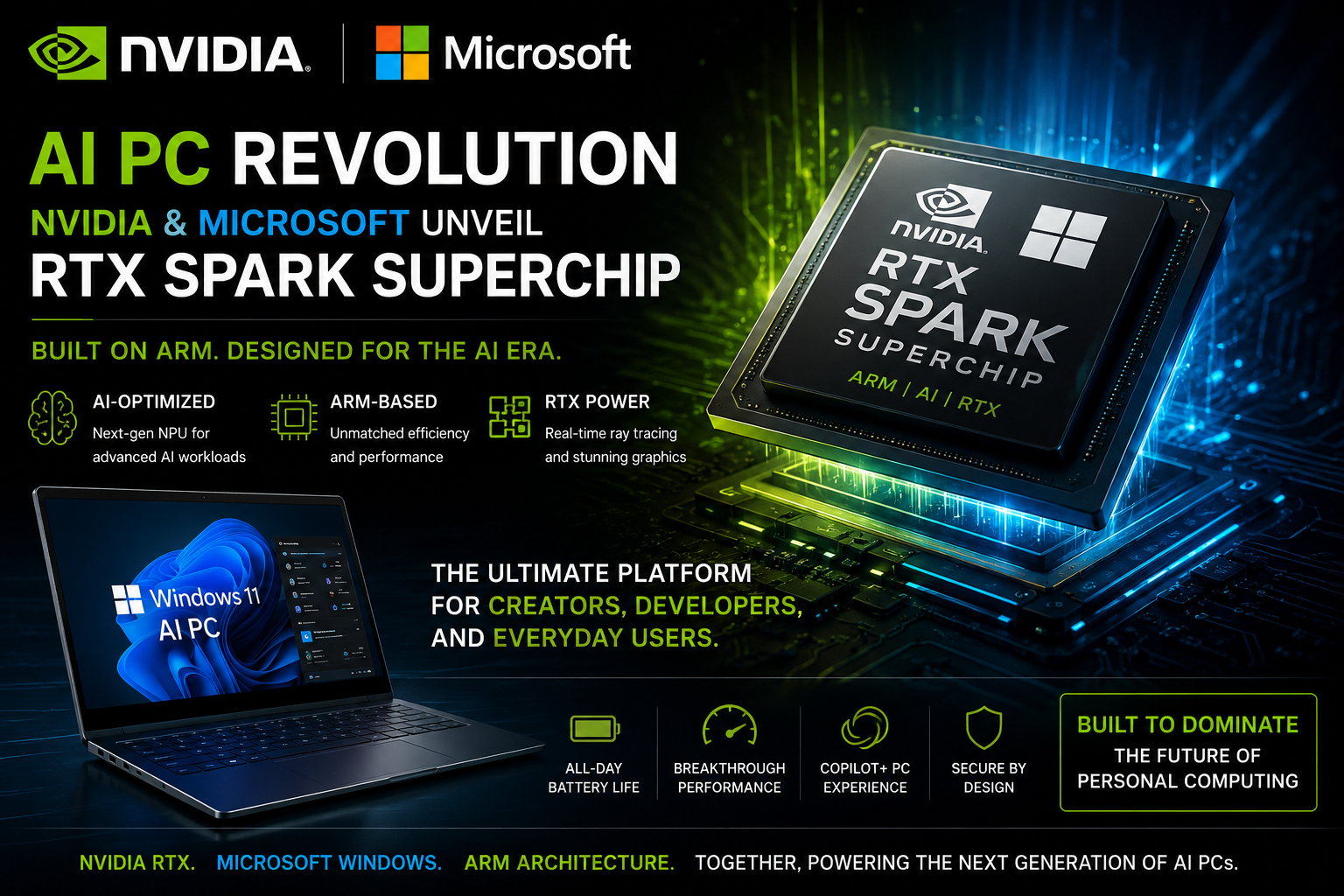
The personal computer is seeing its biggest change in 40 years. At the COMPUTEX event in Taiwan, NVIDIA CEO Jensen Huang introduced the NVIDIA RTX Spark. This is a powerful new computer chip made for Microsoft Windows laptops and desktops. Built together with Microsoft and MediaTek, this chip is designed to run smart AI assistants directly on your computer without needing the internet.
By launching this new chip, NVIDIA is moving its top-tier AI technology from massive data centers straight into everyday home and office PCs. This move sets up NVIDIA to compete directly with traditional chip makers like Intel and AMD, as well as Apple’s MacBooks. With great power efficiency and a new built-in security system from Microsoft, the age of the personal AI computer has truly begun.
The Genesis of the NVIDIA RTX Spark Superchip
For the past several years, NVIDIA has ridden an unprecedented wave of enterprise demand, briefly emerging as the world’s most valuable company due to its data center graphics processing units (GPUs). However, the tech landscape has long anticipated the company’s return to the heart of personal computing architecture. The culmination of that strategy is the NVIDIA RTX Spark, a single platform that consolidates thirty years of proprietary engineering into a highly efficient, ultra-powerful consumer processor.
As Jensen Huang noted during his address, the fundamental way humans interact with computers is shifting away from traditional application management. “For forty years, you launched apps. Click. Type. With RTX Spark and Microsoft Windows, you ask—and the PC does the work,” Huang explained.
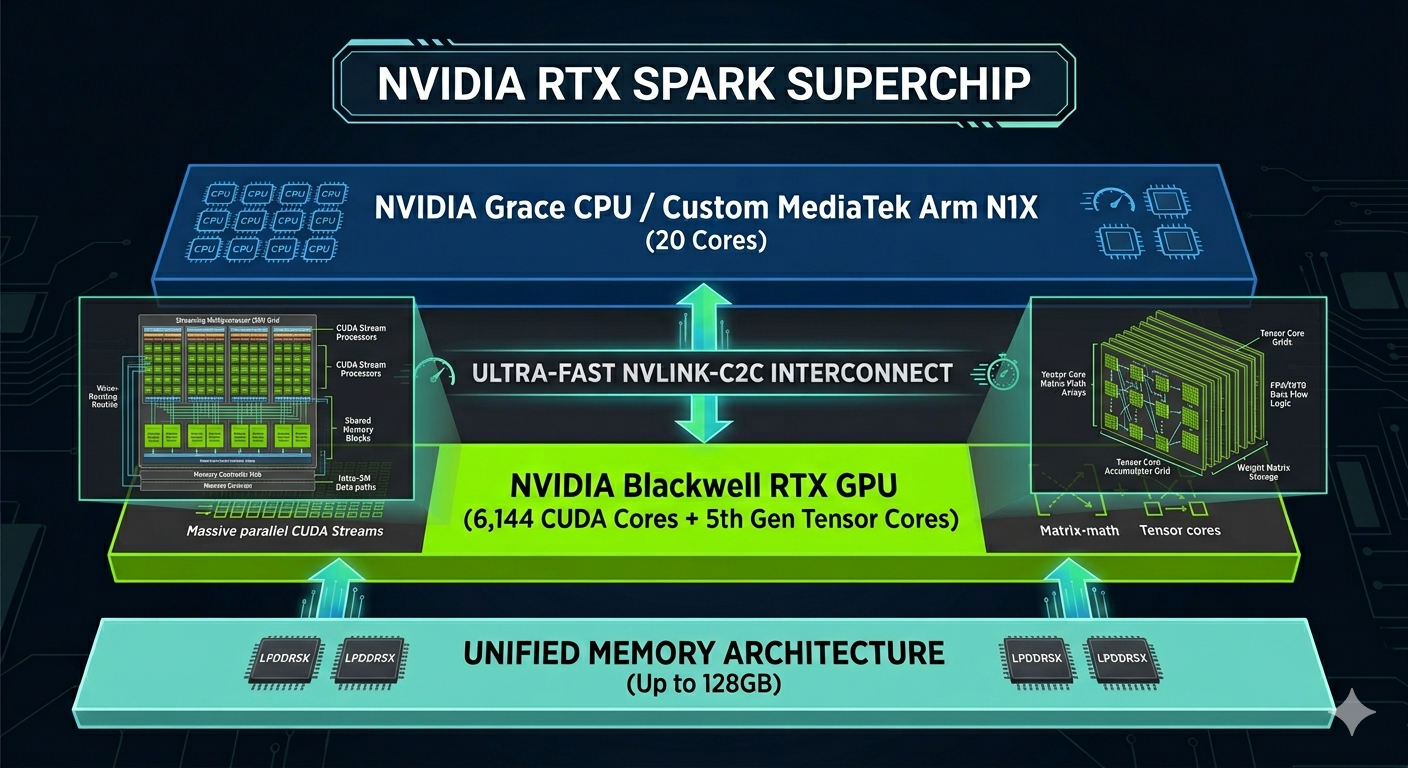
To achieve this level of seamless local computation, the superchip utilizes an innovative architectural layout. It fuses a high-performance, 20-core custom central processing unit (CPU)—dubbed the N1X and engineered in partnership with Arm-design leader MediaTek—with an advanced NVIDIA Blackwell RTX GPU. The two distinct components are bound together via the high-speed NVIDIA NVLink-C2C chip-to-chip interconnect, allowing them to share an unprecedented pool of up to 128GB of high-bandwidth unified memory.
Dissecting the Technical Specifications
The sheer hardware density crammed into the NVIDIA RTX Spark allows it to deliver performance metrics previously restricted to specialized enterprise workstations. By shifting to an Arm-based design, the processor maximizes instructions per clock cycle while drastically reducing power consumption, offering a blueprint for slim laptops that do not sacrifice compute power for battery longevity.
Graphics and Compute Core Configuration
At the core of the graphics system lies the Blackwell architecture, featuring 6,144 dedicated CUDA cores designed to handle parallel processing tasks with immense speed. This is paired with fifth-generation Tensor Cores that introduce native support for FP4 precision. This ultra-low-precision math format allows the processor to compress massive artificial intelligence models down to a fraction of their standard size, meaning models that once required multiple cloud servers can now fit comfortably inside a portable laptop chassis.
Breakthrough Local Performance Thresholds
The integration of these components yields 1 petaflop of local AI performance. To put this in perspective, this raw processing capability allows local applications to handle workloads that would stifle conventional systems:
Massive LLM Capacity: Users can run 120-billion-parameter large language models (LLMs) completely offline.
Expanded Context Windows: The architecture supports context windows up to 1 million tokens using local personal agents.
Heavy Visual Rendering: Visual creators can load, manipulate, and render massive 90GB+ 3D scenes locally using real-time path tracing without running out of video memory.
The Rise of Agentic AI: Moving Beyond ChatbotsWhile standard AI tools are reactive—requiring a direct prompt to yield a single response—the industry is rapidly moving toward “agents.” AI agents are independent programs capable of planning multi-step workflows, executing cross-application tasks, observing outcomes, and correcting errors autonomously. The NVIDIA RTX Spark is engineered precisely to act as the primary engine for this next step in software evolution.
Alongside the consumer client chips, Huang introduced a dedicated enterprise-grade agent processor known as the Vera CPU, confirming that the next-generation Vera Rubin AI platform has entered full-scale production. Designed specifically to accelerate independent operational software, the Vera architecture achieves up to an 80% faster agentic task completion rate compared to existing silicon architectures. Key international innovators, including OpenAI, Anthropic, and SpaceX, have already signed on as early adopters of the Vera framework, signaling a massive corporate shift toward fully automated digital processes.
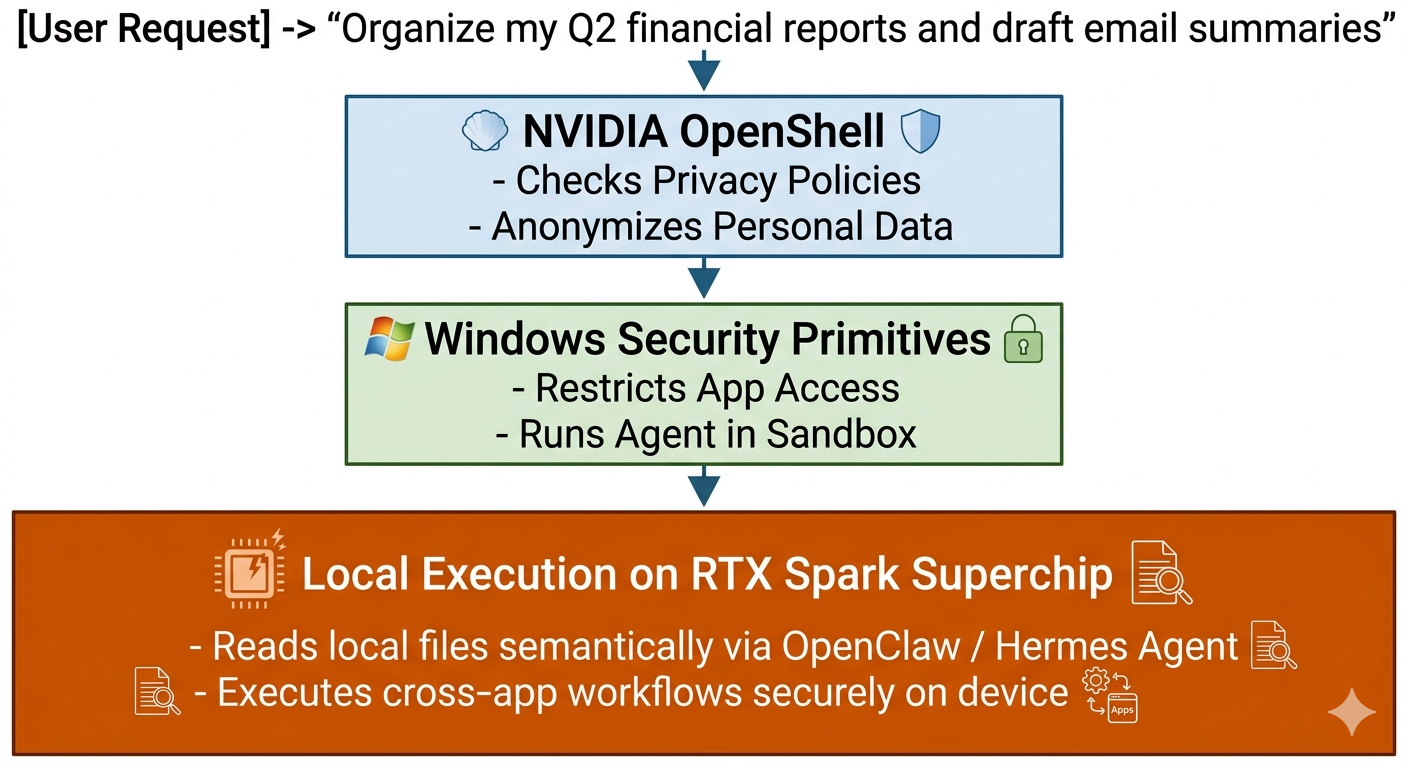
On consumer devices, the challenge has never been the desire for agents, but rather the logistics of privacy and security. Letting an automated agent read through your personal emails, access financial folders, and modify files requires a deeply secure operating environment. To solve this, NVIDIA and Microsoft have built a native, multi-tiered security layer from scratch to ensure personal data remains entirely under user control.
Architecture of On-Device Privacy: Windows Security and NVIDIA OpenShell
The widespread implementation of open-source agent frameworks like OpenClaw and Hermes Agent on developer hubs like GitHub proved that the software was ready for the mainstream. However, running these tools on primary personal computers required a fundamental rethink of operating system architecture. The joint initiative between Microsoft and NVIDIA addresses this by pairing new native Windows security primitives with the NVIDIA OpenShell runtime environment.
Windows Isolation and Containment Primitives
Microsoft is introducing dedicated security primitives built directly into the core of Windows. These primitives provide absolute identity, strict software containment, and granular policy enforcement tools. When an open-source agent like OpenClaw is launched, the operating system isolates it within a secure digital sandbox. The agent cannot access files, track keystrokes, or interface with external networks unless explicit permission is granted by the system administrator.
The Role of NVIDIA OpenShellOperating as an intelligent runtime layer directly above the hardware, NVIDIA OpenShell gives users comprehensive governance over agent behaviors. The toolkit functions as an automated privacy filter through several key mechanisms:
Granular Policy Definition: Users can draw strict boundaries mapping out exactly what an active agent can and cannot do within local directories.
Intelligent Query Routing: OpenShell evaluates incoming tasks and routes them dynamically. If a query involves sensitive personal data, it forces the task to execute locally on the RTX Spark processor using an on-device model.
Data Disguise and Anonymization: In scenarios where a task requires massive cloud-scale computing, OpenShell scans the prompt, intercepts personal identifiers, and masks or anonymizes the data before it leaves the machine.
This integrated approach has already won the endorsement of leading developer groups. Vincent Koc, Chief Architect at the OpenClaw Foundation, stated that running their solutions on top of OpenShell and Microsoft’s new primitives allows for a fully integrated, private, and personal user stack. Similarly, Nous Research CEO Dillon Rolnick stressed that the hardware-software combination transforms the purchase of a laptop from buying a standard computer into securing a permanent, full-fledged digital assistant.
Revamping Creative Workflows: The Adobe Architecture Overhaul
To prove the real-world advantages of this massive computing shift, NVIDIA has partnered closely with Adobe to rearchitect some of the most widely used creative programs in existence. Rather than simply applying minor updates, Adobe is rebuilding the fundamental media processing pipelines of Adobe Premiere Pro and Adobe Photoshop to run natively on the unified memory and Blackwell GPU cores of the NVIDIA RTX Spark.
| Creative Application | Rearchitected Engine Component | Key Performance Benefit on RTX Spark |
| Adobe Premiere Pro | Unified Memory & TensorRT Video Pipeline | 2x faster AI rendering; real-time 12K 4:2:2 timeline editing and color correction. |
| Adobe Photoshop | GPU-Accelerated Compositing Engine | Live non-destructive filters; high-speed HDR processing; real-time natural brushing. |
| Adobe Substance 3D | Native Painter & Stager Ecosystem | Ultra-smooth 3D texturing, complex scene assembly, and latency-free viewport previews. |
By utilizing the massive memory capacity of the new superchip, video editors can work on native 12K 4:2:2 footage directly on a lightweight laptop without waiting for proxies to render. Features like Firefly-powered Generative Fill in Photoshop and Generative Extend in Premiere Pro will execute locally up to twice as fast as previous generations, eliminating cloud credit fees and internet latency. Furthermore, Adobe plans to integrate specialized Windows agents directly into the user interface of these applications, allowing editors to command their software verbally to execute complex tasks like color matching, clip sorting, and audio cleanup.
Transforming the Modern PC Gaming LandscapeBeyond the professional creative and development spheres, the NVIDIA RTX Spark introduces a host of cutting-edge technologies to the PC gaming sector. By combining the processing efficiencies of Arm architecture with the raw graphics power of Blackwell, the superchip allows ultra-thin laptops to run resource-intensive AAA video games at 1440p resolution while maintaining frame rates well north of 100 frames per second with full ray tracing enabled.
The platform introduces DLSS 4.5 Ray Reconstruction, which incorporates a sophisticated second-generation transformer neural model designed to predict and generate clean, path-traced lighting data with minimal hardware overhead. This technology is slated to debut in Blender 5.3 and dozens of upcoming game releases. Additionally, RTX Video receives a massive upgrade with native 4x Frame Generation capabilities, which will be integrated directly into popular generative AI video toolkits like ComfyUI.
Major game developers and industry platforms—including Xbox, NetEase, KRAFTON, and Remedy Entertainment—have already committed to optimizing their engines for the hardware. Xbox Vice President of Next Generation Jason Ronald noted that the team has worked closely with NVIDIA to ensure the Xbox app runs flawlessly on the platform, providing gamers with instant access to their entire PC library on highly efficient hardware.
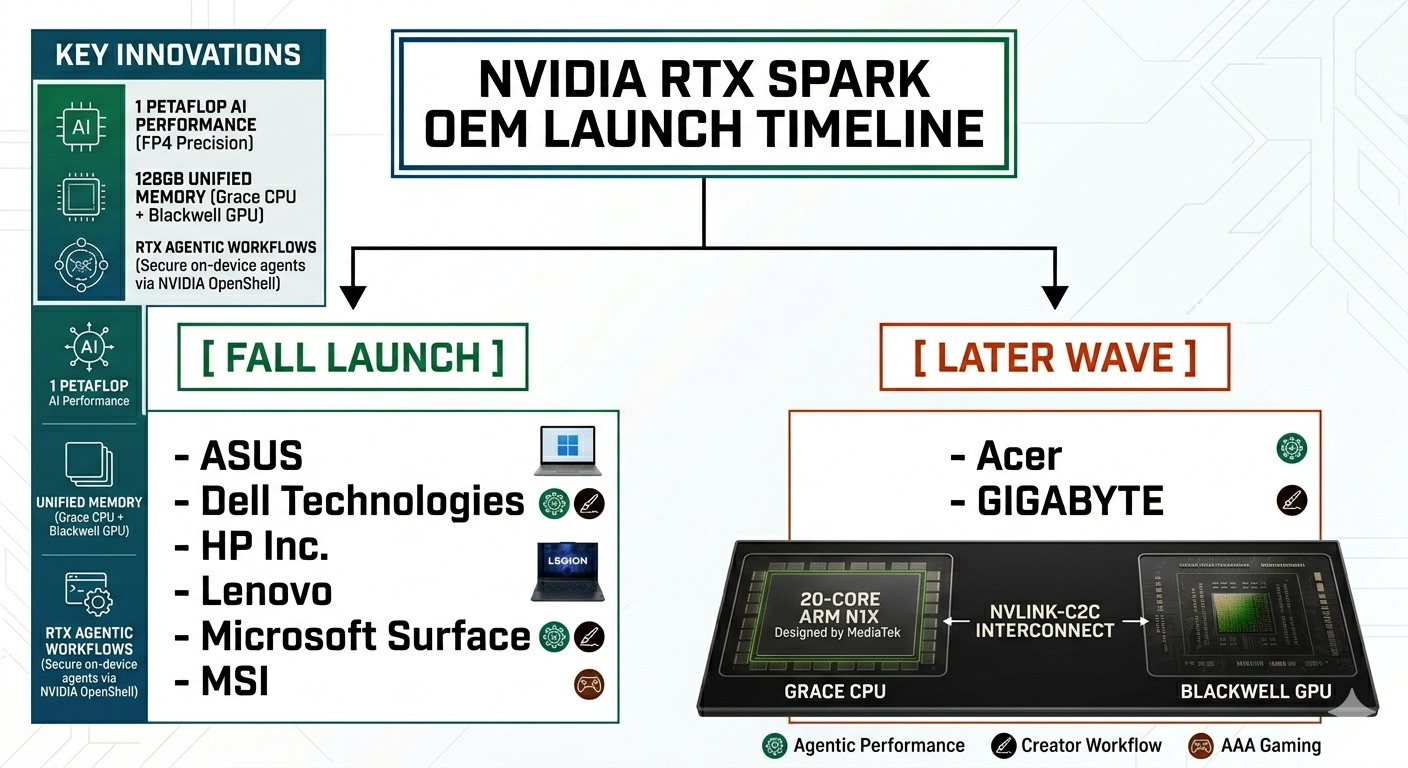
Hardware Ecosystem: Massive Industry Alignment and AvailabilityThe transition to an entirely new processing architecture requires deep commitment from global original equipment manufacturers (OEMs). To ensure widespread market penetration from day one, NVIDIA and Microsoft have assembled an alliance of the world’s largest hardware brands to construct a comprehensive ecosystem of laptops and compact desktops around the NVIDIA RTX Spark.
The physical design parameters enabled by the custom Arm processor are striking. Launch laptops will feature physical chassis profiles as thin as 14 millimeters while weighing as little as three pounds, all while offering full-day battery life. These premium devices will be equipped with color-accurate tandem OLED displays supporting NVIDIA G-SYNC technology to eliminate screen tearing during high-refresh-rate tasks.
Top executives from across the industry expressed immense confidence in the platform:
ASUS: Chairman Jonney Shih stated that the superchip gives the company the exact platform it needs to design systems that define the next decade of mobile computing.
Dell Technologies: CEO Michael Dell highlighted the upcoming XPS 16 Creator Edition, which pairs the high-bandwidth unified memory of the platform with premium, portable industrial design.
HP Inc.: Interim CEO Bruce Broussard previewed the next-generation HP OmniBook, pointing out that it will be one of the thinnest hardware implementations available, balancing portability with extreme developer-level power.
Lenovo: Chairman Yuanqing Yang emphasized how their engineering expertise and global supply chain scale will deliver a comprehensive portfolio of AI devices, offering broader choices to customers seeking local AI deployment.
Microsoft Surface: Corporate Vice President Brett Ostrum unveiled the Surface Laptop Ultra, detailing it as a flagship workstation thoughtfully engineered for professional developers and creators who rely deeply on the integrated Windows platform.
Conclusion: The Horizon of Personal Computing
The debut of the NVIDIA RTX Spark marks a definitive turning point in the technology sector. For decades, personal computers functioned purely as digital tools, completely dependent on manual input for every micro-task. By combining efficient Arm architecture, massive unified memory, and advanced local AI acceleration with an entirely re-engineered Windows operating system, NVIDIA and Microsoft are shifting the machine toward true digital partnership.
With hardware shipments scheduled to commence this fall from major global manufacturers, the industry is preparing for a massive realignment of market share. Developers, creators, and general consumers look to gain a level of unmetered, private digital intelligence that functions completely independent of the cloud. The transformation of the personal computer has moved past conceptual prototypes, laying down a highly performant, remarkably efficient foundation for the upcoming age of ubiquitous personal AI agents.