
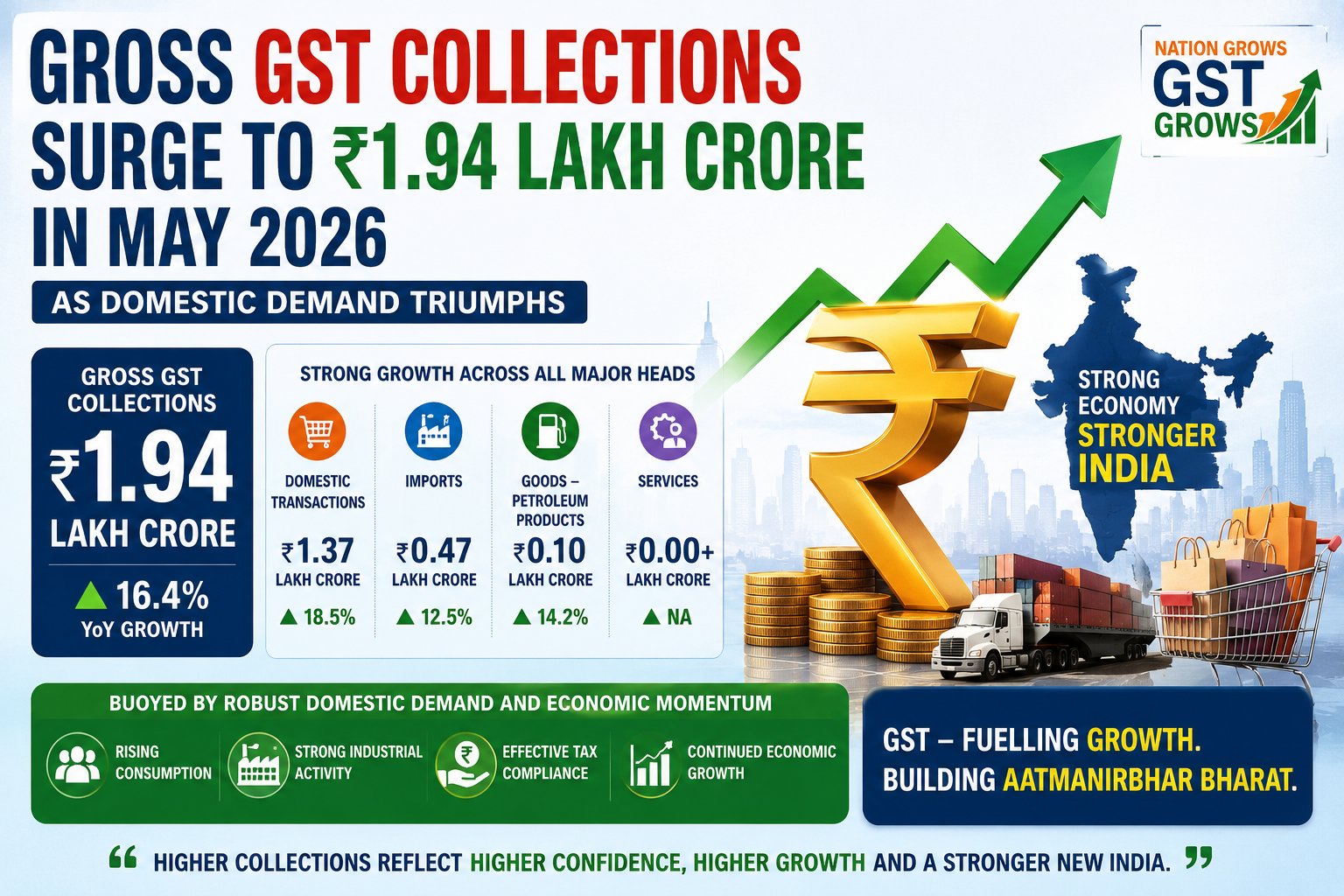
Gross GST collections in India have maintained a strong upward trajectory, crossing the ₹1.94 lakh crore milestone in May 2026. According to official data released by the Ministry of Finance on Monday, June 1, 2026, the country’s total indirect tax mop-up grew by 3.2% year-on-year, driven heavily by a powerful surge in domestic consumption, robust supply chains, and steady growth in industrial imports.
This solid fiscal performance follows the absolute historic peak achieved in April 2026, where collections hit an all-time record of ₹2.43 lakh crore due to year-end fiscal closings. The May 2026 figures underscore the foundational strength of the Indian economy, proving that consumption patterns remain highly resilient despite global macroeconomic pressures. Compared to May 2025, when the gross collection stood at ₹1.88 lakh crore, the latest numbers provide a transparent look into sustained industrial capacity and thriving consumer market dynamics.
The Fiscal Breakdown: Analyzing the Component Sheets
To truly understand where this massive revenue is originating, we must dissect the multi-tiered architecture of the Goods and Services Tax framework. The government’s reporting for May 2026 highlights a balanced distribution of revenue across central, state, and integrated tax components.
Domestic Transactions Breakdown
For the month of May 2026, the revenue generation from domestic economic activities remained the core pillar of strength. The clear division of collections from local business operations across the states includes:
Gross Central GST (CGST): Settled firmly at ₹37,397 crore. This component represents the federal government’s direct share of intra-state transactions.
State GST (SGST): Clocked in at ₹45,143 crore. This reflects the direct revenue accrued by states and union territories from internal commercial exchanges.
Integrated GST (IGST) from Domestic Supply: Stood at ₹51,990 crore. This represents the tax collected on inter-state movements of goods and services.
The Import Factor
Beyond domestic borders, international trade contributed heavily to the exchequer. The IGST collection from imports climbed by a massive 19.1%, reaching ₹59,654 crore.
In macroeconomic terms, a double-digit spike in import tax collection is a definitive leading indicator of industrial capacity expansion. It signals that Indian manufacturers are actively importing capital goods, specialized machinery, and raw materials to scale up internal production lines to meet future market demands.
Key Drivers: Domestic Goods and Services Take the Lead
The primary narrative behind the steady 3.2% growth rate is the phenomenal performance of both the tangible manufacturing sector and the intangible service industry. The growth percentages in these sectors showcase structural resilience in domestic consumption.

1. Skyrocketing Demand for Goods (+26.9%)
Taxable supplies of goods expanded by an astonishing 26.9% during the reported period. This metric completely outpaces the headline inflation rate and baseline GDP projections, showing that physical consumption is booming. From fast-moving consumer goods (FMCG) to consumer electronics, automotive vehicles, and heavy infrastructure materials, the volume of traded products has scaled significantly.
2. Resilient Growth in Services (+22.2%)
Simultaneously, the service sector expanded its taxable footprint by 22.2%. This sector—encompassing hospitality, aviation, financial services, digital entertainment, IT consultancy, and real estate—continues to serve as India’s structural engine. The post-pandemic shift toward an experiential economy, where consumers spend aggressively on travel, dining, and premium services, is clearly reflected in these double-digit gains.
Net Revenues and the Tax Refund Mechanism
A major sign of an efficient tax administration is how smoothly it handles corporate and individual tax refunds. For May 2026, the government maintained its commitment to business liquidity by ensuring that genuine refund claims were processed rapidly.
Total GST Refunds: Reached ₹27,281 crore, marking a steady 2.6% increase compared to the same timeframe last year.
Net Revenue Post-Refunds: After subtracting these essential refunds from the gross collections, the net cash inflow to the government treasury stood at ₹1.67 lakh crore. This translates to a clear 3.3% net growth year-on-year.
By releasing ₹27,281 crore back into the business ecosystem, the tax department directly supports the working capital requirements of exporters and small-to-medium enterprises (SMEs), ensuring that strict tax compliance does not bottleneck corporate cash flows.
From April’s Peak to May’s Stability: Understanding the Trend
It is critical for market analysts not to misinterpret the drop from April’s all-time record of ₹2.43 lakh crore to May’s ₹1.94 lakh crore as a slowdown.
Historically, the month of April always registers anomalous, sky-high revenues. This occurs because April collections reflect the economic activities of March—the closing month of the Indian financial year. During March, corporate entities clean up their ledgers, rush to clear pending tax liabilities, pay out year-end performance bonuses, and settle outstanding cross-border invoices.
Once that cyclical peak passes, May figures naturally stabilize back to a sustainable, baseline run-rate. Recording ₹1.94 lakh crore in a standard operational month like May proves that India’s baseline monthly collections are now comfortably consolidating around the ₹1.9 lakh crore to ₹2.0 lakh crore range.
Macroeconomic Impacts: What This Means for India's Growth PathThe fiscal data for May 2026 provides a wealth of positive indicators for the wider Indian economy:
Fiscal Deficit Control: With net revenues holding strong at ₹1.67 lakh crore, the Central Government remains well-equipped to manage its fiscal deficit targets. Strong tax collection limits the need for market borrowings, keeping sovereign bond yields stable.
Capital Expenditure Runway: Higher state and central revenues ensure that massive national infrastructure projects—such as expressways, dedicated freight corridors, and clean energy grids—will continue to receive uninterrupted public funding.
Boost in Consumer Confidence: The double-digit jumps in taxable goods and services show that rural and urban wages are successfully matching market pricing, leaving healthy disposable income for discretionary purchases.
Conclusion: A Resilient Path Forward
The latest revenue figures show that India’s economic machinery is operating at high efficiency. Powered by a 26.9% jump in goods supply and an incredible 19.1% growth in imports, the gross GST collections of ₹1.94 lakh crore for May 2026 set a confident, stable tone for the rest of the fiscal year.
As corporate investments scale up and systemic tax compliance widens via digital oversight, the nation remains firmly on track to sustain its position as one of the fastest-growing major economies globally.