
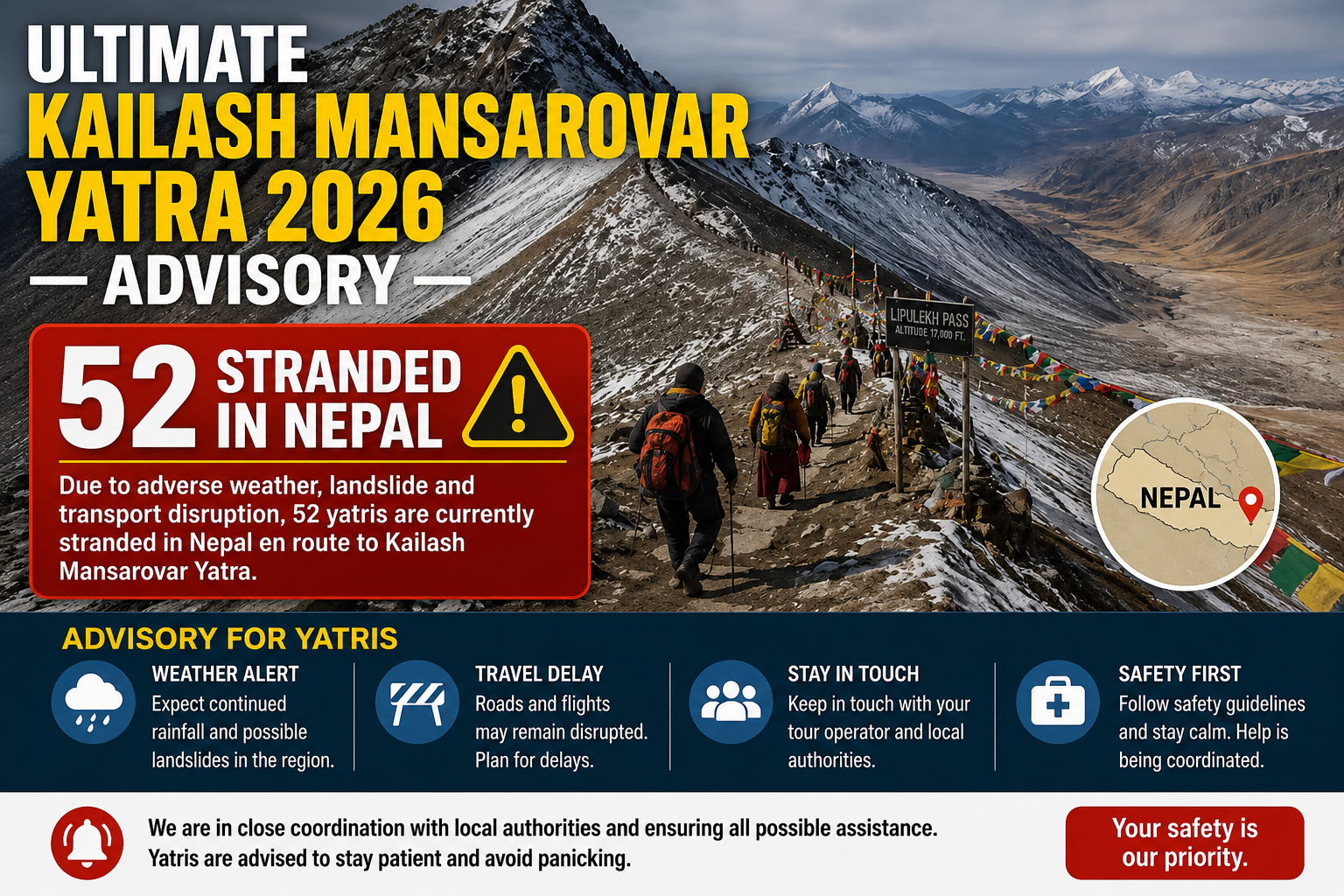
The Kailash Mansarovar Yatra 2026 advisory recently released by the Ministry of External Affairs (MEA) serves as an urgent wake-up call for thousands of Indian devotees planning this sacred pilgrimage. Undertaking a journey to Mount Kailash, nestled deep within the Tibet Autonomous Region of China, is a life-changing spiritual milestone for many. However, the dream has turned into a harrowing logistical nightmare for dozens of travelers this season.
The Indian government was forced to step in after receiving frantic distress calls from citizens who found themselves trapped across the border. Currently, at least 52 Indian pilgrims are stranded in Kathmandu, Nepal, unable to move forward or return easily due to a severe lack of official clearance. This comprehensive guide breaks down the government’s official warning, details the ground reality in Nepal, and explains exactly how you can safeguard your spiritual journey from fraudulent operators.
The Crisis in Kathmandu: Why 52 Indian Pilgrims Are Stranded
The spiritual fervor surrounding the Kailash Mansarovar Yatra 2026 advisory stems from a breaking crisis in neighboring Nepal. Over the weekend, news emerged that more than fifty Indian nationals were stuck in transit hotels across Kathmandu. These individuals had saved money for years and booked their tours through private agencies, expecting a seamless transition from India to Nepal, and finally into China.
Instead, they hit an absolute legal wall. Upon reaching Kathmandu—the primary transit hub for the overland and flight routes to Tibet—the pilgrims discovered that their private tour operators had failed to secure the mandatory Chinese visas and Tibet entry permits. Because these documents cannot simply be obtained on arrival or negotiated at the border checkpoints, the travelers were left entirely in limbo.
The situation rapidly escalated, prompting political intervention back home. Nationalist Congress Party (Sharadchandra Pawar) MP Supriya Sule officially flagged the matter, publicly urging the Ministry of External Affairs and Indian embassies to launch immediate rescue operations and provide logistical support to the stranded citizens. While diplomatic channels are currently working to assist these specific individuals, the incident exposed a massive vulnerabilities gap in how private religious tours are being managed.
Understanding the Ministry of External Affairs’ Official Warning
In direct response to the unfolding emergency in Kathmandu, the MEA issued a stern, unconditional statement directed at all future pilgrims. The core message of the government’s announcement is simple: Do not leave Indian soil under the assumption that your paperwork will be processed while you are en route.
For years, many private travel agencies have operated on a system of “anticipatory documentation.” They collect advance payments from clients, book initial flights to Kathmandu, and claim that group visas or special entry permits will be stamped by Chinese authorities while the group is resting in Nepal. The MEA has explicitly warned against this practice for the 2026 season.
CRITICAL MEA ADVISORY CHECKLIST:
1. Do NOT cross the Indian border without physical/confirmed Chinese Visas.
2. Ensure Tibet Autonomous Region (TAR) entry permits are fully issued.
3. Verify the registration of your private tour operator before paying.
4. Do not rely on verbal assurances or promises of "on-arrival" documentation.
Commencing an international journey of this scale based on verbal promises or expectations heavily increases the probability of getting stranded in foreign territories. If Chinese border authorities or immigration officials in Nepal find any discrepancy in your group paperwork, you will be denied entry immediately, often facing heavy financial losses and legal scrutiny.
The Legal Reality: Chinese Visas and Tibet Entry Permits
To understand why the Kailash Mansarovar Yatra 2026 advisory is so crucial, one must understand the complex geopolitical geography of the pilgrimage destination. Mount Kailash and Lake Mansarovar are located within Tibet. Therefore, entering this zone requires passing through two distinct layers of strict bureaucratic oversight:
1. The Regular Chinese Visa
An ordinary passport holder cannot simply walk into Tibet with a standard tourist visa. Indian citizens must obtain a specific visa category designated for religious pilgrims. This process involves submitting biometric data, valid passports with at least six months of validity, and verified itinerary details.
2. The Tibet Entry Permit (Alien Travel Permit)
Issued exclusively by the Tibet Tourism Bureau (TTB), this permit is a mandatory requirement over and above your passport and visa. The Chinese government tightly regulates the number of people entering the region. These permits are non-transferable and are bound tightly to specific entry dates and border checkpoints. If your tour operator misses the application deadline or submits incorrect traveler data, the entire group permit is rejected.
Private operators who lack official accreditation often try to bypass these channels or cut corners, leaving travelers vulnerable at international border gates.
Private Tour Operators vs. The Official Government Route
The Kailash Mansarovar Yatra has traditionally been executed via two distinct pathways. Understanding the differences between them can mean the difference between a successful pilgrimage and a legal disaster.
| Feature | Government-Organized Route (MEA) | Private Tour Operators |
| Route Path | Lipulekh Pass (Uttarakhand) / Nathu La Pass (Sikkim) | Primarily via Kathmandu (Nepal) overland or helicopter |
| Document Processing | Handled directly via state-to-state diplomatic channels | Managed by private agencies and local third-party fixers |
| Security & Support | Full government backing, ITBP escorts, medical teams | Dependent entirely on the agency’s local infrastructure |
| Strictness | High screening, lottery-based selection, strict fitness tests | Commercial booking, lower initial entry barriers |
While the government-organized route through passes like Nathu La—which successfully saw its first batch of 2026 pilgrims cross into China on June 20—is highly secure, it is also limited by strict quotas and rigorous health screenings. As a result, hundreds of pilgrims turn to private companies every year. While legitimate private operators do exist, the lack of centralized regulation allows unauthorized, fraudulent agents to prey on unsuspecting devotees.
Step-by-Step Guide: How to Verify Your Tour Operator’s Credentials
If you are planning to book your pilgrimage through a private agency for the remainder of the 2026 season, you must act as your own investigator. Do not let religious sentiment blind you to basic travel security. Use this step-by-step verification method before handing over any money:
Step 1: Demand Official Registration Numbers
Every legitimate tour operator handling international religious tourism must be registered with the Ministry of Tourism (India) or recognized by the corresponding tourism boards in Nepal (such as NTB or TAAN) and China. Ask for their official registration certificates and cross-verify the numbers on official government portals.
Step 2: Request Proof of Affiliation with Foreign Vendors
Indian operators do not work alone; they partner with local ground operators in Kathmandu and Lhasa. Ask your provider for the name and license of their Nepalese and Chinese counterparts. A genuine operator will have no issues providing transparent documentation regarding their foreign partners.
Step 3: Reject Verbal Assurances
If an agent tells you, “Don’t worry, your visa will be arranged by our guide when you land in Kathmandu,” terminate the conversation immediately. Insist on receiving written timelines showing exactly when your Chinese visa application will be submitted and when the physical permit will be handed over to you.
Essential Travel Checklist for the 2026 Pilgrimage Season
To ensure absolute safety and alignment with the latest government mandates, every pilgrim should double-check their preparations against this checklist before packing their bags:
Passport Validity: Ensure your passport has at least 6 to 12 months of validity remaining from your scheduled return date, along with multiple blank pages.
Medical Fitness Clearance: The high-altitude environment of Mount Kailash (exceeding 18,000 feet) places immense stress on the human cardiovascular system. Get a full medical evaluation, focusing on lung capacity and blood pressure.
Comprehensive Travel Insurance: Ensure your insurance policy explicitly covers high-altitude medical evacuation, helicopter rescue operations within Nepal/Tibet, and trip cancellations.
Physical Document Verification: Do not accept scanned copies or verbal confirmations. Before boarding your flight out of India, verify that you hold physical or officially verified digital copies of all visas and entry clearances.
Conclusion: Prioritizing Safety on the Path to Devotion
The Kailash Mansarovar Yatra 2026 advisory serves as a vital reminder that while faith can move mountains, it cannot bypass international borders or immigration laws. The unfolding situation involving the 52 stranded pilgrims in Kathmandu highlights the critical danger of trusting unauthorized travel operators blindly.
As the first batches of pilgrims successfully cross through official checkpoints like Nathu La Pass, it is evident that a safe, lawful journey is entirely achievable with proper planning. Protect your hard-earned savings, your health, and your spiritual peace of mind by demanding complete transparency, verifying every document, and ensuring all permits are firmly in your hands before taking your first step out of India.