

The long fight, between India’s financial regulator and its biggest business group has reached a clear turning point. The Reserve Bank of India rejected Tata Sons’ request to voluntarily give up its Core Investment Company registration.
By refusing this deregistration request the Reserve Bank of India closed the legal path that Tata Sons used to dodge a compulsory stock market listing. As a result the holding company of the ₹30+ trillion Tata Group must now get ready to go public under India’s non‑banking rules.
The Core Trigger: RBI’s Scale-Based NBFC Framework
To understand why the holding company of an empire is being pushed toward an initial public offering (IPO) one must examine the regulatory architecture introduced by the central bank. In October 2021 the RBI launched a Scale‑Based Regulation (SBR) framework for Non‑Banking Financial Companies (NBFCs). This framework categorizes institutions into four layers—Base, Middle, Upper and Top—based on systemic risk, interconnectedness and overall asset size.
| TOP LAYER (Reserved for extreme systemic risk – Empty) |
| UPPER LAYER Includes Tata Sons, REC, PFC (Mandatory Listing) |
| MIDDLE LAYER Systemically Important NBFCs & Unlisted CICs |
| BASE LAYER Non-Systemic NBFCs (Assets < ₹1,000 Cr) |
In September 2022 the central bank officially listed Tata Sons in its Upper Layer (NBFC‑UL) category alongside financial institutions, like Bajaj Finance and Power Finance Corporation. Under these SBR guidelines any entity placed in the Upper Layer faces a strict mandate: it must list its equity shares on recognized stock exchanges within three years of classification.
For Tata Sons that initial regulatory clock set a deadline of September 30 2025.
The Debt Payoff Strategy and Voluntary Deregistration Attempt
Than preparing an IPO prospectus to meet the 2025 deadline leadership chose a different path—one that avoided the regulation altogether.
Under the law a Core Investment Company or CIC is meant to hold investments in companies within its group. It does not offer retail banking services or financial products to the public. If a CIC has no deposits does not interact directly with customers and clears all external debt it can in theory apply to give up its Certificate of Registration or CoR and become an unregistered holding company.
Tata Sons undertook a financial overhaul.
Debt Clearance: In the year 2024 Tata Sons paid back more than ₹21,800 crore, in loans. This allowed the company to wipe out all debt and clean its balance sheet.
Formal Application: On March 28 2024 Tata Sons formally asked the Reserve Bank of India to surrender its CIC registration.
The plan was simple and clear: if the RBI approved the request Tata Sons would no longer be classified as a NBFC. That meant it would fall out of the Upper Layer category, which currently requires companies to go public. Without that classification the need for an IPO would disappear.
Why the Central Bank Declined
The regulator’s formal response arrived via official communication issued to Tata Sons’ executive leadership. The central bank determined that it could not accede to the request for voluntary surrender.
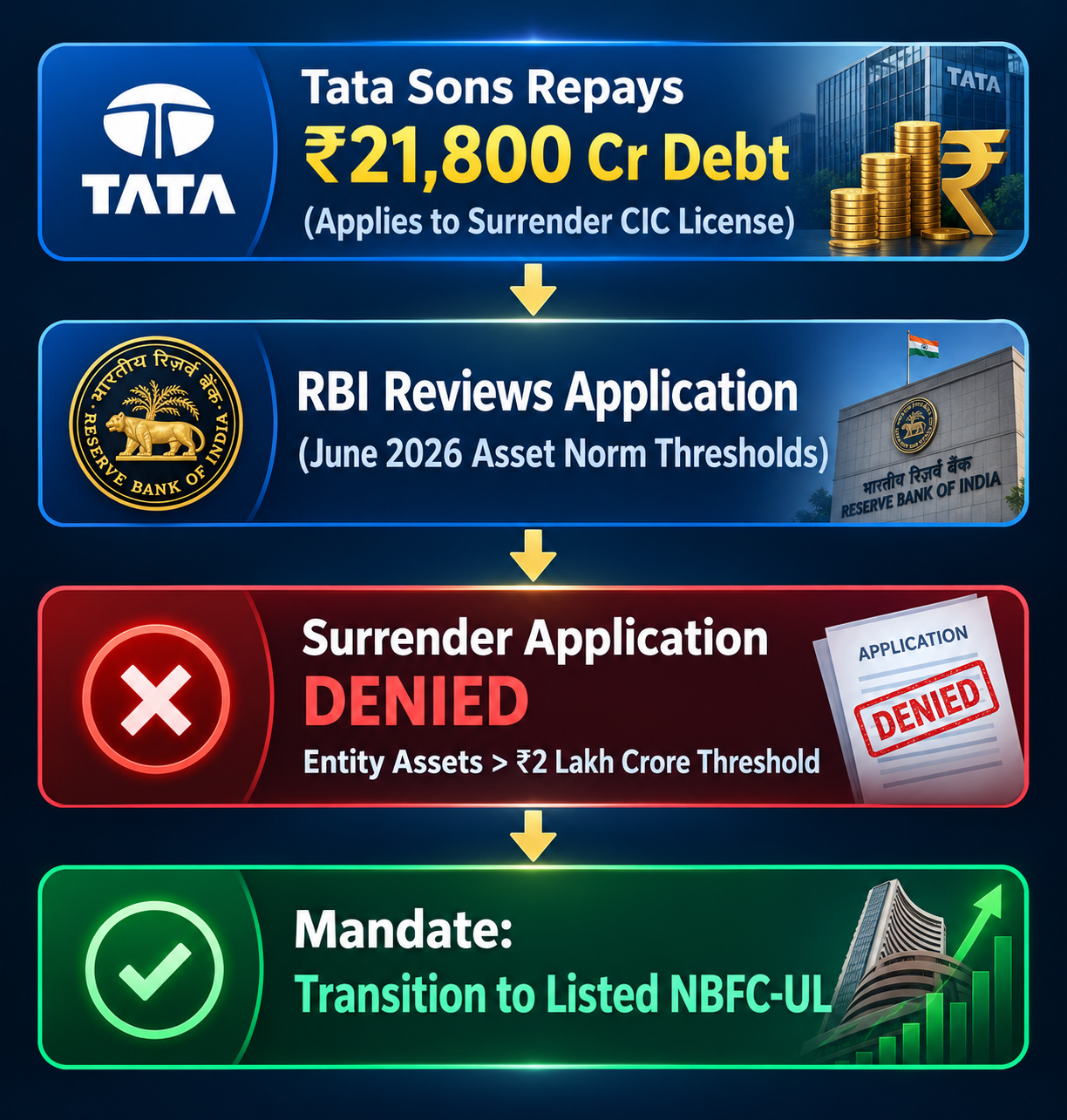
The rejection stems from updated regulatory directives established by the central bank:
Asset Threshold Mandates: Under updated guidelines, any NBFC possessing standalone total assets exceeding ₹1 lakh crore automatically qualifies for Upper Layer classification. As of March 31, 2026, Tata Sons reported standalone assets exceeding ₹2.01 lakh crore—more than double the qualification threshold.
Systemic Impact: Despite having zero external debt, the scale of Tata Sons’ investments in systemically critical sectors—such as aviation, defense, steel, automotive, technology, and consumer finance—means distress at the holding level could create cascading risks throughout the wider national economy.
5-Year Sticky Clause: Central bank rules dictate that once an entity enters the Upper Layer category, it remains bound to that elevated compliance framework for a minimum of five years, regardless of subsequent asset shifts or balance sheet changes.
Shareholder Dynamics: Internal Debates Over Public Listing
The regulatory directive brings long-running internal strategic disagreements between key shareholders to a head.
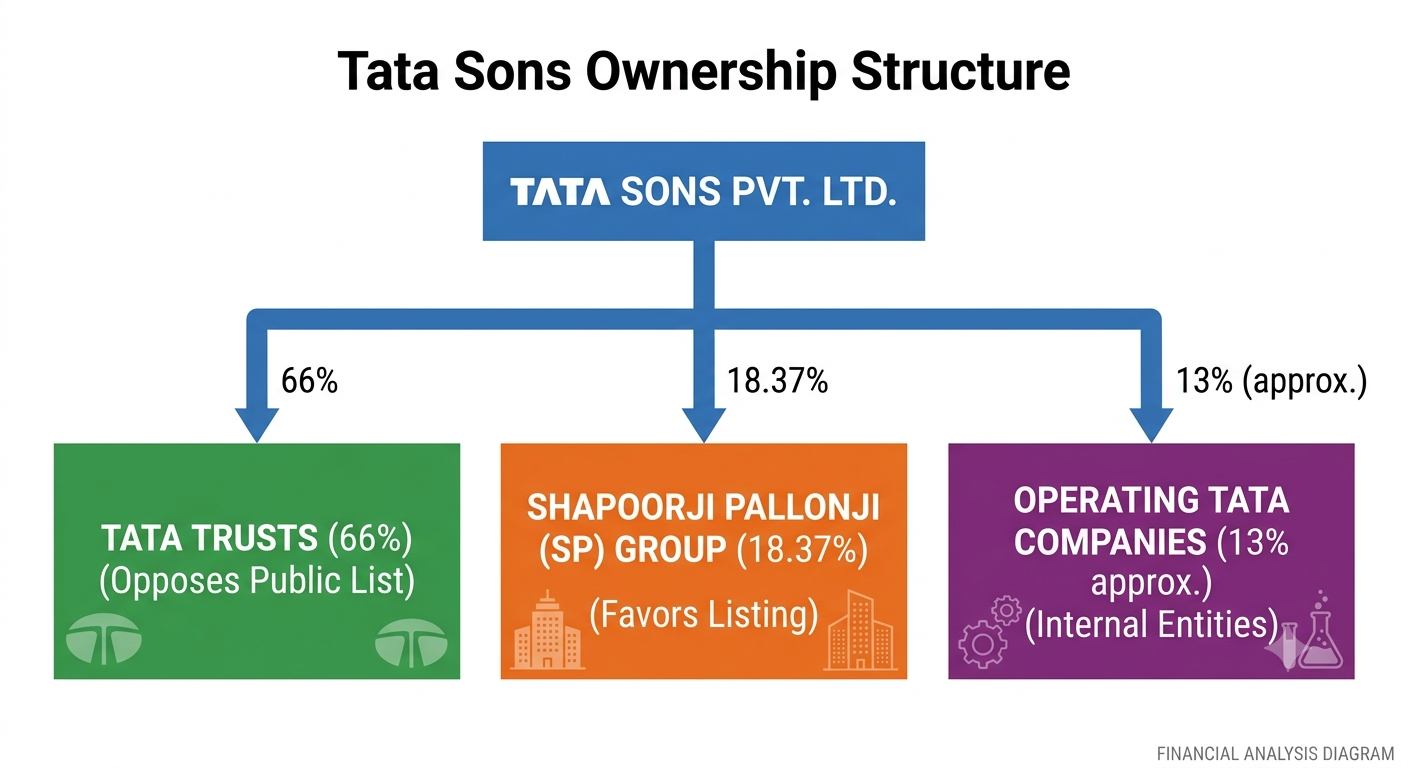
The Position of Tata Trusts (66% Shareholding)
The philanthropic Tata Trusts, led by Noel Tata control two thirds of the equity capital in Tata Sons. Tata Trusts have consistently resisted going public:
Mission Focus: I see that the mission focus of Tata Trusts is to give corporate dividend money to health, education and social relief programs across India.
Control and Structure: I believe that the leaders in Tata Trusts argue that a public listing would put Tata Sons under quarterly earnings pressure cause volatile trading and bring complicated market scrutiny. These problems could pull attention away from long‑term capital use and, from goals.
Board Resolutions: In July 2025 Tata Trusts formally passed resolutions that confirm Tata Trusts commitment to keep Tata Sons privately held. Tata Trusts then spoke directly with banking authorities to argue for an exemption.
The Position of the Shapoorji Pallonji Group (18.37% Shareholding)
The Shapoorji Pallonji (SP) Group is the minority shareholder in Tata Sons. The Mistry family has taken an approach supporting a public listing:
Price Discovery and Value Realization: A stock exchange listing creates a clear and open way to determine the value of Tata Sons’ shares in companies such, as TCS, Tata Motors and Tata Steel.
Liquidity and Debt Restructuring: The SP Group has an amount of debt around ₹60,000 crore. A public listing gives the Mistry family a way to use, sell or partly sell its shares to deal with its debt.
Structural Impact of a Potential Public Listing
If Tata Sons moves forward with an Initial Public Offering to meet regulatory requirements, it will fundamentally alter governance across the conglomerate.
| Strategic Dimension | Private Holding Company (Historical) | Listed Entity Structure (Required Future) |
| Financial Disclosures | Annual reports provided to private shareholders; limited public data access. | Mandatory quarterly disclosures of financial performance, debt structures, and segment performance. |
| Board Composition | Nominated representatives from Tata Trusts and select key group companies. | Strict requirements for independent directors, women directors, and audit committees. |
| Capital Allocation | Flexible internal funding for long-term bets (e.g., semiconductors, e-commerce, battery tech) without immediate return mandates. | Enhanced scrutiny on return on capital employed (ROCE) and dividend payouts from minority public investors. |
| Regulatory Oversight | Standard Registrar of Companies (RoC) and limited operational monitoring. | Joint regulatory oversight from SEBI (stock market rules) and RBI (Upper Layer NBFC guidelines). |
Financial Scale Across Key Group Assets
Tata Sons serves as the primary investment vector for the conglomerate. It holds equity across several high-performing public subsidiaries:
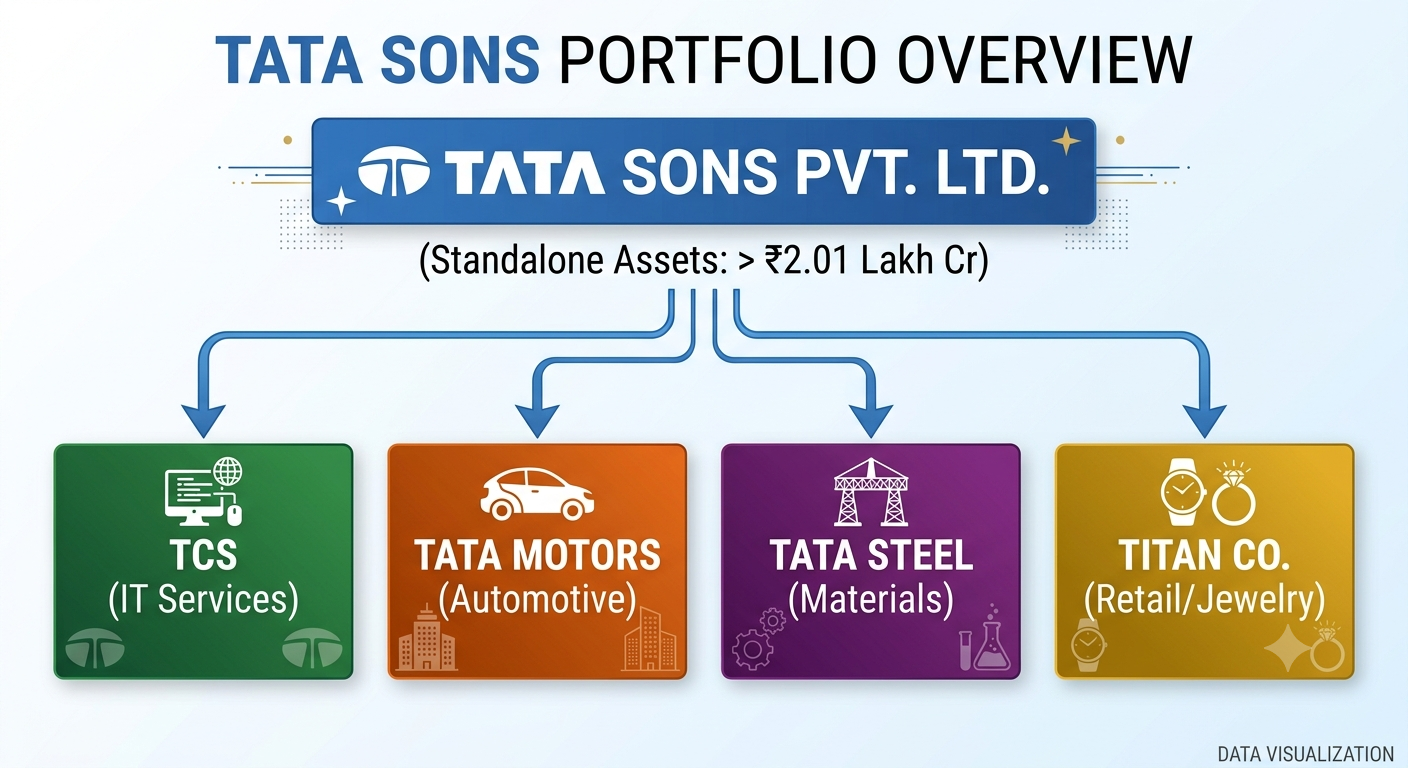
Because of this structure, any public float of Tata Sons would function as a broad-based holding company stock, providing direct investor exposure to India’s expanding industrial, tech, and consumer infrastructure.
What Comes Next for the Holding Company?
Now that the central bank has said no to the deregistration request people are looking at what needs to be done how to follow the rules:
Checking the Timeline for Following Rules: The original deadline of September 30 2025 is in the past so Tata Sons has to work with the people who make the rules to create a schedule that everyone agrees on for the listing.
Deciding How to Do the IPO: The leaders of the group will have to think about what kind of listing they want. They need to decide if it will be an Offer for Sale by people who already own shares or if they will create new shares or if they will change the structure of the company to meet the requirements for public ownership without giving up control.
Staying with the Leaders: The change happens at a time when the company needs strong leadership as the Group Chairman N. Chandrasekaran is nearing the end of his second term in February 2027. Making a plan for following the rules will be a topic for the board, in the coming months.