
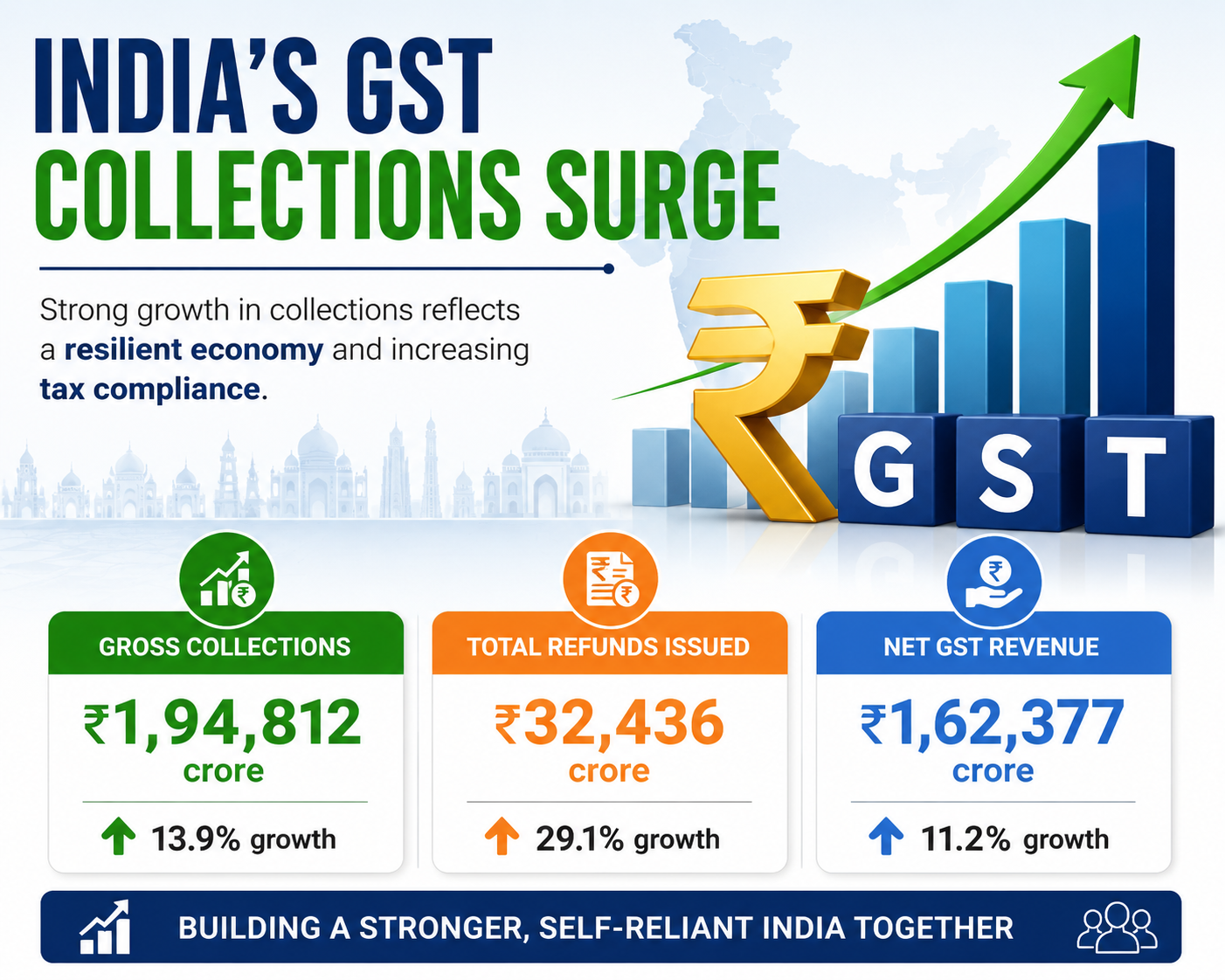
India’s GST collections took a dramatic leap in June 2026, hitting a massive ₹1.95 lakh crore and recording their fastest annual growth pace in 13 months. As the Goods and Services Tax (GST) framework celebrated its ninth anniversary on July 1, the latest revenue figures provided plenty of reasons for the government to cheer. The June print represents a significant acceleration from the previous month (May 2026), where annual growth had slowed down to just 3.2%.
However, beneath the celebratory headline of a 13.9% year-on-year growth lies a complex economic narrative. A closer look at the data reveals that this spectacular fiscal performance was not entirely driven by a roaring domestic marketplace. Instead, it was fueled heavily by a massive, unprecedented surge in customs-front import revenues, while domestic consumption showed signs of cooling off.
The Big Picture: Breaking Down the June 2026 Numbers
The total gross GST revenue for June 2026 came in at exactly ₹1,94,812 crore (roughly ₹1.95 lakh crore). To put this in perspective, gross collections stood at ₹1.71 lakh crore in June 2025. This 13.9% jump marks the strongest annual expansion since May 2025, when revenues grew by 16.4%.
While the headline figure inches tantalizingly close to the historic ₹2 lakh crore milestone, the internal dynamics of the tax collection showcase a stark divergence between international trade and local commerce.
Gross vs. Net: The Refund Impact
It is vital to look at what the government actually keeps after handing back dues to businesses.
Gross Collections: ₹1,94,812 crore (13.9% growth)
Total Refunds Issued: ₹32,436 crore (29.1% growth)
Net GST Revenue: ₹1,62,377 crore (11.2% growth)
The high volume of refunds indicates that tax authorities are processing business claims at a much faster pace. Domestic refunds alone climbed by a staggering 42.9% to reach ₹17,767 crore. Meanwhile, export-related refunds handled through the ICEGATE portal rose 15.6% to ₹14,669 crore. Because the refund outgo remained highly elevated, the net growth (11.2%) trailed slightly behind the gross growth figure.
Why Imports Are the Real Hero of June’s GST Growth
The defining feature of June’s fiscal report card is the disproportionate contribution of external trade. India’s GST collections from imported goods experienced a phenomenal surge, jumping 34.6% year-on-year.
| Revenue Category | June 2025 (in ₹) | June 2026 (in ₹) | Year-on-Year Growth |
| Import GST Revenue | ₹44,600 crore | ₹60,038 crore | 34.6% |
| Domestic GST Revenue | ₹1,26,564 crore | ₹1,34,774 crore | 6.5% |
| Total Gross GST | ₹1,71,164 crore | ₹1,94,812 crore | 13.9% |
As shown in the data, domestic gross GST revenue grew at a much more modest 6.5%, reaching ₹1.35 lakh crore. This means that while local manufacturing and retail sales are moving forward at a steady, cautious pace, it was the inflow of foreign goods that supercharged the national treasury.
Economists point out that this heavy reliance on imports suggests that global supply chains, higher commodity prices, or an increased domestic demand for high-end foreign electronics and machinery are currently steering India’s indirect tax momentum.
Regional Performance: Winners and Losers Among States
The national average of 13.9% growth does not tell the whole story of India’s diverse internal markets. The state-wise breakdown for June 2026 reveals a highly fragmented economic landscape, with some regions booming and others plunging into negative territory.
The Growth Leaders
Uttar Pradesh: The absolute standout performer among major state economies. UP recorded a spectacular 19% growth, with its domestic collections climbing to ₹9,165 crore from ₹7,675 crore in the same period last year.
Assam: Followed closely behind the leader, posting an impressive 17% growth.
Punjab: Showed healthy economic activity with a 14% year-on-year increase.
Gujarat: The industrial powerhouse maintained strong momentum, registering 12% growth.
Telangana & Kerala: Both southern states posted uniform, solid growth of 11%.
The Heavyweights
Maharashtra: As India’s largest economic contributor, Maharashtra maintained its position as the top GST generator, pulling in ₹30,714 crore. However, its growth rate was a relatively modest 9%.
Karnataka: The tech-heavy state recorded a stable 10% annual expansion.
Delhi: The national capital territory posted a conservative growth rate of 8%.
The Underperformers
Surprisingly, several large states experienced a contraction in their tax collections during June, highlighting uneven regional demand:
Jharkhand: Suffered the worst blow among major states, with collections plunging by a sharp 16%.
Rajasthan & Madhya Pradesh: Both states saw a noticeable economic cooling, with collections falling by 5% each.
Tamil Nadu: One of India’s primary manufacturing hubs faced a minor setback, registering a 2% contraction in its monthly tax intake.
First Quarter (Q1 FY27) Overview: A Steady Start
Looking at June in isolation can sometimes distort long-term economic trends. When we widen our lens to look at the entire first quarter of the fiscal year 2026–27 (April to June 2026), the numbers look solid, if not entirely explosive.
During Q1 FY27, cumulative gross India’s GST collections reached ₹6.32 lakh crore, marking an 8.4% growth compared to the ₹5.83 lakh crore collected during the first quarter of the previous fiscal year. On the net front, cumulative collections for the quarter stood at ₹5.40 lakh crore, translating to a 7.1% year-on-year increase.
Key Takeaway: The quarterly data confirms that while the June bounce was spectacular, the broader fiscal year is starting on a steady, conservative path rather than a nationwide economic boom. The growth is concentrated in specific sectors and regions rather than being broad-based.
Nine Years of GST: Structural Challenges That Still Remain
The release of these revenue figures coincided exactly with the completion of nine years since the historic rollout of the GST regime on July 1, 2017. While the tax system has undoubtedly unified India into a single common market, eradicated state-border check posts, and drastically improved compliance through digitalization, tax experts and industry leaders argue that the system is far from perfect.
As the financial ecosystem transitions into its tenth year, several structural pain points continue to frustrate businesses and tax professionals alike:
1. The Inverted Duty Structure
One of the most persistent complaints from manufacturers is the inverted duty structure, where raw materials are taxed at a higher rate than finished products. This creates an uncomfortably large accumulation of input tax credits, blocking vital working capital for small and medium enterprises (SMEs) and forcing them to continuously apply for government refunds.
2. Complex Input Tax Credit (ITC) Rules
The rules governing the matching of invoices between buyers and sellers remain notoriously stringent. Minor clerical errors by a supplier can lead to the freezing of legitimate tax credits for the buyer, leading to aggressive tax notices and compliance bottlenecks.
3. Multiple State Registrations
For businesses operating across pan-India borders, the requirement to maintain separate GST registrations and undergo separate audits in every single state remains an administrative nightmare. Corporate leaders continue to lobby for a centralized compliance mechanism for service sectors like IT, banking, and logistics.
4. Delayed Dispute Resolution
The prolonged delay in setting up the much-anticipated GST Appellate Tribunals (GSTAT) across states has led to an enormous backlog of litigation. Businesses are currently forced to approach high courts for basic tax disputes, making legal remedies expensive and time-consuming.
Final Thoughts: What Lies Ahead for India’s Economy?
The June 2026 tax figures present a fascinating paradox. On one hand, hitting ₹1.95 lakh crore proves that the government’s tax collection machinery is highly efficient, robust, and capable of generating immense fiscal headroom. The massive 34.6% surge in import GST indicates that India remains a highly attractive, consuming market for global goods.
On the other hand, the sluggish 6.5% growth in domestic transactions is a gentle reminder to policymakers that local consumption requires a boost. If the Indian economy is to sustain its high-growth trajectory throughout the rest of FY27, domestic demand, rural income growth, and local manufacturing will need to pick up the slack.
As the GST Council prepares for its upcoming meetings in the later half of the year, all eyes will be on whether they introduce rationalized tax slabs and ease compliance pressures to help domestic businesses match the phenomenal pace set by international trade.