
The global toy industry is undergoing a massive geopolitical shift, and India is positioning itself to be at the very epicenter of this transformation. Speaking at the prestigious 17th Toy Biz International B2B Expo 2026, Union Minister for Commerce and Industry Piyush Goyal laid down a bold, transformative roadmap for domestic manufacturers.
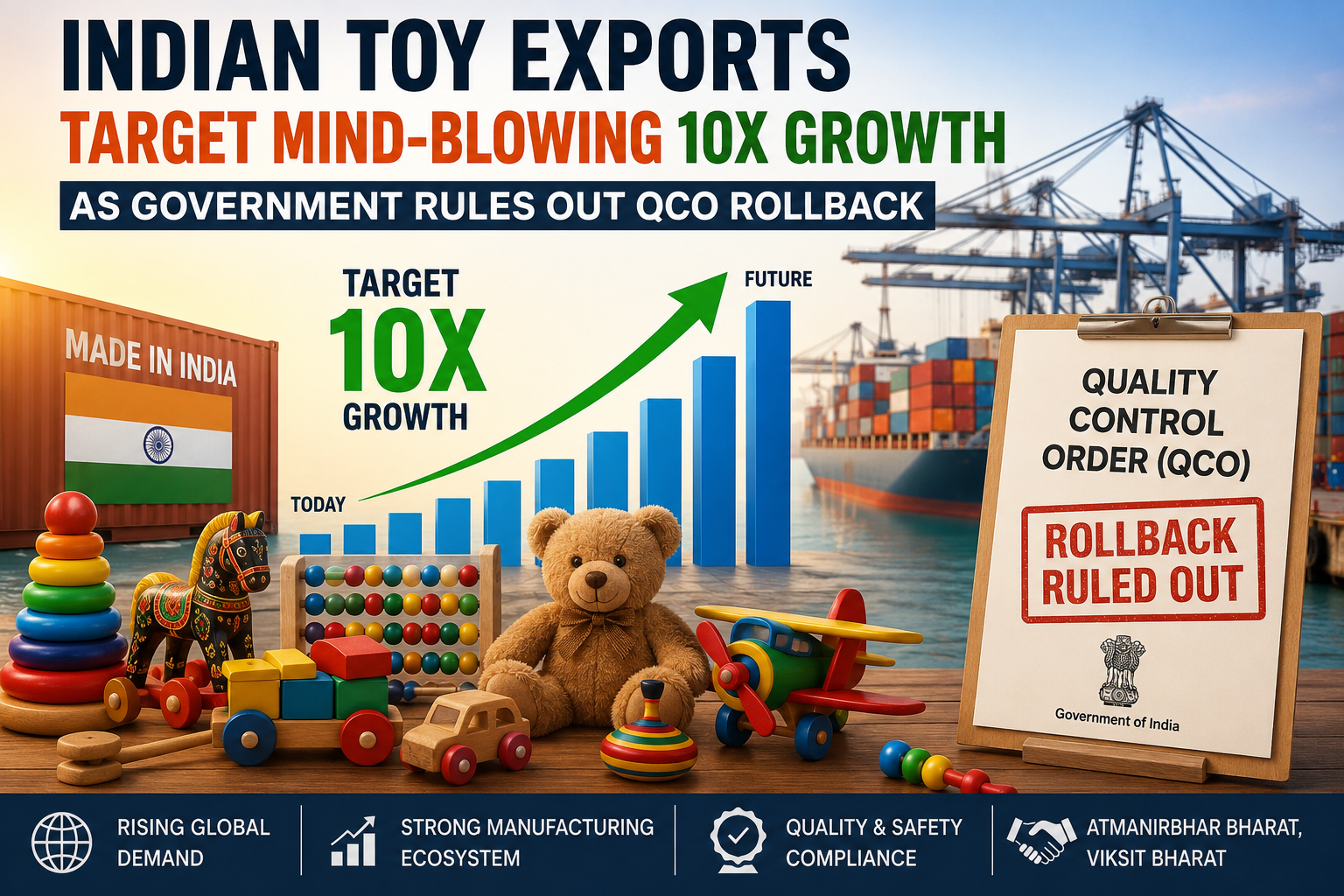
Goyal has officially challenged the domestic industry to target a staggering 10-fold increase in Indian toy exports over the next four years.
While the growth target is highly ambitious, the government’s message to the industry was crystal clear: this expansion will be built entirely on the pillars of uncompromised quality and stringent safety standards. Dismissing ongoing murmurs from certain industry factions, the minister firmly vowed that the mandatory Quality Control Orders (QCOs) are here to stay, ensuring that substandard goods have no place in India’s manufacturing future.
The Global Playground: Bridging the Market Share Gap
Currently, the global toy market is valued at a massive $120 billion. Despite India’s immense human resource potential and rich cultural heritage in craftsmanship, the country’s current share in this global playground remains surprisingly negligible, hovering at just 0.2% to 0.3%.
Global Toy Market: $120 Billion
India's Current Share: 0.2% - 0.3%
Government Export Target: 10x Growth in 4 Years
“The toy industry is as large as $120 billion globally, and we have a 0.2-0.3 per cent share. It is right for us to export in much larger quantities,” Minister Goyal stated during his address.
However, the foundation for this giant leap has already been laid. Over the past four years, Indian toy exports have achieved a remarkable 239% growth trajectory. The next phase of this evolution requires shifting gears from gradual progress to exponential scaling, turning India from a regional player into an international export powerhouse.
Weaponizing Free Trade Agreements (FTAs)
To achieve this ambitious 10x growth, the Indian government is urging toy manufacturers to aggressively exploit the country’s newly forged trade alliances. Over the last three and a half years, India has successfully finalized nine Free Trade Agreements (FTAs), unlocking unprecedented access to lucrative, highly regulated developed markets.
Minister Piyush Goyal’s Direct Charge to the Industry:
“You should be sending delegations to all the 38 countries covered by the nine FTAs and engage with local industries, supermarkets and e-commerce companies so your products go global.”
By directly engaging with international supermarket chains, global distributors, and cross-border e-commerce platforms, Indian toy makers can bypass traditional supply chain bottlenecks and establish a direct brand presence worldwide.
Looking ahead, the international trade horizon looks even brighter. The highly anticipated India-New Zealand FTA is projected to become fully operational within this year. Concurrently, high-level trade negotiations are actively underway with major economic blocs, including:
The Gulf Cooperation Council (GCC)
Canada
Mexico
Brazil
Why Quality Control Orders (QCOs) Are Non-Negotiable
For a long time, sections of the domestic industry have lobbied for the relaxation of the Toys (Quality Control) Order, which was first introduced in 2020. The framework mandates that all toys—whether manufactured locally or imported into India—must strictly conform to the safety norms set by the Bureau of Indian Standards (BIS) and prominently display the ISI mark.
Goyal completely shut down any hopes of a policy rollback. “I can assure you that until I am there, no one will remove QCOs. QCO will be there. We will also protect you from unfair dumping from any nation,” he asserted.
Decoding the Transition Facilitation Order, 2026
The minister’s firm stance arrives just days after the Centre introduced the Transition Facilitation (Quality Control) Order, 2026. Some industry insiders misinterpreted this as a sign of dilution. However, Goyal clarified its exact purpose:
Temporary Compliance Route: It merely provides a temporary operational cushion for businesses to align themselves with standard protocols.
No Dilution of Standards: It does not lower the safety or quality benchmarks required for the final product.
Investment Incentive: The transition window is explicitly designed to facilitate ease of doing business, attract foreign direct investment (FDI), and encourage manufacturing at an industrial scale.
The government emphasizes that the historical success of foreign manufacturing hubs was never built on cheap, low-quality replication, but rather on relentless quality consistency and technological superiority.
Public-Private Partnerships: A Center of Excellence
To help MSMEs and domestic manufacturers transition smoothly into this high-quality regime, the government has proposed an innovative Public-Private Partnership (PPP) model to establish a state-of-the-art Center of Excellence.
This proposed facility will serve a dual purpose:
Advanced Product Testing: Giving local manufacturers affordable access to world-class testing labs to get their BIS certifications quickly.
Cutting-Edge Design Facilities: Helping Indian designers create innovative, safe, and modern toys that appeal to global tastes while retaining Indian cultural elements.
The International Perspective: China Toy Association Commends India’s Rise
India’s dramatic shift in manufacturing capability hasn’t gone unnoticed by its global competitors. Attending a toy exhibition in New Delhi, May Liang, Chair of the China Toy & Juvenile Products Association, expressed immense optimism regarding India’s domestic consumer market and its rapidly improving manufacturing ecosystem.
“The Indian toy market has very good potential, because India has more than 20 million newborn children every year. That is a huge opportunity,” Liang noted.
Spotting Global Synergies
Marking her first-ever visit to an Indian toy fair, Liang highlighted the incredibly warm reception and constructive dialogue shared with the Indian Toy Association. The bilateral discussions highlighted strong mutual interest in co-development, particularly in the high-demand ride-on toys segment.
Furthermore, Liang openly acknowledged the visible upgrading of Indian factories. “As for quality, the Indian toy industry has improved quite a lot. Many multinational companies are now producing in India, such as Hasbro, and this has helped raise standards across the industry,” she remarked.
The presence of global toy giants like Hasbro setting up massive manufacturing operations in India has created a positive spillover effect. Local ancillary suppliers, packaging partners, and component manufacturers are rapidly modernizing their own workflows to meet these strict multinational standards.
The Strategic Roadmap to 2030
To convert the minister’s vision of a 10-fold growth into reality, the Indian toy ecosystem must act on a multi-pronged strategy:
| Strategic Pillar | Action Items |
| Machinery & Tech Upgradation | Moving away from manual assembly lines to automated injection molding and precision manufacturing tools. |
| B2B Global Outreach | Actively participating in international expos and setting up dedicated trade desks across FTA-partner nations. |
| IP & Design Creation | Moving from contract manufacturing (OEM) to creating indigenous Intellectual Property (IP) and global brands. |
| Strict Quality Compliance | Embracing BIS and QCO guidelines as a competitive advantage rather than a regulatory hurdle. |
Conclusion: Playing for Keeps in the Global Market
The narrative surrounding Indian manufacturing is shifting from cost-efficiency to quality-driven scale. By cementing the Quality Control Orders as a permanent fixture, the Indian government is sending an unambiguous signal to the world: toys made in India are safe, durable, and built to the highest global standards.
With a massive domestic market driven by over 20 million newborns annually, a wave of supportive FTAs, and an aggressive 10x export target, India’s toy industry is no longer just playing around—it is playing to win.