
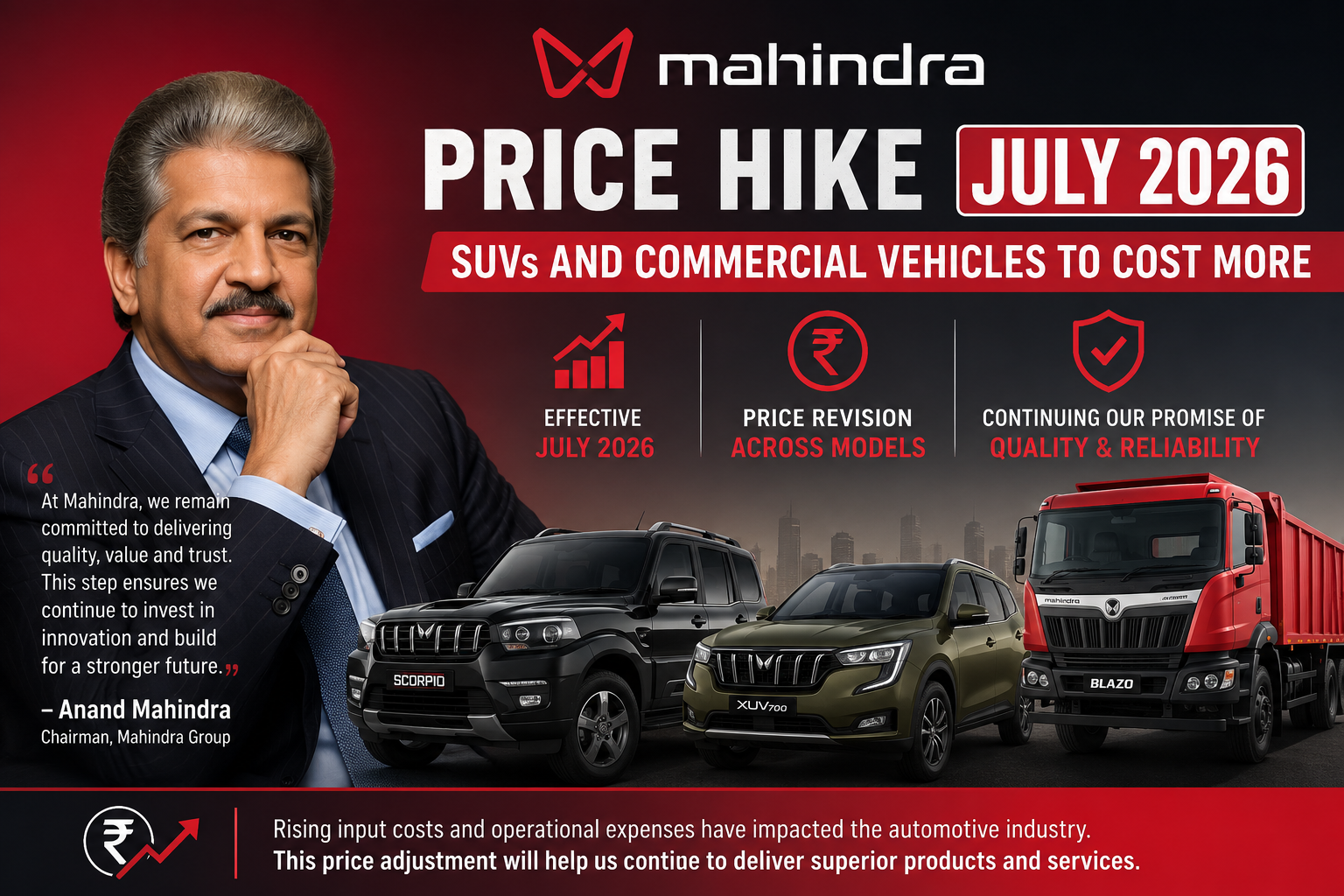
If you have been eyeing a shiny new Scorpio-N, a rugged Thar, or a tech-loaded XUV700, we have some news that might make you want to call your local dealership today. The homegrown automotive giant Mahindra & Mahindra has officially announced an upcoming Mahindra Price Hike July 2026 across its entire lineup of sport utility vehicles (SUVs) and commercial vehicles (CVs).
For anyone planning an automotive purchase this monsoon season, timing is officially everything. This means buyers have a microscopic window of opportunity to finalize their bookings under the current price structure.
Let’s pull back the curtain on this announcement, look at exactly why it is happening, break down the numbers, and figure out what this means for your hard-earned money.
The Breakdown: What Does the Mahindra Price Hike July 2026 Look Like?
The price revision announced by Mahindra is split strategically across its two main operational divisions: the highly popular Sport Utility Vehicle (SUV) segment and its crucial Commercial Vehicle (CV) portfolio.
The increase is structured on an average percentage basis, meaning the exact cash impact on your wallet will fluctuate depending on the specific model, variant, and ex-showroom price point of the vehicle you choose.
SUV Portfolio: Prices are set to increase by an average of 2.7%. Whether you are eyeing a compact urban SUV or a massive ladder-frame off-roader, the base price will see an upward tick.
Commercial Vehicle Range: Prices across the light, medium, and heavy transport lineups will experience an average hike of 2%. This affects logistics providers, small business owners, and intra-city cargo operators who rely heavily on Mahindra’s pickup and loading trucks.
The new pricing structure officially goes live on July 10, 2026. Up until that cutoff date, billing will be processed under the older, prevailing price configurations. However, getting that older price is strictly subject to local dealership inventory availability, booking terms, and immediate allocation timelines.
Behind the Numbers: Why is Mahindra Raising Prices Now?
The core driver behind this pricing strategy is a term every modern consumer is becoming painfully familiar with: commodity cost escalation.
Manufacturing a modern automobile is an incredibly complex process requiring vast quantities of industrial raw materials. Over the past few quarters, global and domestic supply lines have seen a steady, unrelenting increase in the procurement costs of foundational metals and elements.
[Raw Material Costs Rise] ──> [Higher Production Expenses] ──> [Portion Passed to Consumer]
     (Steel, Aluminum,                          (Energy, Sourcing,                           (2.7% SUV / 2.0% CV
      Copper, Rubber)                               Transportation)                                 Average Increase)
When you break down what actually goes into making a vehicle like an XUV700 or a Scorpio-N, it becomes clear why a price adjustment is inevitable:
Steel and Aluminum: The backbone of vehicle chassis, body panels, and structural reinforcement cages. Structural steel pricing directly impacts the baseline cost of production.
Copper: Crucial for complex electrical wiring looms, modern infotainment setups, advanced driver assistance systems (ADAS), and sensor arrays.
Rubber and Plastics: Essential for tire compounds, interior dashboards, door seals, trim pieces, and engine bay components.
Logistics and Operations: Beyond the physical raw materials, the energy required to run massive automated assembly plants, the cost of transporting components from Tier-1 suppliers, and global freight charges all pile onto the final bill of materials (BOM).
For months, car manufacturers have tried to absorb these incremental costs to keep demand alive. However, when input costs cross a specific threshold, companies must pass a portion of the burden onto the retail market to protect their operational margins and maintain healthy financial sheets.
Q1 FY27: A Golden Quarter Met With Global Realities
What makes this price hike fascinating is its timing. Mahindra isn’t raising prices out of desperation; rather, they are doing it from a position of immense market strength. The company recently closed out the first quarter of the 2027 fiscal year (April–June) with staggering sales growth.
Demand for Mahindra’s rugged, feature-loaded lineup has reached historic highs, creating massive waiting periods for several flagship models.
Passenger Vehicle Performance
During the April-June quarter, Mahindra dispatched a whopping 1,74,745 SUVs into the domestic Indian market. When compared to the 1,52,067 units sold during the same three-month window last year, this represents an incredible 15% year-on-year (y-o-y) growth. Vehicles like the Thar, Scorpio, and XUV series continue to dominate consumer mindshare, outperforming broader industry growth metrics.
Commercial Vehicle Performance
The story is equally impressive in the commercial space. Mahindra’s Light Commercial Vehicle (LCV) segment recorded sales of 73,582 units during Q1 FY27, skyrocketing from 61,439 units in the previous year’s matching quarter. This marks an explosive 19.8% y-o-y growth rate. Strong demand from the e-commerce sector, expanding rural supply chains, and aggressive national infrastructure development have kept the commercial fleet business booming.
Step-by-Step Impact: How This Affects the Core Lineup
Because the price hike is a portfolio-wide average, it will not be applied as a flat, uniform rupee amount across the board. Every individual vehicle model and its respective trim levels will feature a distinct price adjustment.
To help prospective buyers understand what this means in practical terms, let’s break down how the average 2.7% hike will likely distribute across Mahindra’s most sought-after passenger vehicle models.
1. The Blockbuster Flagships: XUV700 & Scorpio-N
As premium offerings loaded with advanced tech, ADAS features, and powerful turbo-petrol and mHawk diesel engines, these models represent higher ticket sizes. A 2.7% average hike on a premium variant costing around ₹20-25 lakh means an incremental increase of roughly ₹40,000 to ₹65,000 depending on the trim choice. The high-end luxury packs will naturally bear the highest absolute cash increases.
2. The Lifestyle Off-Roaders: Thar & Thar Roxx
The Thar brand remains an absolute cultural phenomenon. With the lineup expanding to cater to both hard-core off-road enthusiasts and family-oriented buyers looking for practical capability, it commands a major slice of Mahindra’s monthly order book. Buyers looking at these lifestyle machines can expect ex-showroom prices to climb by approximately ₹30,000 to ₹45,000 across the mid-to-high tiers.
3. The Everyday Compacts: XUV 3XO & Scorpio Classic
For budget-conscious buyers looking at the compact or entry-level mid-size segments, the hit will be milder but still noticeable. The popular XUV 3XO and the fleet-favorite Scorpio Classic will see pricing adjustments scaling between ₹20,000 and ₹35,000. These segments are highly price-sensitive, so dealerships will likely work hard to offer flexible financing structures to keep EMI shifts minimal.
A Broad Trend Across the Indian Auto Sector
Mahindra is far from an isolated case. The brand is simply joining an expanding list of major Indian and global automakers who have had to re-evaluate their consumer pricing strategies in 2026. Input cost pressures have been systemic, hitting everything from mass-market two-wheelers to premium commercial haulers.
The broader automotive market continues to display remarkably resilient demand. Consumer behavior has fundamentally shifted post-pandemic, with a massive preference wave turning toward SUVs over traditional hatchbacks and sedans. Because people are willing to wait months for high-riding vehicles with panoramic sunroofs and big screens, manufacturers have found the room to pass on input costs without triggering a massive drop-off in bookings.
What Should Prospective Buyers Do Now?
If you are currently holding an active booking or are on the verge of signing the dotted line for a Mahindra vehicle, timing is absolutely everything.
Ultimately, while price hikes are never welcome news for the consumer’s wallet, a 2% to 2.7% adjustment on a highly desirable, reliable machine is unlikely to derail long-term buying plans. Mahindra’s current momentum proves that Indian buyers prioritize safety ratings, performance, and road presence over minor price fluctuations. If you want to beat the hike, the clock is ticking down to July 10.