
The Rupee USD exchange rate became the focal point of global financial markets this week as escalating geopolitical tensions in the Middle East triggered massive volatility for the Indian currency. In a dramatic 48-hour turn of events, the Indian Rupee (INR) experienced a sharp rollercoaster ride against the US Dollar (USD), driven by fluctuating crude oil prices, military strikes, and shifting global risk sentiments.
For India, a country that relies heavily on energy imports, the stability of the local currency is deeply intertwined with global oil benchmarks. The events of July 7 and July 8, 2026, perfectly illustrated this vulnerability, as the currency swung from a position of strength to a steep daily loss.
The Tuesday Rally: How Optimism Initially Pushed the Rupee Higher
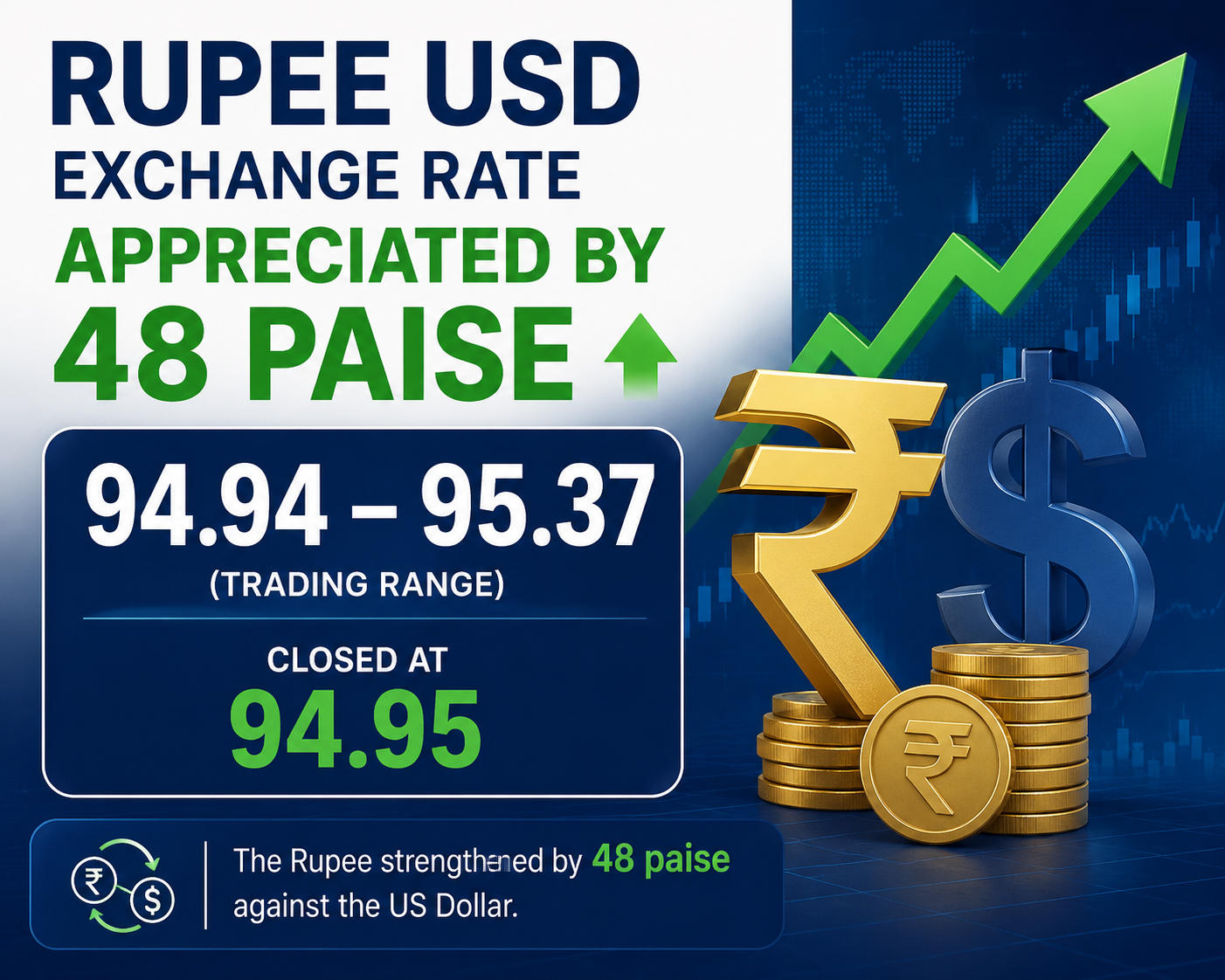
On Tuesday, July 7, 2026, the Indian domestic currency recorded a impressive performance. The Rupee USD exchange rate appreciated by 48 paise, allowing the local unit to close at 94.95 against the greenback.
Tuesday's Trading Range: 94.94 – 95.37 (Closed at 94.95)
This recovery was primarily fueled by positive developments in global energy supply chains and a temporary sigh of relief regarding shipping routes.
Key Drivers of Tuesday’s Rupee Appreciation:
Strait of Hormuz Traffic: Higher traffic flows through the vital Strait of Hormuz reduced immediate supply uncertainties, easing the anxieties of global commodity traders.
Saudi Arabia’s Price Cut: Sentiment was greatly buoyed after Saudi Arabia announced a massive price cut for its August crude oil supplies to Asia, slashing prices by a staggering $11 per barrel.
Easing Inflationary Pressures: Market analysts noted that the softness in Brent oil prices was a massive win for India. As the world’s third-largest oil importer, lower crude prices directly translate to a reduced current account deficit and lower domestic inflation.
At the interbank foreign exchange market, the rupee had opened at 95.33 and showed remarkable resilience throughout the day, trading in a tight intraday bracket before settling near its daily high.
The Wednesday Reversal: US-Iran Escalation Triggers a Steep Decline
The optimism of Tuesday was entirely wiped out the following day. On Wednesday, July 8, 2026, the Rupee USD exchange rate plummeted by 59 paise to settle at a provisional 95.55 against the American dollar.
The primary catalyst for this sudden downturn was a severe military escalation in the Persian Gulf. The United States military launched fresh air strikes on Iran early Wednesday morning. This action came as a direct response to claims from Washington that Tehran had struck three commercial ships navigating the Strait of Hormuz.
Wednesday's Trading Range: 94.98 – 95.61 (Closed at 95.55)
In addition to the physical strikes, the US government revoked the Islamic Republic’s ability to openly sell crude oil on the global market. The geopolitical crisis deepened further when Iran retaliated with targeted strikes against regional hubs in Bahrain and Kuwait.
Market Impact: Following the military developments, global crude oil prices rose exponentially. Brent crude, the global benchmark, surged by 6.16% to trade at $78.73 per barrel in futures markets, placing immediate pressure on India’s macroeconomic indicators.
The Twin Blow: Stronger Dollar Index and Crashing Domestic Equities
The geopolitical fallout created a domino effect across financial sectors, hurting the rupee from multiple angles. As global investors panicked, they rushed toward safe-haven assets, which naturally strengthened the US dollar.
The Dollar Index, which measures the greenback’s strength against a basket of six major global currencies, climbed up by 0.11% to reach 101.13.
Simultaneously, the Indian domestic equity markets suffered a brutal sell-off. Fearful investors liquidated assets, causing a massive crash on the Dalal Street indices:
| Index | Points Dropped | Percentage Decline | Closing Level |
| BSE Sensex | 1,677.12 | 2.15% | 76,503.60 |
| NSE Nifty | 516.65 | 2.12% | 23,882.05 |
The weakness in the equity markets meant foreign capital was halting its inflows. While foreign institutional investors (FIIs) had been net buyers on Tuesday—purchasing equities worth ₹393.19 crore—the momentum completely reversed on Wednesday as risk-off sentiments took center stage.
Expert Commentary on the Rupee’s Movement
Currency experts highlight that the sudden devaluation of the rupee is not a reflection of internal economic weakness, but rather a reaction to systemic global shocks.
Anil Kumar Bhansali, Head of Treasury and Executive Director at Finrex Treasury Advisors LLP, provided deep insights into the intraday market behavior on Wednesday:
“The rupee opened weaker against the dollar and continued to remain volatile intra-day. The dollar was consistently bought on dips as the equity markets were down and the dollar index was up. Overall, today’s rupee weakness was externally driven, mainly by higher crude oil prices, a stronger U.S. dollar, and sudden geopolitical uncertainty.”
Looking ahead, Bhansali provided a near-term forecast for corporate treasuries and importers, noting that the Rupee USD exchange rate is heavily expected to trade within a volatile range of 95.25 to 96.00 on Thursday, July 9, 2026.
What This Means for the Indian Economy Moving Forward
The volatility in the currency market directly impacts various sectors of the Indian economy. If the conflict in the Middle East prolongs and oil prices stay elevated, India could face several challenges:
Imported Inflation: Since India imports over 80% of its crude oil requirements, expensive oil means higher transport costs, which eventually trickles down to higher prices for everyday consumer goods.
Current Account Deficit (CAD): A weaker rupee combined with expensive oil widening the trade deficit puts immense pressure on India’s foreign exchange reserves.
Corporate Margins: Sectors heavily reliant on oil derivatives—such as paints, plastics, aviation, and logistics—will likely see their profit margins squeezed in the upcoming quarters.
Conclusion
The fluctuations in the Rupee USD exchange rate this week serve as a stark reminder of how deeply connected emerging market currencies are to global geopolitical stability. While domestic macroeconomic fundamentals in India remain structurally sound, sudden supply-side shocks in the energy corridor will always pose a direct threat. Investors, traders, and corporates will need to maintain a highly cautious approach and keep a close eye on the Persian Gulf as the situation unfolds into the weekend.