
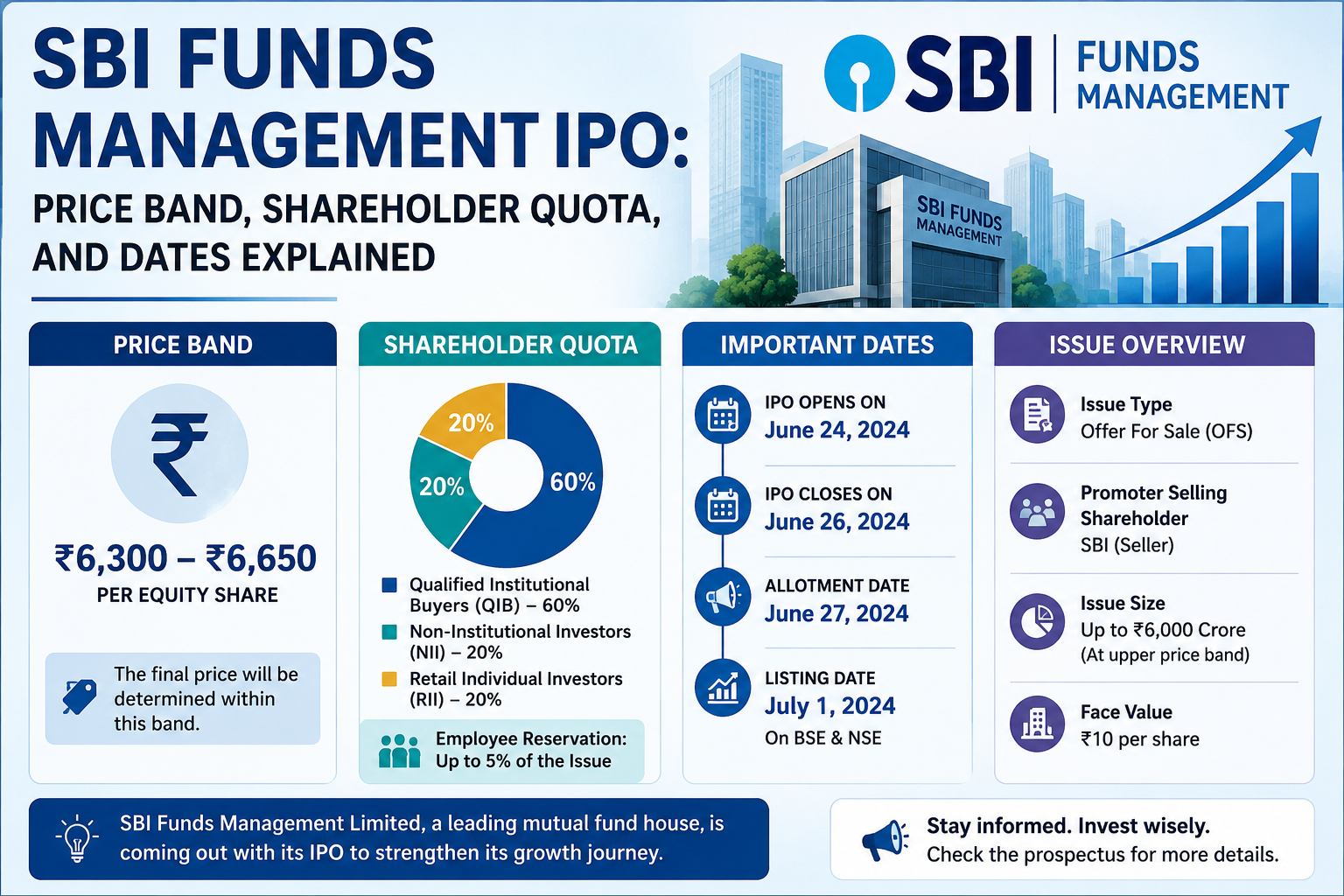
The Indian primary market is gearing up for its biggest blockbuster event of 2026. SBI Funds Management Ltd, India’s largest asset management company, has officially announced the details for its highly anticipated initial public offering (IPO). As a subsidiary of the state-owned banking giant State Bank of India (SBI), this public issue is drawing immense interest from retail investors, institutional buyers, and existing SBI shareholders alike.
With a massive issue size of ₹11,692.91 crore, the SBI Funds Management IPO is set to test the market’s appetite for premium asset management stocks. If you are looking to invest, here is a comprehensive, deep-dive analysis of the price band, minimum investment requirements, reserved quotas, and key dates you need to keep on your radar.
SBI Funds Management IPO: Key Details at a Glance
Before diving into the strategic analysis, let’s look at the core numbers driving this massive public issue:
| Parameter | Details |
| IPO Opening Date | July 14, 2026 |
| IPO Closing Date | July 16, 2026 |
| Anchor Investor Bidding | July 13, 2026 |
| Price Band | ₹545 to ₹574 per equity share |
| Market Lot Size | 26 Shares |
| Minimum Investment (Retail) | ₹14,924 |
| Total Issue Size | ₹11,692.91 Crore |
| Issue Type | 100% Offer for Sale (OFS) |
| Estimated Market Cap | Nearly ₹1.17 Lakh Crore (at upper band) |
Understanding the Pricing and Minimum Investment for Retail Buyers
The company has established a price band of ₹545 to ₹574 per share. For retail investors, the entry barrier is defined by the minimum lot size. The market lot is fixed at 26 shares, meaning you cannot bid for individual shares; you must bid in multiples of 26.
To calculate the minimum investment required for a single lot at the highest price point:
Retail investors can apply for a maximum of 13 lots (338 shares), keeping their total investment just under the ₹2 lakh threshold designated for the retail category.
The Structure of the Offer: Why It’s a Pure OFS
An essential factor for investors to note is that this IPO is entirely an Offer for Sale (OFS) involving over 20 crore shares.
Crucial Note: Because this is a 100% OFS, SBI Funds Management Ltd will not receive any proceeds from this public issue. Instead, the money raised will go directly to the selling promoters who are trimming their stakes.
According to the Red Herring Prospectus (RHP), the divestment breakdown includes:
State Bank of India (SBI): Offloading up to 128.33 million equity shares.
Amundi India Holding: Divesting up to 75.39 million shares.
Currently, SBI Funds Management is a joint venture where SBI holds a dominant 61.98% stake and Paris-based Amundi holds 36.40%. Following the IPO, SBI’s direct holding in its asset management arm will decrease from 98.19% to 88.19% on a consolidated basis, ensuring it maintains absolute majority control.
The Exclusive SBI Shareholder Quota: What You Need to Know
One of the most talked-about features of the SBI Funds Management IPO is the dedicated reservation for existing shareholders of State Bank of India. If you hold even a single share of SBI in your demat account on the eligibility record date (as specified in the RHP), you can leverage this category.
The Quota Size: Around 1.3 crore shares, valued at approximately ₹750 crore, have been explicitly set aside for eligible SBI shareholders.
Is There a Discount? No. Unlike some public sector IPOs that offer a price concession to loyal shareholders, there is no price discount for SBI shareholders in this issue. You will have to bid within the standard ₹545 to ₹574 price band.
The Advantage: The primary benefit of bidding under the shareholder quota is a significantly higher probability of allotment. Since the retail segment is frequently oversubscribed by dozens of times, the shareholder category experiences distinct demand dynamics, offering a smoother path to securing shares.
Can You Double Dip? Yes. Eligible individuals can typically apply under both the Retail Category (up to ₹2 lakh) and the Shareholder Category (up to ₹2 lakh), effectively doubling their allocation potential.
Employee Benefits
While shareholders do not get a price break, employees of the company do. Eligible employees have a dedicated reservation worth ₹170 crore and enjoy a hefty discount of ₹54 per share during the bidding process, making their effective upper-band purchase price ₹520 per share.
Investor Allocation Breakdown
The ₹11,693-crore issue has been structured to accommodate all tiers of market participants. The institutional and retail allocations are divided as follows:
Qualified Institutional Buyers (QIBs): 50% of the net offer is reserved for large institutional funds, ensuring strong foundational backing.
Retail Individual Investors (RIIs): 35% of the offer is secured for retail applicants, providing ample room for small-scale public participation.
High-Net-Worth Individuals (HNIs): The remaining 15% is split between small HNIs (5% for bids between ₹2 lakh and ₹10 lakh) and large HNIs (10% for bids exceeding ₹10 lakh).
Timeline and Key IPO Dates
Missing an IPO deadline can mean missing out on a major market opportunity. Ensure your capital is aligned with the following official schedule:
July 13, 2026 (Monday): Anchor Investor Bidding Opens. This day provides an early indication of how global and domestic mutual funds value the company.
July 14, 2026 (Tuesday): The IPO opens to the general public for subscription.
July 16, 2026 (Thursday): The subscription window closes at 5:00 PM.
July 17, 2026 (Friday): Finalization of the Basis of Allotment. Investors will find out if they received shares.
July 20, 2026 (Monday): Unblocking of funds in bank accounts for unsuccessful applicants, credit of equity shares to the demat accounts of successful bidders, and the official listing day on the NSE and BSE.
Market Impact: Why SBI Shares Are Gaining Ground
The announcement of the IPO pricing has already sent positive ripples through the stock market. Shares of State Bank of India (SBI) gained nearly 1% in early trading following the news, hitting an intraday high of ₹1,025 per share on the National Stock Exchange (NSE).
Stock market analysts view this value-unlocking exercise as highly beneficial for the parent bank. Because the IPO is entirely an Offer for Sale, the entire ₹11,692.91 crore proceeds (minus issue expenses) will flow straight into SBI’s balance sheet. This massive cash inflow will further fortify the bank’s capital adequacy ratios and fund its core corporate and retail lending expansions without diluting its own banking equity.
Corporate Profile: Inside India’s Largest Fund House
SBI Funds Management Ltd is not just another financial firm; it is the undisputed titan of the Indian mutual fund landscape.
A Historic Legacy
Established in 1987, SBI Mutual Fund was the very first non-UTI mutual fund set up in India. Over the last nearly four decades, it has played a foundational role in institutionalizing retail savings across urban and rural India.
Unparalleled Scale
As of December 2025, the company commanded a Quarterly Average Assets Under Management (QAAUM) of nearly ₹12.5 lakh crore. Its massive distribution network leverages SBI’s unmatched pan-India banking footprint, giving it a deep structural competitive advantage over private sector asset managers.
Peer Comparison
Upon its official listing, SBI Funds Management will join an elite, highly competitive group of listed asset management companies on the Indian bourses. It will be measured directly against established peers such as:
HDFC Asset Management Company Ltd
ICICI Prudential AMC
Nippon Life India Asset Management Ltd
UTI Asset Management Company Ltd
Aditya Birla Sun Life AMC
With a projected post-listing market capitalization of ₹1.17 lakh crore, SBI Funds Management will instantly claim the crown as the most valuable listed asset management company in India, trading at a premium valuation that reflects its systemic importance and market leadership.
The Lead Managers Powering the Issue
Given the sheer scale of this multibillion-dollar transaction, a heavy-hitting syndicate of global and domestic investment banks has been appointed to manage the book-building process. The consortium of merchant bankers includes:
Kotak Mahindra Capital Company
Axis Capital Ltd
BofA Securities India
HSBC Securities and Capital Markets (India)
ICICI Securities
Jefferies India
JM Financial
Motilal Oswal Investment Advisors
SBI Capital Markets
The presence of these leading global and domestic financial institutions underscores the institutional precision and global marketing push behind this public offering.
Final Verdict: Should You Invest?
The SBI Funds Management IPO represents a rare opportunity to own a direct piece of India’s savings boom. As financialization accelerates across the country and domestic capital shifts from traditional physical assets (like gold and real estate) into financial instruments, asset management companies are prime beneficiaries.
Strengths:
Unmatched Scale: Leading position with ₹12.5 lakh crore in QAAUM.
Parentage: Backed by the trust and physical reach of State Bank of India.
Strategic Partner: Global expertise via Amundi’s minority stake.
Risks to Consider:
OFS Structure: No fresh capital is entering the company for operational expansion.
Market Sensitivity: Asset management revenues are closely tied to stock market performance; a prolonged market correction can depress AUM growth.
For retail investors looking for long-term compounding stability, or SBI shareholders seeking to leverage their preferred quota status, this IPO stands out as a foundational portfolio candidate. Ensure your funds are ready for the July 14 opening date.
Disclaimer: The information provided above is for educational purposes only. We strongly advise investors to consult with SEBI-certified financial experts before making any investment decisions.